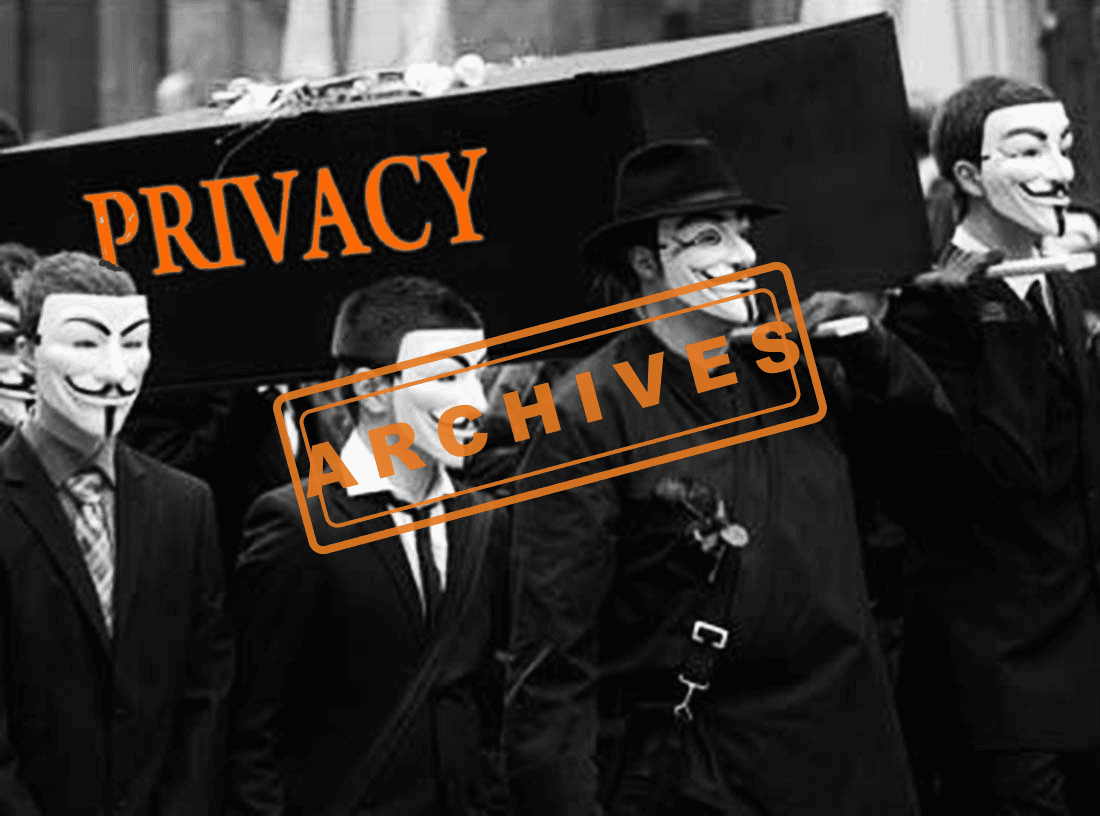
Does anyone ever mourn the death of privacy?
FROM THE ORIGINAL 2016/17 SITE: Privacy is stone dead. Let's make sure we all understand that. It died a slow and largely unlamented death over the period 1998 to 2015. Contrary to popular opinion, it's murderer wasn't government.
Privacy is stone dead. Let's make sure we all understand that. It died a slow and largely unlamented death over the period 1998 to 2015. To the extent anyone ever noticed its demise its murderer was sometimes said to be government. In truth, we all participated in privacy's death not only by our apathy but our behavioural, economic and legal acquiescence.
The OED defines Privacy as a state in which one is not observed or disturbed by other people
That state is extinct in most of the world.
Some of the key technological hardware enablers of the demise of privacy:
- the increase in the number of video surveillance cameras in public and private use which has now reached hundreds of millions worldwide
- which is utterly swamped by the number of handheld portable video recorders connected to the internet with integrated GPS locators [aka smartphones]
- and is underpinned by the drop in the cost of data storage from over $1 million per Gigabyte in 1995 to around US$10,000 per Gigabyte at the turn of the century and to under 2 cents per Gigabyte now
These technologies have driven the nails in privacy's coffin. To discuss just a few:
Google and Facebook
Google gave the world a search engine of amazing power and reach. It mapped and indexed all of modern society and photographed the streets where we live from the sky and the ground.
Facebook profiled us. Integrating this new medium into our lives it customises the information which reaches us, whether from our "friends" or other sources.
They have both only just started…
Electronic tracking
GPS tracking built in to your smartphone allows your whereabouts to be tracked. Do you know that many shopping centres track your movements even if you are not logged in to their wifi system? Your phone has an IMEI – a unique identifier. Readily available software tracks where you walk in the centre, where you linger. It may not track who you are, but link it to a shop's customer tracking system (aka "loyalty plan") or your credit card details and all is revealed.
Video cameras built into Smartphones allow covert surveillance and handily mark the time and location as they automatically upload their video feed to the cloud. I mention Pokemon GO in the timeline above, not because of its own capabilities, but because it normalised the practice of publicly videoing everything and anything with your phone. Launch a new app which uploads and stores the video along with the game play, plant the Pokemon in the places you want kept under surveillance. Bingo!
Facial Recognition
Governments originally led the way in comparing massive databases of photos which took enormous computer resources. The problem of doing this on a smartphone has now been cracked through the use of neural networks. I'll let NTechLab CEO and founder Artem Kukharenko who launched FindFace in 2016 explain.
We have found a special type of internal architecture for neural networks, that perfectly fits the face recognition tasks. To search among huge datasets — up to billions [of images] — we use our specially developed search engine, which is extremely quick and accurate. Each face in the search index is represented by only 80 numbers (a very small amount for such algorithms), and the overall search time is about half a second.
According to Kukharenko, FindFace has so far performed about one quadrillion photo comparisons using images from the Russian social network Vkontakte, which has around 200 million profiles. The dream of FindFace is quite literally to be able to do what its name suggests: to let users see someone on the street, snap a quick photo, and immediately be able to link that person to their social media profile.
Who you are, where you are, what you like, what you do in every aspect of your life are important drivers of today's marketing. You sit down at a cafe in the city and your phone, knowing that you love Chinese food, helpfully suggests the nearest Chinese restaurants. You've been researching shirts online and are walking to a department store to make a purchase. The message on your smartphone diverts your interest to a nearby shirt retailer with a sale on the styles you like.
Drones
Not the biggest issue perhaps but the proliferation of affordable drones which can be fitted with video recorders closed one of the last private refuges – the ability to retreat behind walls. Google Street View had already opened the front of our houses to public scrutiny. Drones opened the backyard.
The Distraction – "Government surveillance"
In 2013 the Guardian newspaper reported that the US National Security Agency (NSA) was collecting the telephone records of tens of millions of Americans. The paper published the secret court order directing telecommunications company Verizon to hand over all its telephone data to the NSA on an "ongoing daily basis".
That report was followed by revelations in both the Washington Post and Guardian that the NSA tapped directly into the servers of nine internet firms, including Facebook, Google, Microsoft and Yahoo, to track online communication in a surveillance programme known as Prism. Shortly afterwards, the Guardian revealed that ex-CIA systems analyst Edward Snowden was behind the leaks about the US and UK surveillance programmes.
Many of us became concerned about this government surveillance and there were a number of protests. But increasingly, surveillance isn't conducted solely or even the predominately by governments. Governments play only a minor part in what we are talking about here – the monitoring of virtually everyone's locations and activities 24/7. The technological capabilities have filtered down or in many cases were originally invented for mass commercial use. Surveillance is no longer a costly exercise by governments – it is a profit seeking enterprise by the marketplace.
The key reason for the death of privacy is that we have discovered the** utility of omniscience** and incorporated it into the global economy. With the costs of enabling technologies falling and the the application of captured and interpreted data to push marketing just beginning the net market value of this omniscience is rising fast.
More about this in future Battling Entropy articles. In the meantime, you can be sure that people are hanging on your every word.
Get more like this
New analysis delivered to your inbox. No spam, unsubscribe anytime.
Take care, Tony
Disclosure: Battling Entropy is my independent commentary. The views expressed are my own and do not represent those of any organisation unless explicitly stated. This is not financial or investment advice.
I also have commercial interests in the energy technology field. I am working on a venture, Petajoule Capital, which is developing People-Powered Energy: one particular approach for the coordination of consumer-owned batteries, EVs and flexible demand. This article discusses issues relevant to that work.
Discussion
Loading comments...