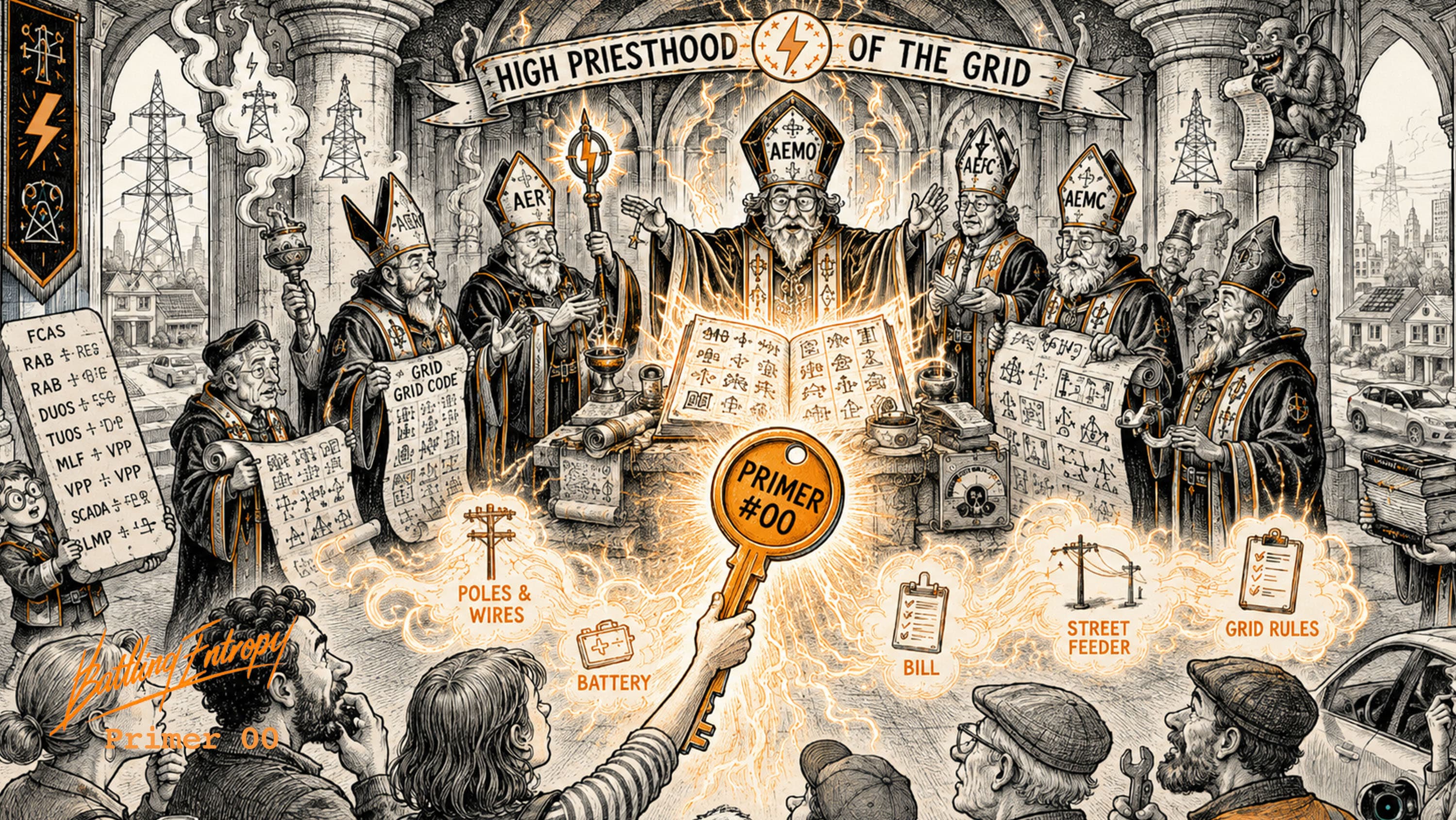
Battling Entropy Primer
Electrical Jargon Demystified
Primer #00: The strange terminology of electricity and grids explained in plain English
Electricity discussions are full of jargon. Some of it is necessary. Much of it is inherited from engineering, regulation and market design traditions that evolved separately over decades. The result is that ordinary discussions about electricity can quickly become unreadable. This primer is intended as a plain-English guide to some of the most common terms used in modern electricity discussions, particularly in Australia’s National Electricity Market (NEM). It is not exhaustive. It is a working glossary.
AEMC
Australian Energy Market Commission.
The AEMC is the rule-maker for Australia’s national electricity and gas markets. It makes and changes the National Electricity Rules and conducts reviews into market design.
A simple way to remember the distinction between the three main national energy market bodies is this:
AEMO operates the system and the market. AER regulates and enforces. AEMC creates and changes the rules.
AEMO
Australian Energy Market Operator.
AEMO operates the National Electricity Market, manages power system security, forecasts supply and demand, and publishes major planning documents such as the Integrated System Plan.
In real time, AEMO’s job is to keep electricity supply and demand balanced. In planning time, its job is to help work out what the future grid may need.
AER
Australian Energy Regulator.
The AER is the economic regulator for electricity and gas networks and retail energy markets in much of Australia. It regulates network revenues, monitors wholesale and retail markets, enforces parts of the energy rules, and publishes the annual State of the energy market report.
For electricity networks, the AER is especially important because it decides how much regulated network businesses are allowed to recover from customers.
Aggregator
A company or platform that combines many small energy resources and operates them as a fleet.
One home battery is small. Thousands of home batteries, EV chargers or flexible loads acting together can become a meaningful grid resource. Aggregators try to assemble those small resources into something large enough to matter.
Ancillary Services
Specialised services that help keep the electricity system stable and secure.
Electricity systems need more than energy. They also need frequency control, voltage support, reserves, system strength and other technical services that keep the grid operating safely.
See also: FCAS, System Security, System Strength.
Augmentation
An upgrade to the electricity network.
Augmentation may involve bigger transformers, thicker wires, new substations, underground cable replacement or new transmission lines. The important point is that augmentation is usually capital-intensive. Once built, the new asset often becomes part of the regulated asset base and customers pay for it over time.
Avoided Augmentation
Network investment that does not need to be built because another solution reduces, delays or removes the need.
For example, if a local network upgrade would otherwise be needed to handle a short evening peak, a non-network solution might defer that upgrade. The value is not just the energy saved. It is the network capital that may no longer need to be spent immediately.
Bankability
The point at which a revenue stream, contract or project is reliable enough to support investment or finance.
A technology may be technically possible long before it is bankable. In energy, many ideas fail not because they cannot work physically, but because the revenue stream is too uncertain for investors or lenders.
Baseload
An old electricity industry term for the minimum level of demand that exists most of the time.
Historically, baseload demand was served by large coal generators running continuously. The term is still used, but it has become less helpful as modern electricity systems become more flexible, weather-driven and storage-rich.
Battery Energy Storage System (BESS)
A battery system that stores electricity for later use.
A BESS can be a household battery, a commercial battery or a large grid-scale battery. The term refers to the full system, not just the cells: batteries, inverters, control systems, cooling and safety equipment may all be part of the BESS.
Behind the Meter
Energy assets located on the customer side of the electricity meter.
Examples include rooftop solar, household batteries, EV chargers and smart appliances. Behind-the-meter assets are physically small compared with power stations, but in aggregate they are becoming a major part of the electricity system.
Capex
Capital expenditure.
Money spent on long-lived assets such as poles, wires, transformers, substations, batteries, transmission lines or software platforms.
In regulated electricity networks, capex matters because approved capital expenditure can enter the regulated asset base.
Capacity Factor
The amount of electricity a generator actually produces over time compared with its theoretical maximum output.
A generator that could produce 100 MW every hour of the year but actually averages 30 MW has a capacity factor of 30%. Wind and solar farms have capacity factors below 100% because the wind does not always blow and the sun does not always shine.
Capacity Market
A market or mechanism that pays for available capacity, not just energy actually generated.
Capacity markets are designed to ensure enough resources are available when needed. Supporters argue they improve reliability. Critics argue they can overpay for capacity and weaken energy-market price signals.
Australia’s NEM is primarily an energy-only market, although it has reliability backstops and capacity-like mechanisms in some contexts.
CER
Consumer Energy Resources.
Small-scale energy resources owned or controlled by customers.
CER includes rooftop solar, home batteries, EVs, smart appliances and flexible loads. The term overlaps with DER, but puts more emphasis on the customer as the owner or controller of the resource.
Congestion
A situation where electricity network infrastructure cannot carry all the power that market participants would like to move through it.
Congestion can occur on transmission lines, substations, distribution feeders or transformers. When congestion occurs, electricity may still flow, but not in the quantities or directions that would be economically preferred.
Congestion Management Model
A proposed way of managing transmission congestion in the National Electricity Market without moving fully to nodal pricing.
The phrase has been used in Australian transmission access reform debates. The basic idea is to improve incentives and settlement around congestion while avoiding some of the complexity of full locational marginal pricing.
Controllable Load
A load that can be increased, reduced, shifted or interrupted in response to customer, network or market needs.
Examples include EV charging, hot water systems, pool pumps, air-conditioning and some industrial processes.
Copper Build-Out
Battling Entropy shorthand for building more physical network infrastructure: poles, wires, transformers, substations and cables.
The phrase is useful because many network problems can be solved either by "building more copper" (although these days the wires are more likely to be aluminium—transformers still have lots of copper) or by using existing assets more intelligently.
Curtailment
Reducing electricity generation below what it could otherwise produce.
Curtailment often affects solar and wind when there is too much generation, not enough demand, or insufficient network capacity. A solar farm may be physically capable of producing more electricity than the system can absorb at that moment.
Demand Response
A change in electricity consumption in response to price, system need or a request from a market or network operator.
Demand response can mean reducing load, shifting load to another time, or using stored energy instead of grid electricity. It is one of the main ways demand can become an active part of the electricity system.
DER
Distributed Energy Resources.
Small-scale electricity resources located close to customers rather than at large centralised power stations.
DER includes rooftop solar, batteries, EV chargers, smart hot water systems and flexible appliances.
See also: CER, Behind the Meter, Rooftop Solar.
Dispatch
The process of instructing generators or other resources to produce, consume or reduce electricity.
In Australia’s NEM, dispatch occurs every five minutes. AEMO dispatches resources to keep supply and demand balanced while respecting technical constraints.
Distribution Network
The lower-voltage part of the electricity system that delivers electricity from substations into suburbs, towns, rural areas and local streets.
Distribution networks are the “street-level” grid. They include poles, wires, transformers, underground cables and local substations.
Distribution Transformer
A transformer that steps electricity down to the low voltage used by homes and small businesses.
In older suburbs, distribution transformers are often mounted on poles. In newer underground areas, they may sit in green pad-mounted boxes.
DNSP
Distribution Network Service Provider.
A regulated monopoly business responsible for operating local electricity distribution networks.
DNSPs own and maintain poles, wires, transformers, substations and local distribution infrastructure. Examples include Ausgrid, Endeavour Energy, SA Power Networks, Powercor and Energex.
Duck Curve
A famous graph showing how rooftop solar changes the demand seen by the grid.
During the middle of the day, solar generation pushes grid demand down. In the evening, solar output falls and household demand rises, creating a steep ramp. The curve resembles the shape of a duck.
DUOS
Distribution Use of System.
The distribution network charge embedded in electricity bills.
DUOS pays for the local poles, wires, transformers and distribution network services that deliver electricity to homes and businesses. Most customers do not see DUOS as a separate line item, but it is part of the network component of the bill.
Dynamic Operating Envelope
A limit on how much a customer or device can import or export at a particular time, based on local network conditions.
For example, a rooftop solar system might be allowed to export more when the local feeder has spare capacity and less when voltage or congestion becomes a problem.
Dynamic Regional Pricing
A proposed form of more locationally granular pricing in the NEM.
The phrase has been used in Australian market-design debates, particularly around transmission access reform. It is related to the idea that prices should better reflect local network conditions when constraints bind.
Electric Slide
A term coined by Packy McCormick & Sam D'Amico — shorthand for the rapid improvement and falling cost of electrical technologies: solar panels, batteries, inverters, power electronics and software.
The Electric Slide is one reason electrification keeps becoming more practical. The electric version of a technology often starts expensive, then improves quickly.
Electrification
The replacement of fossil-fuel technologies with electrically powered alternatives.
Examples include EVs replacing petrol cars, heat pumps replacing gas heating, and induction cooking replacing gas stoves. Electrification matters because electricity can increasingly be produced from low-emissions sources.
Energy Ministers
The state, territory and Commonwealth ministers responsible for energy policy.
In Australia, electricity policy is not controlled by one national minister. It is shaped by multiple governments, each with different political pressures, state-owned assets, planning powers and consumer concerns.
Entropy
In physics, entropy is often described as disorder or the tendency of systems to run down.
Battling Entropy uses the term more broadly: civilisation is the deliberate work of creating and maintaining order in a universe that does not provide it for free.
The electricity grid is one of the clearest examples of humans battling entropy.
ESB
Energy Security Board.
A former coordinating body created after the Finkel Review to advise governments on reliability, security and market design.
The ESB has now been wound down, but many recent Australian energy reforms and debates still refer to ESB work.
Essential System Services
Services needed to keep the power system secure and stable.
These may include frequency control, inertia, system strength, voltage support, operating reserves and other services that were historically supplied as by-products of large synchronous generators.
EV
Electric Vehicle.
A vehicle powered primarily by electricity stored in batteries.
EVs matter to the grid because they are both new demand and potential flexible demand. A car may sit parked for most of the day, but when it charges can matter a lot.
Export Limit
A limit on how much electricity a rooftop solar system, battery or other device can export to the grid.
Export limits can be fixed or dynamic. They are often used to manage local voltage or network capacity problems.
Export Tariff
A network tariff that charges or credits customers based on electricity exported to the grid.
Export tariffs are controversial because rooftop solar owners often see exported electricity as a benefit, while networks may see high exports as a source of local cost or congestion at certain times.
Fast Frequency Response
A service that helps stabilise grid frequency very quickly after a disturbance.
Batteries and power electronics can often respond faster than traditional generators, which makes fast frequency response increasingly important in inverter-rich grids.
Fault Current
The surge of current that flows during an electrical fault, such as a short circuit.
Fault current helps protection systems detect and isolate faults. Traditional synchronous generators naturally provided high fault current. Inverter-based systems behave differently, which changes how the system must be protected.
FCAS
Frequency Control Ancillary Services.
Services that help maintain the grid’s operating frequency close to its target level.
In Australia’s NEM, frequency is maintained close to 50 hertz. FCAS markets pay resources that can rapidly increase or reduce power in response to frequency deviations.
Feeder
A local electricity circuit supplying homes or businesses from a distribution transformer.
In residential areas, a low voltage feeder may supply anything from a few homes to more than 100 customer connections. Feeder problems are often highly local: one street can be constrained while the next street is fine.
See also: Low Voltage Network.
Financial Transmission Right
A financial instrument used in some electricity markets to hedge congestion risk between locations.
Financial transmission rights are common in markets with locational marginal pricing. They help participants manage the risk that prices differ between where electricity is generated and where it is sold.
Flexible Demand
Electricity demand that can shift in time without major inconvenience.
Examples include EV charging, hot water heating, pool pumps, pre-cooling buildings and some industrial processes. Flexible demand is important because it can help match electricity use to renewable generation and network capacity.
Frequency
The rate at which alternating current oscillates.
In Australia, the electricity system operates at a nominal frequency of 50 hertz. If supply and demand become unbalanced, frequency moves away from 50 hertz. Keeping frequency stable is one of the core tasks of power system operation.
Frequency Operating Standard
The technical standard that defines acceptable frequency performance for the power system.
It sets ranges and recovery requirements for frequency after normal operation, disturbances and major events.
Front of Meter
Energy assets located on the grid side of the customer meter.
Examples include wind farms, solar farms, grid-scale batteries, substations and network assets. The distinction matters because front-of-meter and behind-the-meter resources are often regulated, metered and paid differently.
Gigajoule
One billion joules.
A gigajoule is 1,000 megajoules. Large gas use is often measured in gigajoules.
Gigawatt-hour
One thousand megawatt-hours.
A gigawatt-hour is a large unit of electrical energy. It is used for annual generation, large storage quantities and system-wide demand.
Grid
General term for the interconnected electricity system.
In practice, “the grid” is not one machine. It includes generation, transmission, distribution, markets, control systems, communications, regulation and customer devices.
That is why “the grid” can be a misleading phrase. Many grid problems are not system-wide. They are local.
Grid-Following Inverter
An inverter that follows an existing voltage and frequency reference provided by the grid.
Most older solar and battery inverters are grid-following. They rely on the wider grid to provide the electrical rhythm they follow.
Grid-Forming Inverter
An inverter that can help establish voltage and frequency conditions for other devices to follow.
Grid-forming inverters are increasingly important as traditional synchronous generators retire and inverter-based resources become more common.
Hedge
A financial contract used to reduce exposure to electricity price volatility.
Retailers and generators use hedges extensively because wholesale electricity prices can move dramatically. A retailer that sells customers fixed or predictable tariffs needs a way to manage volatile wholesale costs.
Headroom
Spare capacity in a network asset.
A feeder, transformer or substation with plenty of headroom can accommodate more load or export. A network asset with little headroom is closer to its operating limits.
Hosting Capacity
The amount of additional solar, battery, EV charging or other customer energy resources that a local network can accommodate without breaching technical limits.
Hosting capacity varies by feeder, transformer, voltage level and time of day.
Inertia
The stabilising effect provided by large rotating machines.
Traditional coal, gas and hydro generators store energy in spinning mass. That spinning mass slows changes in frequency after disturbances. As synchronous generators retire, the system needs other ways to provide stability.
Integrated System Plan
A major planning document published by AEMO.
The Integrated System Plan, or ISP, sets out possible development paths for generation, storage and transmission in the NEM. It is one of the central planning documents in Australia’s energy transition.
Interconnector
A high-voltage transmission link connecting two regions or states.
Interconnectors allow electricity to flow between regions when prices, supply or demand conditions differ.
Inverter
A device that converts electricity between direct current and alternating current.
Solar panels and batteries require inverters to interact with the grid. As more electricity comes from solar, batteries and wind, inverters become a central part of power system operation.
Island of Calm
Battling Entropy shorthand for the energy, infrastructure and institutional order required to sustain modern life.
The grid is one of the most important parts of that island. It quietly creates order, reliability and comfort — until it fails.
Joule
A unit of energy.
A joule is very small. It is the amount of energy transferred when one watt of power is applied for one second.
Electricity bills usually use kilowatt-hours rather than joules, but joules sit underneath all energy measurement.
Kilowatt
A unit of power.
It measures the rate at which electricity is being produced or consumed at a particular moment.
A kettle might use around 2 kilowatts.
Kilowatt-hour
A common unit of electricity consumption.
If a 2 kilowatt appliance runs for one hour, it uses 2 kilowatt-hours. Household electricity bills are usually measured in kilowatt-hours. If that a kettle of water drawing 2 kilowatts takes 6 minutes to boil it has used 0.2 kWh.
Levelised Cost of Energy
A commonly used estimate of the average lifetime cost of generating electricity from a technology.
Levelised cost of energy, or LCOE, is useful for comparing generation technologies, but it can be misleading if treated as the whole system cost. It often does not fully capture storage, firming, transmission or local network costs.
Locational Marginal Pricing
A market design where electricity prices vary by location to reflect local network conditions, losses and congestion.
Locational marginal pricing is widely used in parts of the United States. Supporters argue it better reflects physical reality. Critics argue it adds complexity and financial risk.
Low Voltage Feeder
A street-level electricity circuit supplied by a distribution transformer.
In Australia, low voltage supply is typically described as 230/400 volts. A low voltage feeder may supply a handful of rural homes, a short street, several suburban streets or more than 100 customer connections.
Low Voltage Network
The street-level part of the electricity grid that supplies homes and small businesses.
It is the final layer of the network before electricity reaches the customer meter. It includes low voltage feeders, service lines and the local equipment that connects customers to the distribution transformer.
Managed Charging
Controlling when and how fast an EV charges.
Managed charging can reduce peaks, absorb cheap solar, avoid local network stress and lower customer costs. Without management, EV charging can create sharp new evening peaks.
Marginal Cost
The cost of producing one additional unit of electricity.
Electricity markets generally dispatch generators based on marginal cost. Low marginal cost resources, such as wind and solar, tend to bid differently from fuel-burning generators because they do not pay for fuel each time they generate.
Marginal Loss Factor
A factor used in the NEM to account for electrical losses between where electricity is generated and where it is consumed.
Marginal loss factors affect generator revenue because they adjust how much generation is credited for settlement purposes. They have been controversial because changes in loss factors can materially affect project economics.
Megajoule
One million joules.
Gas bills in Australia are often measured in megajoules. This can make electricity and gas comparisons confusing because electricity bills usually use kilowatt-hours.
A useful conversion is:
1 kilowatt-hour = 3.6 megajoules.
Megawatt
One million watts.
Megawatts are used to describe larger-scale electricity generation or demand. A power station, wind farm or grid battery may be described in megawatts.
Megawatt-hour
One megawatt of electricity sustained for one hour.
Megawatt-hours are used for larger quantities of electricity generation, consumption or storage.
NEL
National Electricity Law.
The legislation that underpins the National Electricity Market.
The NEL creates the legal framework for the electricity rules, market bodies and regulatory obligations.
NEM
National Electricity Market.
The wholesale electricity market covering Queensland, New South Wales, the Australian Capital Territory, Victoria, South Australia and Tasmania.
Western Australia and the Northern Territory operate separate electricity systems.
NEO
National Electricity Objective.
The legal objective that guides electricity rule-making and regulation in the NEM.
In plain English, it says the market should promote efficient investment, operation and use of electricity services in the long-term interests of consumers.
NER
National Electricity Rules.
The detailed rulebook for the National Electricity Market.
The NER governs dispatch, settlement, network regulation, connection processes, reliability obligations and many other parts of the electricity system.
Network Constraint
A physical or operating limit on the electricity network.
Examples include feeder congestion, transformer loading, voltage limits, export limits and thermal limits.
Network Tariff
A charge for using the electricity network.
Network tariffs are paid by retailers and passed through to customers, usually inside the retail bill. They can be flat, time-based, demand-based or export-related depending on jurisdiction and tariff design.
Non-Network Solution
A way of solving a network problem without building more traditional network infrastructure.
Examples include demand response, batteries, flexible tariffs, local generation control and other resources that reduce the need for poles, wires or transformers.
Non-Wires Alternative
A term often used in North America for a non-network solution.
It means using demand response, storage, distributed energy resources or other measures instead of building more poles, wires or transformers.
Operating Reserve
Spare capacity that can be called on to meet unexpected changes in supply or demand.
Operating reserve is about short-term reliability. It helps the system cope when demand is higher than expected, a generator fails, or renewable output changes suddenly.
Opex
Operating expenditure.
Money spent running and maintaining assets rather than building new ones.
For electricity networks, opex includes maintenance, vegetation management, labour, systems and operations.
Peak Demand
The highest level of electricity demand reached over a period.
Network infrastructure is often built to handle short peaks rather than average demand. This is one reason electricity networks can be expensive: they must be sized for stressful moments that may occur only occasionally.
Petajoule
One quadrillion joules.
A petajoule is 1,000 terajoules. At electricity scale:
1 petajoule ≈ 277.8 gigawatt-hours.
Petajoules are useful for discussing national energy systems, fuel use and very large energy quantities.
Phase
One of the electrical conductors in an alternating current system.
Most Australian homes are connected to a single phase, but some homes and businesses have three-phase supply. Phase balance matters because uneven loading across phases can create voltage and capacity problems.
Phase Imbalance
A situation where the phases of an electricity network are not carrying similar loads.
Phase imbalance can cause voltage problems and reduce usable network capacity.
Pole-Top Transformer
A small distribution transformer mounted on a utility pole.
Pole-top transformers are common in older Australian overhead distribution networks.
Price Cap
The maximum wholesale spot price allowed in the NEM.
The price cap exists because electricity prices can otherwise rise extremely high during scarcity events.
Price Floor
The minimum wholesale spot price allowed in the NEM.
Negative prices can occur when there is more generation than demand and some generators are willing to pay to keep running.
Procurement
The process of buying a service.
In electricity, procurement can mean buying energy, reserves, network support, demand response, flexibility, system strength or other services.
RAB
Regulated Asset Base.
The value of regulated electricity network infrastructure on which network businesses are allowed to earn a return.
Once network infrastructure enters the RAB, customers effectively pay for it over decades through network charges.
Regional Reference Price
The wholesale electricity price for a NEM region.
The regional reference price is determined every five minutes and applies across an entire region, such as New South Wales or Victoria. This is one reason local network problems can be invisible to wholesale prices.
Regulated Revenue
The amount a regulated network business is allowed to recover from customers.
The AER determines regulated revenue for transmission and distribution networks through periodic revenue determinations.
Reliability Panel
A specialist panel within the AEMC framework that advises on reliability, security and related standards.
The Reliability Panel plays a role in setting and reviewing technical standards for the NEM.
Renewable Energy Zone
A geographic area identified as suitable for large-scale renewable energy development and associated transmission investment.
Renewable Energy Zones, or REZs, are intended to coordinate wind, solar, storage and transmission development in areas with strong renewable resources.
RERT
Reliability and Emergency Reserve Trader.
An emergency mechanism that allows AEMO to contract reserves outside the normal market when reliability is at risk.
RERT is meant to be a backstop, not the normal way the market supplies energy.
Retailer
A company that sells electricity to customers.
Retailers manage customer billing, tariffs, hedging and customer service. Examples include Origin, AGL and EnergyAustralia.
Revenue Cap
A form of regulation that limits the total revenue a network business can recover.
Revenue caps are used because electricity networks are monopoly businesses. The regulator limits the revenue they can collect rather than allowing them to charge whatever the market will bear.
Revenue Determination
A regulatory decision setting how much money a network business can recover from customers over a regulatory period.
Revenue determinations are central to network charges because they decide how much regulated network revenue must be recovered through tariffs.
Ring-Fencing
Rules that separate a regulated monopoly network business from competitive businesses.
Ring-fencing is intended to stop monopoly network businesses from unfairly favouring related businesses in competitive markets.
RIT-D
Regulatory Investment Test for Distribution.
A test used to assess whether a major distribution network investment is economically justified.
It is meant to compare network and non-network options before customers pay for new infrastructure.
RIT-T
Regulatory Investment Test for Transmission.
A similar test for major transmission network investments.
It is intended to ensure large transmission projects deliver net benefits before customers pay for them.
Rooftop Solar
Small-scale solar PV systems installed on homes or businesses.
Australia has one of the world’s highest rates of rooftop solar adoption. Rooftop solar has transformed households from passive consumers into small generators.
Scarcity
A condition where available supply or network capacity is tight relative to demand.
Scarcity can produce high wholesale prices, reliability concerns or emergency interventions.
SCADA
Supervisory Control and Data Acquisition.
A system used by network and system operators to monitor and control parts of the electricity system.
SCADA systems collect data from substations, generators, network equipment and other assets.
Service Line
The wire or cable connecting a customer’s premises to the low voltage network.
In overhead areas, this may be the wire running from the street pole to the house. In underground areas, it may run from a service pillar or pit.
Single-Phase Supply
A common household electricity connection using one active phase and a neutral conductor.
Most ordinary homes historically used single-phase supply.
Smart Appliance
An appliance that can respond to signals, prices or settings.
Examples include smart hot water systems, pool pumps, air-conditioners and EV chargers.
Smart Meter
A digital electricity meter capable of recording and communicating electricity usage data remotely.
Smart meters enable more detailed tariffs, time-based pricing and better visibility of consumption and exports.
Software Orchestration
The coordination of many devices through software rather than central mechanical control.
Software orchestration is increasingly important as the grid moves from a few large generators to millions of smaller devices.
Spot Price
The wholesale electricity price at a particular moment.
In the NEM, spot prices are determined every five minutes.
SRES
Small-scale Renewable Energy Scheme.
The national scheme that supports small-scale renewable energy systems through certificates.
The scheme has supported rooftop solar and, through policy changes, can also support eligible battery installations.
State of Charge
The amount of energy currently stored in a battery, usually expressed as a percentage.
A battery at 80% state of charge is mostly full. A battery at 10% is close to empty.
STC
Small-scale Technology Certificate.
A certificate created under Australia’s small-scale renewable energy scheme.
STCs help subsidise eligible small-scale energy technologies by creating tradable certificates linked to expected clean energy benefits.
Strike Price
The agreed price in a financial contract.
In electricity hedging, a contract may pay out when the spot price rises above a specified strike price.
Substation
A facility that transforms voltage levels and routes electricity flows within the grid.
Substations exist at many scales, from large transmission substations to local zone substations supplying suburbs.
Synchronous Condenser
A large spinning machine that does not generate electricity but helps provide system strength, inertia and voltage support.
It behaves electrically like a synchronous generator without producing energy.
System Integrity Protection Scheme
A fast-acting protection scheme designed to prevent major power system disturbances.
These schemes can trip generation, load or network elements to stop a disturbance from cascading into a wider failure.
System Security
The ability of the electricity system to remain stable and within technical limits after disturbances.
System security is different from having enough energy over the year. It is about keeping the system physically stable second by second.
System Strength
A technical measure of how well the electricity system can maintain stable voltage waveforms, especially after disturbances.
System strength has become more important as inverter-based resources replace synchronous machines.
Telemetry
Measurement and communication of device or network data.
Telemetry can include battery state of charge, inverter output, EV charging status, feeder loading or substation measurements.
Terajoule
One trillion joules.
A terajoule is 1,000 gigajoules. It is often used for large fuel, gas or industrial energy quantities.
Thermal Constraint
A limit caused by the heating of electrical equipment.
Conductors, transformers and cables can only safely carry a certain amount of current before overheating.
Three-Phase Supply
An electricity connection using three active phases.
Three-phase supply can support larger loads and is common for larger homes, businesses, workshops, EV chargers and some appliances.
Transformer
An electrical device that changes voltage levels.
Transformers allow electricity to move efficiently across long distances at high voltage before being stepped down for local distribution and household use.
Transformer Loading
The level of demand or power flow through a transformer relative to its operating limits.
High transformer loading may indicate overload risk or the need for network support.
Transmission Network
The high-voltage part of the electricity system used to transport bulk electricity across long distances.
Transmission lines connect large generators, major substations, interconnectors and load centres.
Transmission Queue
A proposed access model in which generators receive priority or queue positions for access to transmission capacity.
The concept has appeared in Australian transmission access reform debates. It is controversial because queue-based access can favour incumbents or early movers.
TUOS
Transmission Use of System.
The transmission network charge embedded in electricity bills.
TUOS pays for high-voltage transmission infrastructure that moves bulk electricity across long distances.
V2G
Vehicle-to-Grid.
A system allowing electric vehicles to discharge electricity back into the grid, a home or a local energy system.
V2G turns an EV from a load into a potential storage resource.
Virtual Power Plant
A coordinated fleet of distributed energy resources operated together as though they were a single power station.
VPPs commonly aggregate home batteries, solar systems, EV chargers or flexible loads.
Voltage
The electrical “pressure” that pushes electricity through the system.
Different parts of the grid operate at different voltage levels. Homes in Australia are typically supplied at around 230 volts.
Voltage Drop
A reduction in voltage, often caused by high demand, long feeder distances or heavily loaded conductors.
Too much voltage drop can affect power quality and equipment performance.
Voltage Rise
An increase in local voltage, often caused by high rooftop solar exports on a low voltage feeder.
Too much voltage rise can force solar inverters to reduce output.
Volatility
Rapid or large movement in electricity prices.
The NEM can be highly volatile because supply and demand must balance in real time and electricity is difficult to store at large scale.
WACC
Weighted Average Cost of Capital.
A finance term used to estimate the cost of funding a business through debt and equity.
For regulated networks, the allowed rate of return is closely related to WACC. A higher allowed return generally means higher network charges.
Watt
A unit of power.
A watt measures how fast energy is being used or produced. One watt equals one joule per second.
Watt-Hour
A unit of energy.
A watt-hour is one watt sustained for one hour. Electricity bills use kilowatt-hours because household electricity consumption is easier to understand over time than second-by-second power.
Wholesale Market
The market where electricity generators and retailers buy and sell electricity in bulk before it reaches end customers.
In Australia, the wholesale market is operated by AEMO through the NEM.
Zone Substation
A distribution substation that steps electricity down from transmission or sub-transmission voltage to distribution voltage for local supply.
Zone substations feed suburban and regional distribution networks.
Why this glossary exists
Modern electricity systems are becoming more distributed, more digital and more dynamic. That also makes them more linguistically complicated.
Part of the goal of Battling Entropy is not simply to discuss energy systems, but to make them understandable enough that ordinary people can participate in the conversation.
Because electricity is no longer something happening somewhere else.
Increasingly, it is happening on the roof, in the garage and at the end of the street.
Take care, Tony
Further reading
Australian Energy Market Commission. (2018). Coordination of generation and transmission investment: Final report. https://www.aemc.gov.au/sites/default/files/2018-12/Final%20report_0.pdf
Australian Energy Market Commission. (2019). Coordination of generation and transmission investment: Access reform: Directions paper. https://www.aemc.gov.au/sites/default/files/2019-06/COGATI%20-%20directions%20paper%20-%20for%20publication.pdf
Australian Energy Market Commission. (n.d.). National Electricity Rules. Retrieved May 28, 2026, from https://www.aemc.gov.au/regulation/energy-rules/national-electricity-rules
Australian Energy Market Commission. (n.d.). National energy objectives. Retrieved May 28, 2026, from https://www.aemc.gov.au/regulation/national-energy-objectives
Australian Energy Market Operator. (2024). 2024 Integrated System Plan. https://aemo.com.au/energy-systems/major-publications/integrated-system-plan-isp/2024-integrated-system-plan-isp
Australian Energy Market Operator. (2024). Engineering roadmap to 100% renewables. https://aemo.com.au/initiatives/major-programs/engineering-roadmap
Australian Energy Market Operator. (n.d.). National Electricity Market. Retrieved May 28, 2026, from https://aemo.com.au/energy-systems/electricity/national-electricity-market-nem
Australian Energy Market Operator. (n.d.). Virtual Power Plant demonstrations. Retrieved May 28, 2026, from https://aemo.com.au/initiatives/major-programs/nem-distributed-energy-resources-der-program/virtual-power-plant-vpp-demonstrations
Australian Energy Regulator. (2025). State of the energy market 2025. Commonwealth of Australia. https://www.aer.gov.au/publications/state-of-the-energy-market-reports/state-of-the-energy-market-2025
Australian Energy Regulator. (2025). State of the energy market 2025: Chapter 2: National Electricity Market. Commonwealth of Australia. https://www.aer.gov.au/system/files/2025-08/State%20of%20the%20energy%20market%202025%20-%20Chapter%202%20-%20National%20Electricity%20Market.pdf
Australian Energy Regulator. (2025). State of the energy market 2025: Chapter 3: Electricity networks. Commonwealth of Australia. https://www.aer.gov.au/system/files/2025-08/State%20of%20the%20energy%20market%202025%20-%20Chapter%203%20-%20Electricity%20networks.pdf
Australian Energy Regulator. (2025). State of the energy market 2025: Chapter 6: Retail energy markets and energy consumers. Commonwealth of Australia. https://www.aer.gov.au/system/files/2025-08/State%20of%20the%20energy%20market%202025%20-%20Chapter%206%20-%20Retail%20energy%20markets%20and%20energy%20consumers.pdf
Australian Energy Regulator. (n.d.). Network determinations. Retrieved May 28, 2026, from https://www.aer.gov.au/industry/registers/determinations
Australian Government. (1996). National Electricity (South Australia) Act 1996. https://www.legislation.sa.gov.au/lz?path=%2FC%2FA%2FNATIONAL%20ELECTRICITY%20(SOUTH%20AUSTRALIA)%20ACT%201996
Clean Energy Council. (2024). Clean energy Australia report 2024. https://assets.cleanenergycouncil.org.au/documents/resources/reports/clean-energy-australia/Clean-Energy-Australia-2024.pdf
Clean Energy Regulator. (n.d.). Small-scale Renewable Energy Scheme. Retrieved May 28, 2026, from https://www.cleanenergyregulator.gov.au/RET/Scheme-participants-and-industry/Agents-and-installers/Small-scale-Renewable-Energy-Scheme
Department of Climate Change, Energy, the Environment and Water. (2025). Cheaper Home Batteries Program. Australian Government. https://www.energy.gov.au/energy-and-climate-change-ministerial-council/working-groups/consumer-energy-resources/cheaper-home-batteries-program
Energy Networks Australia. (2017). Electricity network transformation roadmap: Final report. https://www.energynetworks.com.au/resources/reports/electricity-network-transformation-roadmap-final-report/
Energy Security Board. (2021). Post-2025 market design: Final advice to Energy Ministers. https://www.energy.gov.au/sites/default/files/2021-07/Post-2025%20Market%20Design%20Final%20advice%20to%20Energy%20Ministers%20Part%20A.pdf
Finkel, A., Moses, K., Munro, C., Effeney, T., & O’Kane, M. (2017). Independent review into the future security of the National Electricity Market: Blueprint for the future. Commonwealth of Australia. https://www.energy.gov.au/sites/default/files/independent-review-future-nem-blueprint-for-the-future-2017.pdf
International Energy Agency. (2023). Electricity grids and secure energy transitions. https://www.iea.org/reports/electricity-grids-and-secure-energy-transitions
International Energy Agency. (2024). Global EV outlook 2024. https://www.iea.org/reports/global-ev-outlook-2024
International Energy Agency. (2024). Renewables 2024: Analysis and forecast to 2030. https://www.iea.org/reports/renewables-2024
International Renewable Energy Agency. (2024). Renewable power generation costs in 2023. https://www.irena.org/Publications/2024/Sep/Renewable-Power-Generation-Costs-in-2023
Kroposki, B., Johnson, B., Zhang, Y., Gevorgian, V., Denholm, P., Hodge, B.-M., & Hannegan, B. (2020). Research roadmap on grid-forming inverters (NREL/TP-5D00-73476). National Renewable Energy Laboratory. https://www.nrel.gov/docs/fy21osti/73476.pdf
Lazard. (2024). Levelized cost of energy+. https://www.lazard.com/research-insights/levelized-cost-of-energyplus/
McCormick, P., & D’Amico, S. (2025, August 26). The Electric Slide: The history, 99% decline, and future of the Electric Stack with Sam D’Amico. Not Boring. https://www.notboring.co/p/the-electric-slide
McCormick, P., & D’Amico, S. (2025). The Electric Slide [Interactive data visualisation]. Not Boring. https://electricslide.notboring.com
OpenNEM. (n.d.). National Electricity Market data. Retrieved May 28, 2026, from https://opennem.org.au
Our World in Data. (n.d.). Solar photovoltaic module price. Retrieved May 28, 2026, from https://ourworldindata.org/grapher/solar-pv-prices
Parliament of Australia. (2024). Electricity transmission, distribution and consumer energy resources. Parliamentary Library. https://www.aph.gov.au/About_Parliament/Parliamentary_departments/Parliamentary_Library
SA Power Networks. (n.d.). Flexible exports. Retrieved May 28, 2026, from https://www.sapowernetworks.com.au/industry/flexible-exports/
U.S. Department of Energy. (2023). The future of resource adequacy. https://www.energy.gov/sites/default/files/2023-04/Future%20of%20Resource%20Adequacy%20Report.pdf
Ziegler, M. S., & Trancik, J. E. (2021). Re-examining rates of lithium-ion battery technology improvement and cost decline. Energy & Environmental Science, 14(4), 1635–1651. https://doi.org/10.1039/D0EE02681F