Battling Entropy Primer
The NEM 101
Primer #01: Australia's National Electricity Market
Australia's National Electricity Market (NEM) — What is it, how does it work, who are the players and what do they do?
What is Australia's National Electricity Market and how does it work?
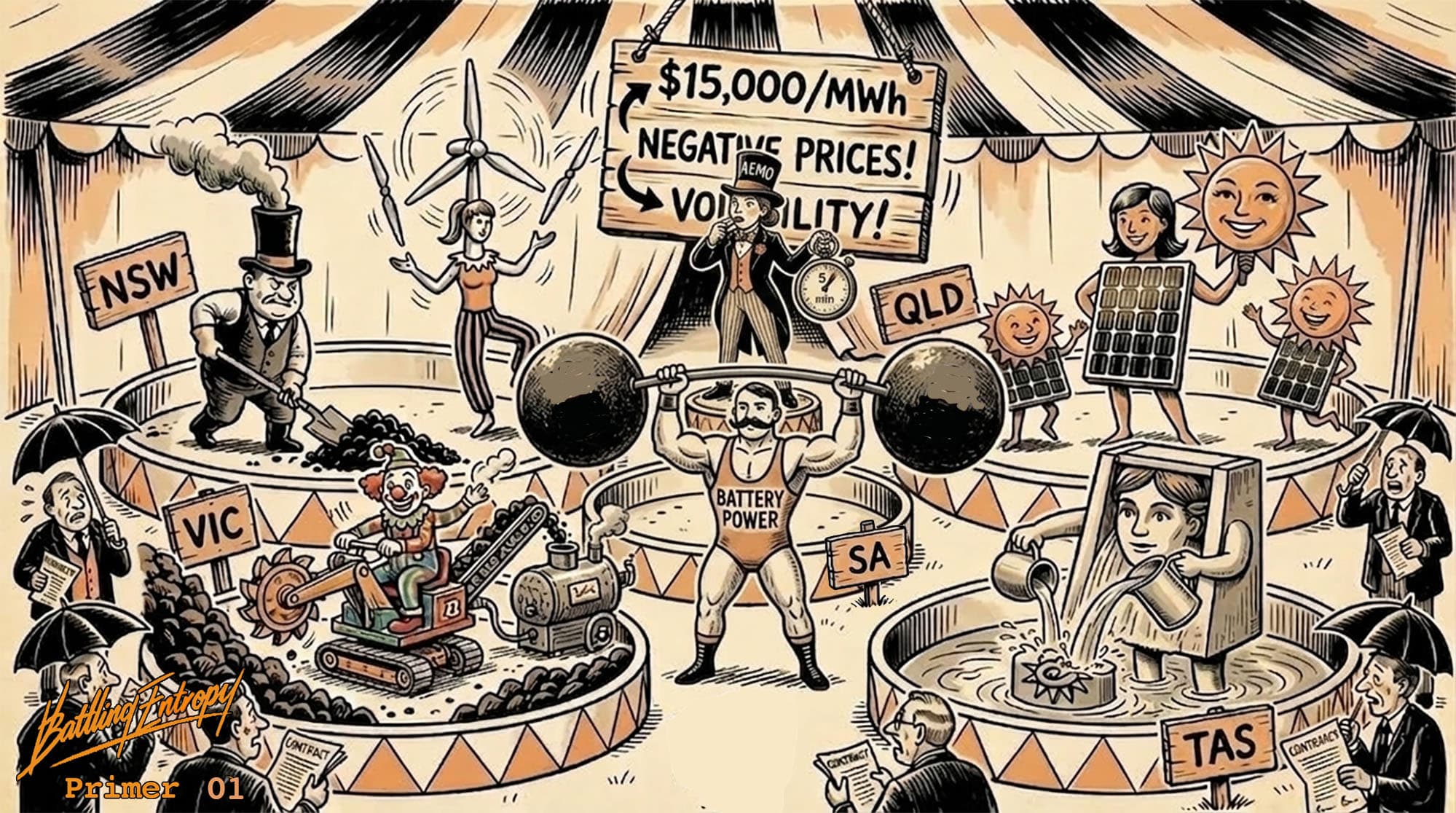
The National Electricity Market (NEM) is Australia's wholesale electricity market — a single market covering New South Wales, Victoria, Queensland, South Australia and Tasmania. It connects generators across five interconnected regions to distributors and retailers serving more than ten million homes and businesses. Started in December 1998, the NEM is one of the world's longest interconnected power systems by line length, stretching over 5,000 kilometres from Far North Queensland to the south of Tasmania.
This primer explains what the NEM is, who runs it, how prices are set, what each player does behind the scenes, and how all of that connects to your electricity bill.
Quick answers
- What is the National Electricity Market (NEM)? Australia's wholesale electricity market, operating across the eastern and southern states. Generators bid into a five-minute auction; the market clears at a single Regional Reference Price for each region.
- Which states are in the NEM? New South Wales (including the ACT), Queensland, South Australia, Tasmania and Victoria. Western Australia and the Northern Territory are NOT in the NEM — WA runs its own Wholesale Electricity Market (WEM), and the NT runs three separate small grids.
- Who runs the NEM? Three institutions: AEMO operates the market and the power system in real time, the AER regulates network charges and enforces compliance, and the AEMC writes the National Electricity Rules.
- How are NEM electricity prices set? Generators submit bids; AEMO dispatches the cheapest combination that meets demand every five minutes; the most expensive accepted bid sets the Regional Reference Price (RRP). All energy in that region for that five minutes settles at the RRP.
- What is the Regional Reference Price (RRP)? The single wholesale electricity price for a NEM region every five minutes. There is one RRP per region (so five RRPs across the NEM at any moment). The RRP is the anchor for all wholesale settlement and most contract-market pricing.
- Does the NEM use locational marginal pricing (LMP)? No. The NEM uses regional pricing — one price per state-sized region — rather than the node-by-node LMP used in major US markets and New Zealand. Local network constraints are managed through dispatch instructions rather than directly priced.
- When did the NEM start? December 1998.
What is in the NEM, and what is not
The NEM covers five regions that broadly correspond to state borders: New South Wales (which includes the ACT), Queensland, South Australia, Tasmania, and Victoria. Each region has its own wholesale spot price at any given moment, even though the regions are connected by transmission interconnectors that allow electricity to flow between them.
Two parts of mainland Australia sit outside the NEM. Western Australia runs the Wholesale Electricity Market (WEM) on the South West Interconnected System, with its own market operator settings and a separate capacity mechanism. The Northern Territory runs three separate small grids (Darwin–Katherine, Alice Springs, and Tennant Creek), none of which trade electricity in a wholesale market the way the NEM does.
This primer is about the NEM. WEM and the NT systems are separate animals, with separate institutions and separate rules.
How wholesale electricity is bought and sold
The NEM is a gross pool, energy-only spot market. That is a mouthful, but the idea is straightforward.
Gross pool means every megawatt hour of electricity generated in the market is sold into a single pool, and every megawatt hour consumed is bought from the same pool. There are no bilateral physical contracts that bypass the spot market.
Energy-only means generators are paid for the energy they actually produce, at the spot price in their region, at the time they produce it. They are not paid a separate "capacity payment" simply for being available. This is in contrast to the WEM and many overseas markets, which include a capacity mechanism.
Spot market means the price changes continuously. Every five minutes, AEMO determines a new spot price for each region based on the bids submitted by generators and the level of demand at that moment.
The mechanic for setting the price is called marginal pricing. Generators submit bids describing how much they are willing to sell, and at what price. AEMO stacks these bids from cheapest to most expensive and accepts them in order until total supply matches demand. The price paid to every accepted generator is set by the most expensive bid that had to be accepted. This is the marginal price.
The result is that solar and wind generators, which have near-zero marginal costs, almost always clear at the bottom of the bid stack and accept whatever spot price the marginal generator (typically gas or coal) sets. When a battery or pumped hydro asset is the marginal unit, the price is set by what they are willing to discharge for.
The spot price has a floor of negative 1,000 dollars per megawatt hour and a market price cap of 16,600 dollars per megawatt hour (the cap escalates with CPI each year). Negative prices occur when oversupply forces generators to pay to keep generating, typically in the middle of the day when rooftop solar pushes large-scale output beyond what demand can absorb.
Settlement occurs every five minutes. It used to be 30-minute settlement, with the price for each half hour being the average of six 5-minute dispatch prices. That changed in October 2021. The shift to 5-minute settlement sharpened the incentive for fast-responding assets like batteries and made it harder for slow-ramping thermal generators to recover their costs through brief evening price spikes.
Who runs what
The NEM has four main institutions plus a fragmented retail layer.
AEMO (Australian Energy Market Operator) is the system operator. It runs the dispatch process, sets the spot prices every five minutes, manages settlements between generators and retailers, and publishes the planning documents that guide investment (the Integrated System Plan, the Electricity Statement of Opportunities, the Generation Information). AEMO does not own any generation, transmission or distribution assets. It is jointly owned by the Commonwealth and the participating state governments and recoups its costs through fees on market participants.
AER (Australian Energy Regulator) regulates the parts of the system that are natural monopolies, principally the transmission and distribution networks. The AER sets the maximum revenue each network business can recover from customers in a five-year regulatory period. It also monitors the wholesale market for misconduct, publishes the State of the Energy Market report, and administers the retail Default Market Offer in NSW, SA and south-east Queensland.
AEMC (Australian Energy Market Commission) writes the rules. The National Electricity Rules (NER) are a several-thousand-page document covering everything from generator connection technical standards to retail competition. The AEMC considers rule change proposals and publishes determinations.
Energy Ministers (the federal Climate Change and Energy Minister plus state and territory counterparts) sit at the top. They agree on policy direction and can direct rule changes through formal mechanisms. The coordinating body has changed names several times; most recently it has operated as the Energy and Climate Ministerial Council.
The retail market sits below all of this. Retailers buy wholesale electricity from the spot market (and hedge it via the contract market), then sell it to households and businesses on retail tariffs. There are around 30 retailers serving NEM customers. Three "tier one" retailers (Origin, AGL and EnergyAustralia) hold more than 70 percent of the market between them.
The physical layers
Electricity in the NEM moves through four physical layers, each with its own rules and its own players.
Generation. Coal, gas, hydro, wind, solar, and increasingly batteries. About 65 GW of registered generation capacity in early 2026, plus more than 25 GW of rooftop solar behind the meter. Generators must register with AEMO, meet technical standards, and bid into the dispatch process every five minutes. Renewable generators also receive Large-scale Generation Certificates on top of the wholesale price, worth around 30 to 50 dollars per MWh depending on market conditions.
Transmission. High-voltage lines (66 kV and above) that move electricity over long distances. Each NEM region has one or two transmission network service providers (TNSPs); for example, TransGrid in NSW, AusNet in Victoria, Powerlink in Queensland, ElectraNet in SA, TasNetworks in Tasmania. Transmission also includes the interconnectors between regions: Heywood and Murraylink between SA and Victoria, Basslink between Tasmania and Victoria, Terranora and QNI between NSW and Queensland, and the Victoria–NSW interconnector. Interconnector flows often determine whether one region's spot price is the same as a neighbour's or much higher.
Distribution. Lower-voltage lines (11 kV down to 230 V) that carry electricity from transmission substations to streets and meter boxes. Each region has multiple distribution network service providers (DNSPs); for example, Ausgrid, Endeavour and Essential cover NSW; United Energy, AusNet, CitiPower, Powercor and Jemena cover Victoria; Energex and Ergon cover Queensland. About half of a typical electricity bill goes to network charges (transmission plus distribution), with distribution being the larger share.
Retail. The customer-facing layer. Retailers handle billing, customer service, marketing, and the financial risk of buying volatile spot prices to sell on fixed retail tariffs. They manage that risk by buying hedge contracts in the contract market.
The contract market
Spot prices are volatile. A retailer that buys electricity at an average 50 dollars per MWh across a year will lose money if the average wholesale price turns out to be 80 dollars, and a generator that sells at the spot price loses money when prices crash to negative levels. Both sides therefore use financial hedge contracts to lock in prices in advance.
The most common products are swap contracts (a fixed price for an agreed volume over a period), caps (an option to receive a payment when the spot price exceeds a strike price, typically 300 dollars per MWh), and futures (standardised swaps traded on the ASX Energy exchange). The contract market is several times larger than the spot market by traded volume.
This contract layer is invisible to consumers but it is where most of the actual money in the wholesale system changes hands. When you read about "wholesale prices" being expensive, the more important question is usually what is happening to contract prices, not the spot.
Ancillary services and FCAS
Generators do not just sell energy. The NEM also runs markets for frequency control ancillary services (FCAS): the ability to instantly increase or decrease output to keep grid frequency at 50 Hz. There are ten FCAS markets, split by direction (raise or lower) and by response time (1-second, 6-second, 60-second, 5-minute, and a regulation service that responds continuously to small frequency deviations).
Batteries dominate fast FCAS because they can ramp from zero to full output in milliseconds. The Hornsdale Power Reserve in South Australia famously paid back its capital cost in its early years primarily through FCAS revenue rather than through energy arbitrage. As more batteries entered the market, FCAS prices collapsed and energy arbitrage has become the bigger revenue line for new entrants.
The NEM also has nascent markets and procurement processes for other services that used to come "for free" from synchronous coal and gas generators: voltage control, system strength, and inertia. As those generators retire, these services need to be paid for separately, often by procuring grid-forming inverters or synchronous condensers.
Reliability
The NEM operates to a Reliability Standard of 0.002 percent unserved energy in any given financial year. In plain language, the system is supposed to deliver 99.998 percent of the electricity demanded. When AEMO's modelling indicates that standard is at risk of being missed, the operator can use the Reliability and Emergency Reserve Trader (RERT) to procure backup generation and demand response on top of what the market provides.
The reliability picture is in flux. Coal generators are retiring on schedule (Eraring in NSW in August 2027, Yallourn in Victoria in 2028, Loy Yang A in 2035), the renewable build is racing to replace them, and AEMO publishes annual updates on whether the pipeline of replacement capacity is adequate. The most recent Electricity Statement of Opportunities is the place to look.
How AEMO plans for the long term
Three planning publications matter most.
The Integrated System Plan (ISP) is updated every two years. It is AEMO's 30-year roadmap for the system, outlining the transmission projects, generation build-out, and policy assumptions consistent with a credible energy transition. The current document is the 2024 ISP, with the 2026 ISP in draft.
The Electricity Statement of Opportunities (ESOO) is annual. It assesses ten-year reliability, asking whether enough generation will be built in time to keep the lights on as coal retires.
Generation Information (GI) is updated quarterly. It is the working list of every existing, committed, anticipated, withdrawn, and publicly announced generation project in the NEM. If you want to know how much battery storage will be online in NSW in 2027, this is the source.
The transition under way
The NEM is in the middle of the largest physical transformation in its history. Coal generation, which provided more than 80 percent of energy in 2010, is now around 55 percent and falling fast. By 2030 it is likely to be below 30 percent. Renewable generation, principally wind and large-scale solar, is the replacement, with batteries and pumped hydro providing the firming.
The federal Capacity Investment Scheme is currently the main commercial mechanism backing this build-out. It uses contracts-for-difference to underwrite revenue for new renewable and storage projects, taking some of the merchant risk off developers and lowering the cost of capital. The 2024–2027 tender rounds collectively contracted around 32 GW of new capacity.
The Cheaper Home Batteries Program, launched in July 2025, is the consumer-facing companion. It subsidises around 30 percent of the upfront cost of small-scale battery systems, with sliding eligibility above 14 kWh. By March 2026 it had supported the installation of more than 250,000 home batteries totalling 6.3 GWh of storage.
Together these schemes are reshaping not just what generates electricity in the NEM but where — pushing more of the build to the distribution edge of the grid and increasing the importance of network coordination.
Where your electricity bill comes from
A typical residential electricity bill in the NEM in 2026 breaks down roughly as follows:
| Component | Share | Who collects it |
|---|---|---|
| Wholesale energy | ~30% | Generators, via the retailer |
| Distribution network charges | ~35% | The local DNSP |
| Transmission network charges | ~10% | TNSPs |
| Environmental schemes (LRET, SRES, state schemes) | ~10% | Renewable generators and scheme administrators |
| Retail margin and operating costs | ~10% | The retailer |
| Metering | ~5% | Metering providers |
The shares shift year to year. In 2022–23 the wholesale energy component of bills spiked above 50 percent during the gas-price crisis. In 2025–26 it has settled back, with the network share growing as DNSPs invest in grid augmentation to support renewable connections and EV charging.
Take care, Tony
Further reading
Further reading
- AEMO. (n.d.). Fact sheet: Australia's National Electricity Market. https://aemo.com.au/learn/energy-explained/fact-sheets
- Australian Energy Regulator. (2025). State of the energy market 2025. https://www.aer.gov.au/industry/registers/state-of-the-energy-market-reports
- AEMC. (n.d.). Energy explained. https://www.aemc.gov.au/energy-system
- AEMO. (2024). 2024 integrated system plan for the National Electricity Market. https://aemo.com.au/energy-systems/major-publications/integrated-system-plan-isp
- AEMO. (2025). 2025 electricity statement of opportunities. https://aemo.com.au/energy-systems/electricity/national-electricity-market-nem/nem-forecasting-and-planning