
When the rhythm section fades...
Issue 05: What happens to grid stability when synchronous generators retire and inverters take over
For a century and a half, the steady beat of our electricity system came from spinning steel. The inertia of synchronous generators held the 50Hz rhythm steady as a mechanical side-effect of rotation. That era is ending. In a grid dominated by power electronics, stability is no longer a by-product of physics. It must be specified, tested, validated and governed. A recent white paper from Australian researchers makes the challenge explicit: we are virtualising the grid without yet having a national architecture to verify its behaviour under stress. The transition that matters for the grid is not from coal to solar and wind. It is from inertia to firmware. That demands a new discipline of coordination, markets and institutional design.
The Grid’s Next Scarcity: Rhythm
Spinning coils of wire next to a magnet has been the dominant way we generate electricity at scale since the 1880s. For almost a century and a half, rotating synchronous machines did the work. All that spinning iron delivered a gift. The inertia embedded in turbines and generators underpinned the 50Hz cadence, the steady electrical heartbeat of modern civilisation. Frequency stability was not a product. The grid kept time because the steel kept spinning.
That inheritance now feels more fragile than it once did. In the wake of the April 2025 Iberian blackout, which left millions without power for up to ten hours, system security has shifted from an academic concern to lived reality. When the cadence falters, everything that depends on it becomes fragile.
The grid is changing. A system increasingly dominated by power electronics, inverter-interfaced wind and solar, and battery converters does not come with inertia bundled in. It must be programmed, coordinated, and validated. The edges of the web must remain synchronised with the centre. The rhythm must now be written, not inherited.
A recent white paper, Securing Power Systems in the Renewable Revolution, produced by researchers at the University of New South Wales, the University of Wollongong, and partners across industry, confronts this shift directly. It is technical, sober, and, when you get into the detail, quietly radical. Its central implication is simple. We are virtualising the grid faster than we are building the systems and institutions required to validate it.
A Software-Defined Grid
The paper lays out investigation questions across system strength, protection, dynamic stability, testing, markets, and governance. Step back from the detail and one theme dominates. A 100 percent inverter-based grid is not a fuel system. It is a control system. We are replacing the reflexes of spinning steel with control laws written in software. Instability is often an incorrect line of code, or an interaction problem caused by two controllers talking past each other.
Control systems must be validated under stress and at scale. A control system that maintains a national heartbeat cannot be left to assumption.
The First 200 Milliseconds
Most people think blackouts begin with shortages, insufficient megawatts to feed demand. In practice, they often begin with loss of coordination. The lights go out when the system cannot keep time. That coherence is defended in the first 200 milliseconds of a fault, long before markets react and long before operators speak. This is the part of the transition we do not talk about enough. The frontier is not megawatts. It is milliseconds.
If you want to see the shift in one place, look at fault current. It is where physics, protection, and regulation collide. One key phrase used in the paper captures the problem: protection-quality fault current. But first, for many readers, what is a fault current and why does it matter? It is the surge of electrical current that flows when something goes wrong on the grid, like a short circuit. Protection systems rely on its size and shape to detect the problem and trip the right breaker.
Spinning Steel vs Silicon & Software
Fault current behaviour is very different for spinning steel and power electronics. The chart below shows the current that flows when a fault occurs on a grid dominated by spinning generators (the black line) and inverters (the orange line).
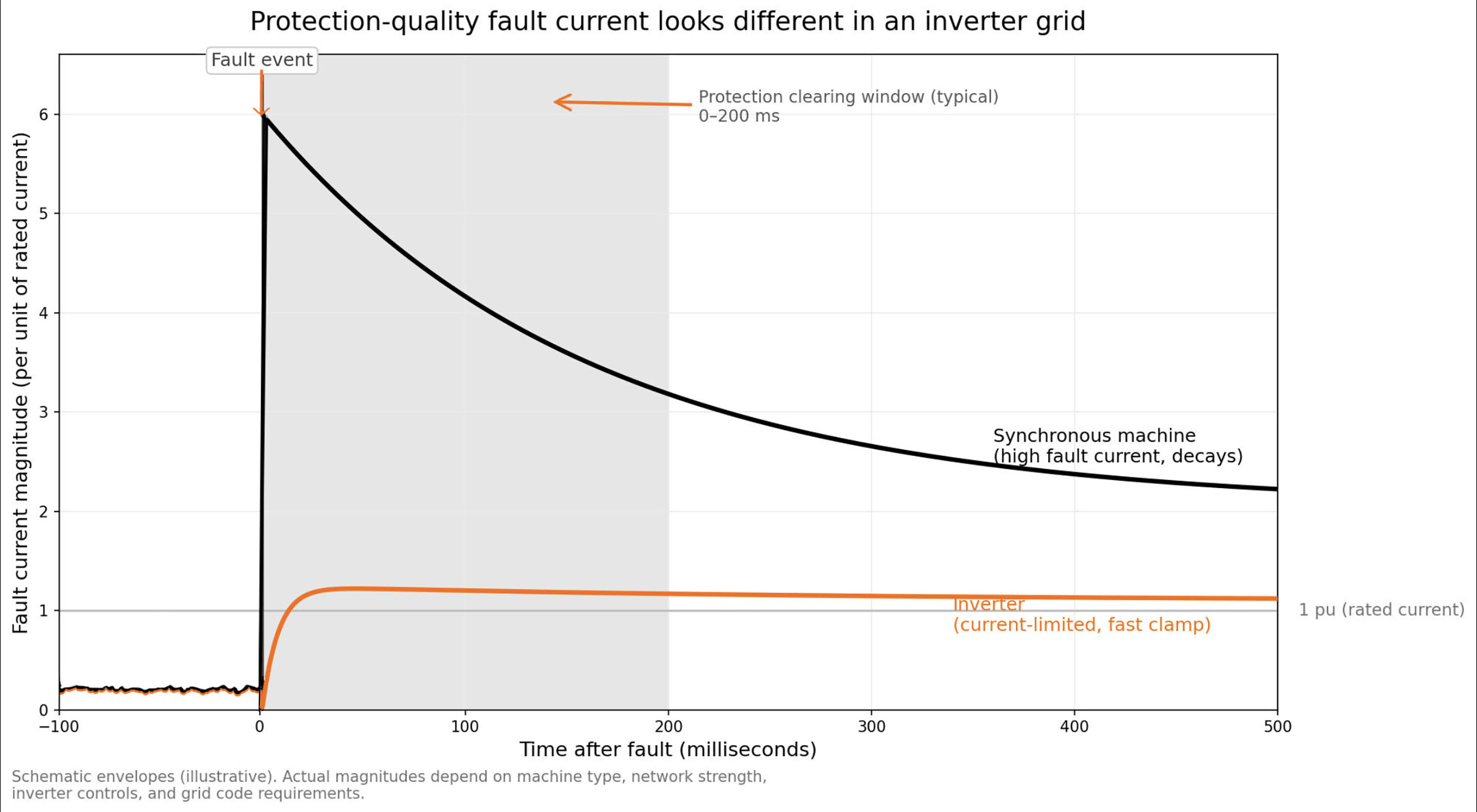
Picture the black line as a massive rotating machine, a turbine-generator set the size of a house. When a fault hits the grid, it is like someone grabbing the shaft. The machine fights back. It throws a surge of current into the fault, several times its rated current, as a physical reflex of magnetism and inertia. That surge is loud and unmistakable, and it lingers as it decays. Classic protection systems were built around that signature. They look for a big, sustained fault current so they can decide quickly that something is wrong, work out where it is, and trip the right breaker.
The orange line is a different kind of creature. An inverter does not have a spinning rotor to dump energy from. It measures the disturbance and injects current through power electronics, but it is deliberately current-limited to protect its semiconductors. The response can be very fast, but it is bounded. You get a smaller fault current, often closer to rated current, shaped by software. It may be held roughly constant for a short window, but it does not produce the same brute-force surge.
What does this mean in plain terms? The grid still tries to protect itself, but the old assumptions break. If fault current is smaller and has a different shape, protection cannot rely on the old loud bang test. The grid needs clearer specifications for what inverters must deliver during faults, and it often needs different protection schemes and settings so relays still detect, locate, and clear faults reliably.
In other words, as we replace the reflexes of iron with the choreography of software, the rules of protection have to become explicit, testable, and enforceable.
Regulatory Entropy
Today, protection-quality fault current is not fully defined in measurable and verifiable regulatory terms.
- If it is not clearly defined, how can it be specified?
- If it cannot be specified, how can it be procured?
- If it cannot be procured, how can it be guaranteed?
This is regulatory entropy.
In an attempt to keep the system safe, some operators are installing synchronous condensers, huge spinning rotors that mimic the stabilising behaviour of synchronous generators without producing any power. A syncon is a very expensive way of recreating something we used to get for free from spinning steel. That may seem absurd, like putting horseshoes on a 1900 car. It makes sense as a transitional measure while we build new solutions. The danger is mistaking a stopgap for the future.
The paper’s authors understand this. Their call for disturbance testing programs, open modelling frameworks, hardware-in-the-loop validation, and a wide-area digital twin is not an academic wish list. It is recognition that the stability layer of the grid is becoming software-defined. Software must be tested. Timing must be proven.
The Quiet Dynamite: Markets and Regulation
The technical questions are serious. The regulatory questions are explosive:
- What is the right regulatory framework for a power-electronics-dominated system?
- Who carries system security risk?
- Are incentives aligned to real-time system quality?
- Who pays when stability margins are misjudged?
We built our energy markets around marginal fuel costs. We are entering a world where energy is getting cheap. Stability and congestion are becoming expensive:
-
Energy is often cheap because wind and solar have no fuel bill. At times the price is negative.
-
Stability is not free in an inverter-heavy grid. We have to pay for things that used to come “bundled” with big spinning machines: frequency support, voltage control, system strength, and fault current for protection.
-
Congestion is becoming dynamic. It is not just a handful of usual bottlenecks. It flares up and subsides with weather, outages, and fast renewable ramps.
-
Coordination becomes the hidden cost. If we do not price and procure it explicitly, it shows up indirectly as tighter constraints, more operator interventions, more conservative margins, and higher system costs that arrive as a surprise.
Security used to be embedded in physics. Now it must be embedded in market design and governance.
Entropy again.
This Is About Coordination, Not Inverters
It is tempting to frame the debate as steel versus silicon, synchronous condensers versus grid-forming inverters. That misses the deeper shift. Coal plants embedded coordination in hardware. Inverter-dominated systems require coordination in software, standards, testing infrastructure and institutional design. That is a higher-order engineering challenge.
The grid is moving from a mechanical network with electrical behaviour to a distributed, real-time control system with political governance layered on top.
The entropy risk is not renewable energy. The entropy risks are unverified interaction, black-box models, misaligned incentives, undefined performance metrics, and planning disconnected from operational reality. The physics will work. The question is whether our institutions will evolve fast enough to keep pace.
The Four Big Moves
Translated into plain language, the paper proposes four structural responses:
- A National Electrification Framework: replace fragmented adaptation with coordinated architecture.
- An immediate inverter and protection disturbance program: stop assuming behaviour. Measure it.
- A wide-area digital twin of the NEM: replace reactive intervention with predictive simulation.
- A deep-expertise working group: align standards, markets and technical evolution with real system behaviour rather than political cycles.
What This Means
We are not merely swapping coal for solar. We are redesigning the stability layer of civilisation. For well over a century, inertia came bundled inside spinning steel. In the renewable era, stability becomes something we must manufacture, technically, economically and institutionally. That is not a weakness. It is a civilisational upgrade. But it requires discipline. In a software-defined grid, rhythm is no longer automatic. It is engineered.
“At some point we have to ask whether we’re still connecting new things to a legacy grid, or whether the new things are the grid,” said co-author Prof. Ty Christopher, Director of the UoW Energy Futures Network. That is something the electricity industry, indeed all of us, needs to consider.
New to this topic? See these Battling Entropy Primers to get you up to speed:
Get more like this
New analysis delivered to your inbox. No spam, unsubscribe anytime.
Take care, Tony
Disclosure: Battling Entropy is my independent commentary. The views expressed are my own and do not represent those of any organisation unless explicitly stated. This is not financial or investment advice.
I also have commercial interests in the energy technology field. I am working on a venture, Petajoule Capital, which is developing People-Powered Energy: one particular approach for the coordination of consumer-owned batteries, EVs and flexible demand. This article discusses issues relevant to that work.
Sources / Further Reading
Alexander, D., Arraño-Vargas, F., Christopher, T., Fletcher, J., Jiang, S., Konstantinou, G., Lewis, M., Twidell, M. Securing power systems in the renewable revolution. University of New South Wales Decarbonisation Innovation Hub, University of New South Wales Energy Institute, University of Wollongong and industry partners: Real-Time Simulations Laboratory, APQRC. https://ap1.hubs.ly/y0BbSX0
Australian Energy Market Operator. (2023). Engineering framework for the future power system. AEMO.
European Network of Transmission System Operators for Electricity. (2025, October 3). Factual report on the grid incident in Spain and Portugal on 28 April 2025. ENTSO-E. https://www.entsoe.eu/publications/blackout/28-april-2025-iberian-blackout/
Kundur, P. (1994). Power system stability and control. McGraw-Hill.
Milano, F., Dörfler, F., Hug, G., Hill, D. J., & Verbič, G. (2018). Foundations and challenges of low-inertia systems. Power Systems Computation Conference (PSCC).
Discussion
Loading comments...