The Battling Entropy Manifesto
Issue 01: Civilisation is a local rebellion against the universe
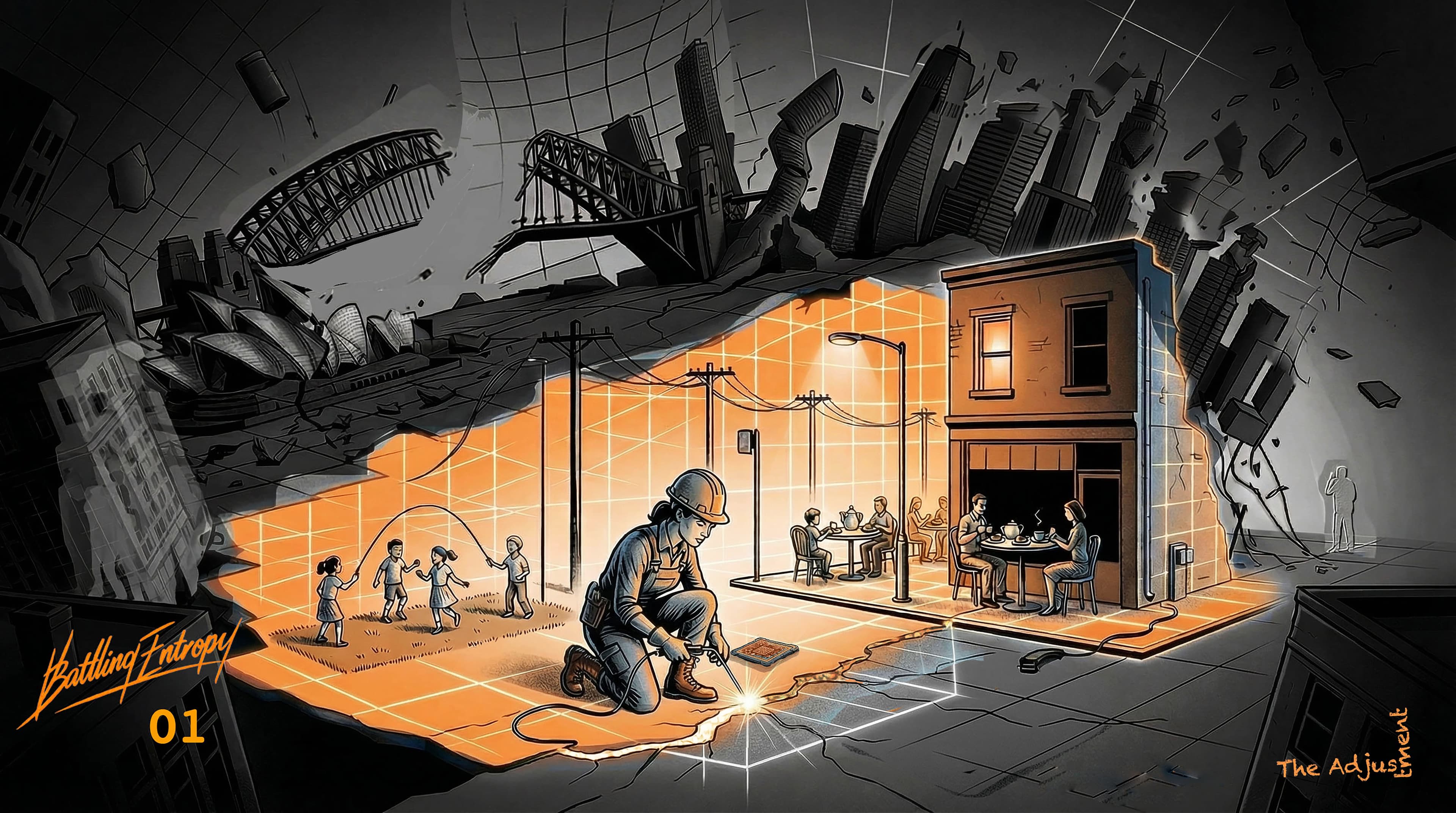
Entropy is relentless. Civilisation is resistance. Technology, collapsing costs, and bold imagination let us redesign energy and create islands of coherence in a chaotic world.
Entropy is inevitable
Entropy is the most important fact about the universe that polite conversation tends to step around. To a mathematician, the classic definition says it all:
If you don't think in symbols, think of as the book-keeping of what you can no longer get back: the part of energy that has become unavailable for useful work, the part of the system that has “gone diffuse,” the part of the future that has quietly been foreclosed. This definition, born from Clausius’ attempt to write the second law in equations, doesn’t need moral language to be unsettling. It simply states that the universe has a destination: heat death — an extraordinarily thin, slightly warm porridge of sameness.
And if you prefer prose to mathematics, I can give you no better advice than this: go and read Ted Chiang’s short story Exhalation. Do it now. I promise you’ll grok the second law in your bones. It’s the most emotionally faithful rendering of thermodynamic inevitability I’ve ever read. An elegant story built around two dawning recognitions. First, that the universe keeps accounts, and the ledger only ever moves in one direction. Second, that this does not make life trivial. It makes it precious.
Entropy is real. Disorder is our destiny. Left alone, everything drifts. Machines wear. Metals fatigue. People age. Societies fray. Institutions rot from the inside like timber. Information compounds while meaning fades. Complexity becomes fragility. Physical and societal systems that once felt invulnerable reveal themselves to have been poorly maintained hollow shells. This isn’t pessimism. It’s the way the universe works.
Civilisation is a local rebellion
If entropy is the universe’s default, then civilisation is the exception we insist upon each day.
We can’t repeal the second law. We can’t suspend it by vote or optimism. Entropy will overtake us all: every life, every empire, every planet, eventually every galaxy. The current runs outward. The river keeps moving toward a darker sea. And the human response, at its best, has never been denial. It has been design.
Like Xanadu raised beside unstable ground, we fence off small territories of order against deeper forces: a home that stays warm through winter; a city that stays lit through night; a market that lets strangers cooperate without trust; a grid that holds its frequency steady while everything else drifts. These are not natural states. They are maintained states.
“Battling entropy” is not a grand cosmic struggle. It is the disciplined choice to build things that keep their shape under pressure. Durability rather than permanence. Resilience rather than perfection.
I first wrote about entropy in 2016, shortly after reading Ted Chiang’s Exhalation. I remember the feeling more than the argument: the quiet recognition that the world does not hold itself together. Left alone, things don’t just stop improving. They come apart: slowly at first. Then all at once, in the way people go broke, institutions sag, and good intentions turn into meetings.
The question was never whether disorder wins in the end. It always does. The question is how fast it arrives, and how much structure we can keep intact before it does. Most of our lives are spent answering that question without admitting we’re answering it.
I made some mistakes. The old blog tried to cover social trends, environmental technology, and sci-fi reviews: none of them particularly well. You could say it had too much entropy. It’s back now with a clearer focus: energy markets, distributed systems, and the grid. Because if you want to know whether civilisation is strengthening or fraying, watch how energy moves. Energy is not just a commodity. It is the flow that keeps what we’ve built from collapsing back into noise.
The grid we inherited is an 1880s machine
Most people assume we have a modern electricity system. We don’t, not at the level that matters. The core architecture was set in the late nineteenth century: central stations pushing power outward over a network built for one-way flow. Edison’s early central stations date to the 1880s; the high-voltage AC breakthrough that enabled scale followed soon after in the 1890s.
Yes, we’ve added digital protection, DERMS, and far more sophisticated dispatch markets. But the mental model is still nineteenth century. Who generates, who consumes, where control lives, which way power “ought” to flow. We’re carrying a century and a half of inertia. I’ve sat through meetings where the diagram on the screen is basically 1905 with better fonts.
It’s in our language: “baseload,” as if civilisation requires a single unblinking furnace to be morally and physically safe. You can see it in institutions: planning processes, reliability metrics, regulatory reflexes built around the premise that electricity is produced by a small number of big machines owned by large and powerful entities. And you can feel it in the psychology: the comforting belief that stability should be centralised, that reliability comes from scale, that complexity must be hidden behind someone else’s control room.
It shows up in politics too: the endless resurrection of nineteenth-century intuitions dressed up as twenty-first-century realism. When people argue that a decentralised, renewable-heavy system is “too complex” to run, what they often mean is simpler. It doesn’t fit inside the cognitive furniture built for 1895. And that furniture is heavy.
The energy transition is an entropy story disguised as climate policy
For two centuries we’ve run civilisation on a brutally effective loop:
extract hydrocarbons → transport them → burn them → convert heat into work.
It is a brilliant hack of concentrated ancient sunlight. It did extraordinary things for human prosperity. But it is also entropically expensive in the systems sense. Long supply chains. Continuous fuel dependency. Volatile input prices. Chokepoints (sometimes literally, like the Suez Canal). Geopolitics. Thermal waste. Fragile coordination. A civilisation built on combustion has to keep feeding the fire. Fire has habits. It concentrates power, rewards centralisation, and punishes interruption.
Now compare the emerging loop:
sunlight and wind → electricity → storage → consumption.
No fuel trains. No tankers. No continuous extraction. Far less transport of matter. More of the system becomes a question of conversion and coordination rather than mining and logistics. This is not a claim that renewables “defeat” thermodynamics. They don't. Nothing does. But the architecture is, in a practical sense, more resistant to disorder. It collapses steps, reduces friction, and turns energy into something that moves more like information: fast, modular, reroutable, increasingly local.
The old system is a pipeline. The new system is a web. Webs, when engineered well, are how complex organisms survive. They demand their own disciplines. Redundancy must be designed in, not assumed. Without top-down control, the system must coordinate itself at every edge. But a web that loses a node survives in a way that a pipeline that loses a pump does not. That is why the engineering of coordination matters as much as the engineering of generation.
Technology enabled the door to open
A couple of decades ago, much of what we’re now watching unfold was not merely “politically difficult.” It was arithmetically impossible. Solar was too expensive. So were batteries. Power electronics were too crude. Control systems were too costly and too blunt. Even if you could imagine the end state, you couldn’t finance the path to get there.
Then the floor dropped out of the cost curves. The Electric Slide is not my phrase. It’s Packy McCormick and Sam D’Amico’s framing at Not Boring (linked in the references below), and it’s one of the clearest ways I’ve seen to explain why electrification is suddenly accelerating. Their claim is simple: the modern world is being rebuilt on an electric stack. Batteries. Electric motors and their magnets. Power electronics. Embedded compute. The cost of that stack has been collapsing for decades, and they did the useful work of assembling it into a single composite curve they call the Electric Slide.
Their conclusion is not incremental. It is civilisational. In their equal-weighted composite, the cost of the electric stack has fallen by around 99% since 1990, roughly 12.6% per year.
-
When costs fall 10%, you optimise.
-
When costs fall 50%, you redesign.
-
When costs fall 99%, you need to reassess what is possible.
That is why the energy transition is happening. Not because we collectively became wiser or kinder. It’s happening because the physics of conversion, plus the economics of learning curves, opened a feasibility window wide enough for the real world to walk through. Technology is the enabler. It made a new kind of energy system financeable.
Economics is the accelerator
Technology opens the door. Economics decides whether anyone walks through it.
Markets are not sentimental. Capital does not care about nostalgia, tradition, or how many decades a technology has been called “reliable.” Capital cares about repeatability, risk, cost of capital, and time to build. When a system becomes cheaper, modular, quick to deploy, and financeable at scale, it starts to behave like a default. The conversation shifts from “should we?” to “why would we build the expensive thing?” This is where storage becomes the hinge.
In a combustion grid, stability is produced by inertia. Literally spinning mass. In an electrified, renewable-heavy grid, stability is produced by control. Sensing and responding. Balancing and buffering. Batteries are not just big AA cells. They are a control layer. They turn volatility into optionality. They convert variability from a weakness into a design parameter.
Economics accelerates what technology enables by making it bankable. Once banks can underwrite it, it stops being an argument. The pace of change stops being set by debate. It becomes set by construction schedules.
Human imagination is the brake
The part most people miss is not technical. It’s psychological. If technology enables and economics accelerates, why does the transition still feel slower than it “should”? Because the biggest brake on human progress is rarely physics, and it is rarely cost. It is imagination.
We are excellent at extrapolating the present. We are terrible at believing in discontinuity until it has already happened. We confuse dominance with permanence. We mistake familiarity for necessity. We keep old categories because they once helped us think, not because they still describe the world.
We inherited an 1880s grid, and we inherited an 1880s mental model to match it. The model says electricity flows one way, from large machines to passive consumers. The model says reliability must be centralised. The model says the best grid is the one that changes least.
Meanwhile the electric stack keeps getting cheaper and more capable. The Electric Slide does not negotiate with our nostalgia. The cost curve is an intellectual insult. It improves whether institutions are ready or not.
That mismatch is what imagination failure looks like in practice. Regulators demand precedent. Planners design for yesterday. Incumbents mistake familiarity for indispensability. Policy becomes theatre. Physics becomes a talking point. And the arguments about whether the future is “realistic” are often delivered by people who haven't done the homework on the shape of the cost curves.
Entropy adores this hesitation. Systems that cannot adapt do not need to be defeated. They simply drift.
What this means for you, personally
A manifesto that doesn’t land in lived experience is just an essay with attitude. So here is the intimate claim behind all this systems talk. The Electric Slide is not only an industrial story. It is a life story.
The electrified world is not merely cleaner. It is more sovereign. It gives households and organisations new ways to carve out pockets of order. Warmth without combustion. Mobility without fuel dependency. Resilience without pleading for centralised rescue (can your car keep your fridge running?). Agency without permission. In the old model, you were a consumer plugged into a machine built by someone else in 1882. In the new model, you can increasingly become a participant in a web. Producing, storing, shifting, buffering. Using intelligence and software as leverage. In plain terms, the ability to create a calmer, more ordered life is becoming cheaper.
And here is the deliberately provocative part. If you choose to ignore this moment, if you insist on living inside nineteenth-century assumptions, you will end up paying an entropy tax you didn’t need to pay. Not because anyone is punishing you, but because the tools that could have lowered your friction were available and you didn’t pick them up.
I use the word “choose” deliberately. Not everyone starts from the same position. Access to capital. Housing you control. Technical literacy. Time. These are unevenly distributed, and pretending otherwise would make this manifesto dishonest. But the direction is clear. The cost of participation is falling, and the cost of passivity is rising. The longer you wait for the old system to look after you, the more you will find yourself paying rent, literal and figurative, to intermediaries standing between you and the energy your life depends on.
The coming era will reward people who can imagine new architectures of order: homes, businesses, communities, markets. People who can see that the grid is not a monolith but a platform. People who understand that “electrify everything” is not a slogan. It is an escape route from the old entropic regime of extraction, transport, and combustion. This is not utopian. It is practical. We are not aiming for paradise. We are aiming for pockets of calm.
Measuring the costs of battling entropy
I’m an engineer and a businessperson. If something can’t be quantified, I treat it with skepticism.
Every pocket of calm has an entropic price. To create order here, we must release greater disorder elsewhere. The question is simple: has civilisation improved the exchange rate?
So I tried to measure it.
An Island of Calm (IoC) is the minimum annual energy required to carve out a pocket of order in our disorderly universe. I define it in human terms: steady warmth against winter, cool air against heat, clean water, safe nourishment, light after sunset, and timely connection to the shared knowledge of humanity. The targets are set with reference to modern, developed-world standards.
IoC measures not wealth, but thermodynamics. It is the primary energy needed, at the technological frontier of each age, to hold one life in that equilibrium.
By fixing the human outcomes while allowing the tools to evolve, the Island of Calm Index traces how civilisation has changed the energy cost of sheltering a mind and body in peace. The references below detail the definitions and calculations. If you want to audit it, the assumptions are laid out in Appendix A (linked below).
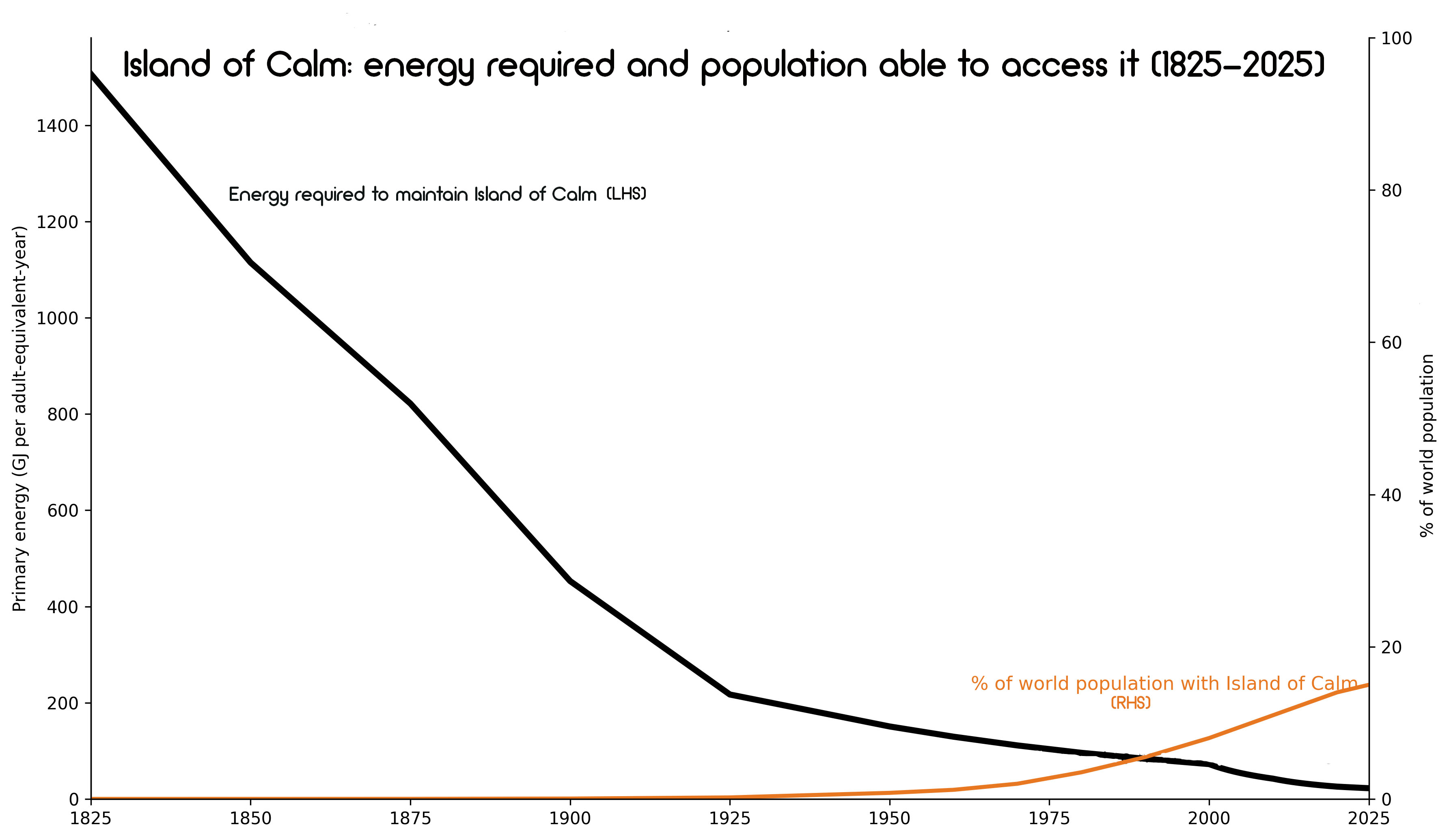
On this measure, the energy required to maintain an IoC has fallen from around 1,500 GJ per adult-equivalent per year (OECD scale) in 1825 to around 22 GJ today. That’s about a 67× difference. You can quibble with my assumptions, but two points are hard to escape:
The per-capita energy overhead of stability is vastly lower now than in the early industrial era.
Far more people, and a higher share of humanity, now live inside this envelope of calm.
In the early nineteenth century, only a handful of people could live at anything like modern comfort. Fewer still had reliable and timely access to almost everything that could be known: prices, politics, wars, credit, shipments. To make the comparison concrete, I start with a state-of-the-art household for its time, where the machinery of calm was visible. An individual, a house, and an unusually extensive private information network that spanned Europe. The 1825 benchmark is anchored in the well-documented household and business life of Nathan Mayer Rothschild. Today, well over a billion people inhabit such conditions. Still a minority of humanity, but no longer a rarity reserved for dynasties.
For two centuries, the thermodynamic burden of sustaining a stable human life has shifted profoundly. What once demanded immense rivers of primary energy to push back disorder can now be achieved with far less input. Not because human needs have diminished, but because our instruments of order have become more efficient and more precise.
Take heating. In 1825, Rothschild’s house at 107 Piccadilly was kept habitable with open fireplaces burning coal. It was a low-efficiency way to hold winter at bay in a large, leaky building, and it depended on a small army of human effort around it: fuel deliveries, tending fires, cleaning, hauling water, laundering, cooking. All those servants brought their own thermodynamic burden. By the late nineteenth century, coal was increasingly burned in stoves and boilers, distributing heat through more controlled systems and shifting some of the human infrastructure of calm from servants to machines. In the twentieth century, central heating, better building materials, and electrification tightened the envelope. Today, a well-insulated home can be held at the same 20°C with high-efficiency heat pumps, thermostats, and automated controls. The human outcome is the same. The energy and labour required to get there are not.
The commitment
Battling Entropy is a commitment to noticing the direction of the universe without surrendering to it. It is a commitment to acknowledging that chaos is always encroaching without making chaos our identity. It is a commitment to designing systems, technical, economic, and institutional, that hold shape under stress.
It is also a commitment to intellectual honesty. We will not flatter the past by calling it “inevitable,” and we will not flatter the future by calling it “guaranteed.” Technology enabled this transition. Economics is accelerating it. Human imagination determines whether we meet it early, on our feet, or late, on our knees.
On the grid, entropy stalks our meeting rooms. It shows up as friction: precedent smothering new initiatives, delays compounding, rules complicating outcomes, workarounds hardening into permanence. The best responses use the sharpest tools we have.
Entropy doesn’t care what you believe. It only cares what you build. That is the job we all have.
Get more like this
New analysis delivered to your inbox. No spam, unsubscribe anytime.
Take care, Tony
Disclosure: Battling Entropy is my independent commentary. The views expressed are my own and do not represent those of any organisation unless explicitly stated. This is not financial or investment advice.
I also have commercial interests in the energy technology field. I am working on a venture, Petajoule Capital, which is developing People-Powered Energy: one particular approach for the coordination of consumer-owned batteries, EVs and flexible demand. This article discusses issues relevant to that work.
Sources / Further Reading
Chiang, T. (2014, April). Exhalation. Lightspeed Magazine. https://www.lightspeedmagazine.com/fiction/exhalation/
Clausius, R. (1865). Concerning several conveniently applicable forms for the main equations of the mechanical heat theory (excerpt/translation). Le Moyne College. https://web.lemoyne.edu/giunta/Clausius1865.pdf
Institute of Electrical and Electronics Engineers. (n.d.). Milestones: Pearl Street Station, 1882. Engineering and Technology History Wiki. Retrieved February 21, 2026, from https://ethw.org/Milestones%3APearl_Street_Station%2C_1882
McCormick, P., & D’Amico, S. (2025, August 26). The Electric Slide: The history, 99% decline, and future of the Electric Stack. Not Boring (Substack). https://www.notboring.co/t/not-boring-world
Not Boring. (n.d.). The Electric Slide (Electric Stack technology cost curves, 1990–2024). Retrieved February 21, 2026, from https://electricslide.notboring.com/
Rothschild (1825 benchmark and information network)
The Rothschild Archive. (n.d.). 107 Piccadilly, London, England. Rothschild Family Estates. Retrieved February 23, 2026, from https://family.rothschildarchive.org/estates/74-107-piccadilly
The Rothschild Archive. (n.d.). The Rothschilds and pigeon post. Rothschild Archive FAQ / Collections. Retrieved February 23, 2026, from https://www.rothschildarchive.org/collections/rothschild_faqs/rothschilds_and_pigeon_post
The Rothschild Archive. (n.d.). Nathan Mayer Rothschild and the Waterloo Commission. Rothschild Archive. Retrieved February 23, 2026, from https://www.rothschildarchive.org/business/n_m_rothschild_and_sons_london/nathan_mayer_rothschild_and_the_waterloo_commission
Liedtke, R. (2015). Agents for the Rothschilds: A nineteenth-century information network. De Gruyter/Brill.
Equivalence scales (adult-equivalent denominator)
Organisation for Economic Co-operation and Development. (n.d.). OECD-modified equivalence scale. OECD.
Background energy / technology conversion references
The Naked Scientists. (2008). How many watts is a burning candle? https://www.thenakedscientists.com/articles/questions/how-many-watts-burning-candle
Victorian Web. (2001). What kind of staff would a Victorian household have? https://victorianweb.org/history/work/burnett5.html
Supporting materials (method index)
Ferguson, A. (2026). Appendix A: Island of Calm (IoC) Index: assumptions and calculations. Battling Entropy. IoC_AE
Discussion
Loading comments...