
Give me the oil, please...
Issue 06: Australia's energy security in a world at war — oil dependence, gas exports and the renewable hedge
While Australia awakens from another blissful summer the world is at war. Our energy supplies are being severely disrupted. Battling Entropy identifies the single most effective thing we can do about it: electrify more of our transport.
Australia is back at work as late summer stretches into early autumn. Perfect days. Beaches. Cricket. Tennis. Beer. We might be working but we're still enjoying this beautiful continent.
Meanwhile, we have a full-scale war in the Middle East. All 8 countries bordering the Gulf (and many more) are involved so far. Last week, the energy minister of Qatar predicted that Gulf energy exporters would be forced to declare force majeure, halting exports and driving oil to $150 a barrel.
Much has been written about “energy security” this past week. I am seeing two broad categories of stories: the first around how many days of petrol / gas / aviation fuel / diesel countries have left in storage and supply chains; the second around how much energy prices (usually petrol at the pump) are likely to rise.
This post is about energy security, but Battling Entropy isn't going to write a story about stockpiles or petrol prices. Rather, we'll take a holistic view of the energy usage of one country: Australia. We use that to address what are the easiest, least painful steps we can take to reduce our vulnerability to disruption of the energy that maintains civilisation and keeps entropy at bay. One step stands out.
First up, let's get our focus right. Energy is energy. We should stop using different languages. We talk about stationary power in watts, coal in tonnes, crude oil in barrels, gas in joules and transport fuel in liters. Different markets, different lobby groups, different regulatory silos. That division might be convenient for historical reasons. It is terrible for diagnosis.
Battling Entropy uses one unit (and its standard multipliers): joules. At national scale the right lens is petajoules (PJ). The advantage isn’t pedantry: it’s ease of accounting. Energy changes form as it moves along the chain, and quantities change because every conversion has an efficiency. If you keep everything in the same units, you can see exactly where the “missing” energy goes.
Take a simple example. A tonne of black steaming coal contains about 24 gigajoules (24,000 MJ) of chemical energy. Burn it in a reasonably efficient coal generator and you might get roughly 9,600 MJ of electricity out (about 40% efficiency). Where did the rest go? It didn’t vanish — it became low-grade heat, pushed out through cooling towers and exhaust stacks, dispersed into the air and water. In other words entropy.
When you translate the whole system into PJ, Australia’s energy security story snaps into focus.
The Numbers
Energy accounting gets complex quickly. Australia is a large-scale exporter of some energy (coal) and a net importer of others (crude oil, refined products). Because this post is about energy security we aren't considering exports. Just the energy used in Australia for all purposes and whether it is sourced domestically or imported. The core data used is from various Australian Government sources, generally 2024 figures which are the latest available. I've had to make some adjustments and assumptions along the way. I've set out the adjustments made, and the maths used, in Appendix A which you can access via the link at the end of this post.
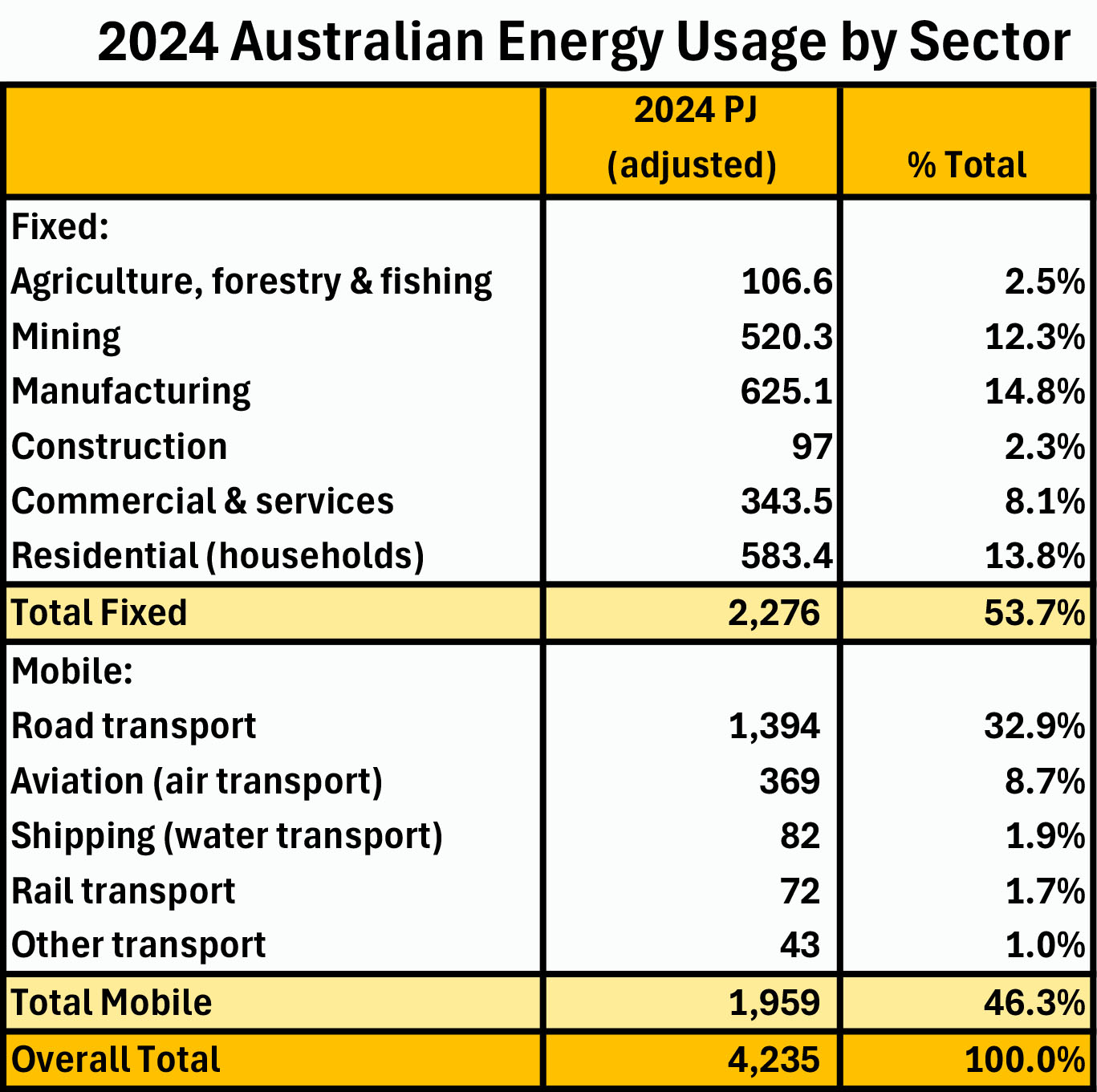
By my reckoning, Australia’s total energy consumption in 2023–24 was 4,235 PJ. That is expressed in final energy consumed by end users. I break that down into fixed and mobile. By fixed I mean households, buildings, industry, agriculture and mining. By mobile I mean transport: cars, trucks, planes, ships, trains. Keep in mind the separation is less than perfect as the ABS groups the off-road fleets that keep mines and farms running as part of those "fixed" industries.
-
Fixed usage 2,276 PJ
-
Mobile usage 1,959 PJ
-
Total energy usage 4,235 PJ
That’s the first punchline: nearly half our energy usage is for moving people and stuff (and that is an underestimate as it excludes haul trucks and tractors). Given the classification and tracking issues in statistics I think of it as a 50/50 split.
A further breakdown by sector is shown in the table below. The table uses an adjusted analytical framework which scales mobility energy to match the fuel accounting used later in the article. Official Australian final energy consumption in 2023-24 was 4,035 PJ (compared to my adjusted 4,235 PJ).
Fixed energy usage: where does the energy come from?
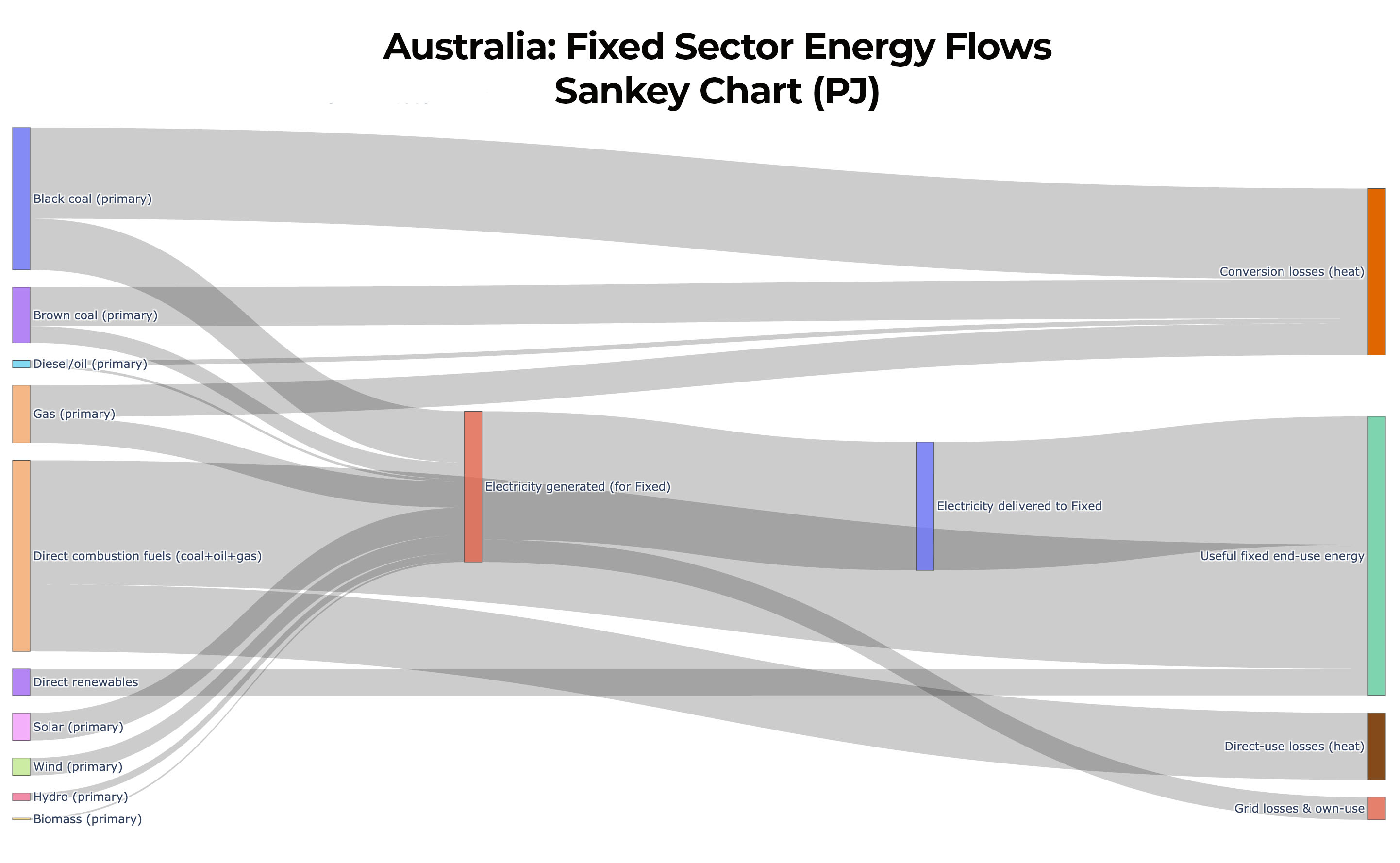
You'll have noticed that the table above doesn't include electricity generation. That is because electricity is an intermediate form of energy, not the end use.
Tracing through from the primary energy sources, via the electricity grid to end uses, and including fuels used directly, the "Fixed" sector looks like this. (It's called a Sankey chart btw, and is very cool). Only the green bar on the right is usable energy, the other bars are all losses of various types (entropy again).
While we are at it we can use this data to answer two key questions:
-
for our fixed sector what is the overall "fuel mix"?
-
are those fuels sourced domestically or imported?
The chart below shows the overall fuel mix (outer ring) and the split between domestic and imported sourcing (inner pie). Note that we have added a separate wedge for "own-consumed rooftop solar" to make this separately visible in this chart.
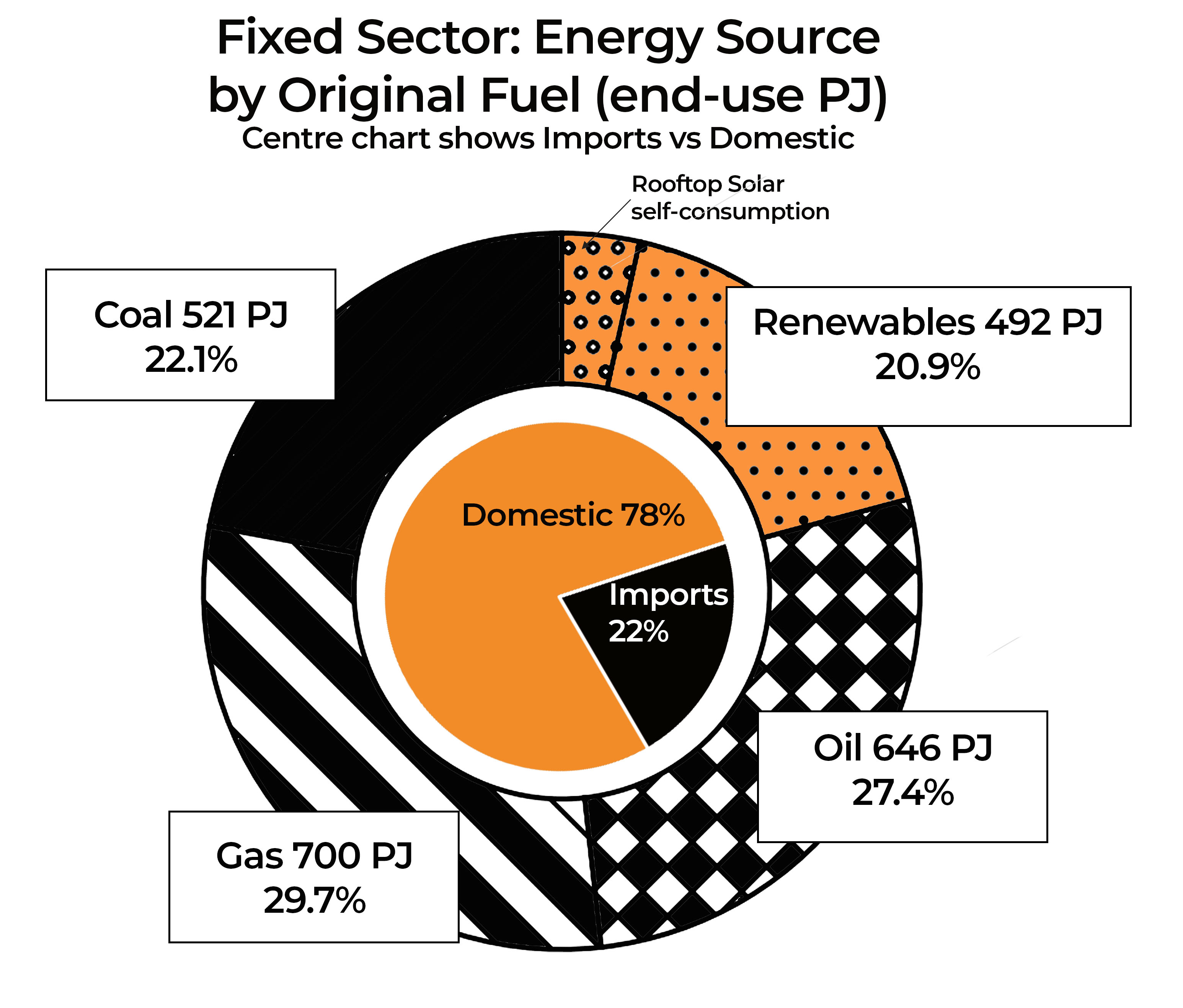
Effectively all of our coal, gas (and of course all our renewable energy) is sourced domestically. Oil and petroleum products is where we rely heavily on imports. Across the board around 79% of liquid hydrocarbons is imported. Because oil is only 27% of the fixed-sector energy mix, total import exposure is about 22%. Whatever we think of our coal and gas, they are not being shipped through the Strait of Hormuz.
Mobile energy usage: where does the energy come from?
The energy mix for mobile is very different. Our locomotion is overwhelmingly fuelled by liquid petroleum products, and around 79% of these are imported. Here is that cool Sankey chart again, this time for the Mobile sector of the economy.
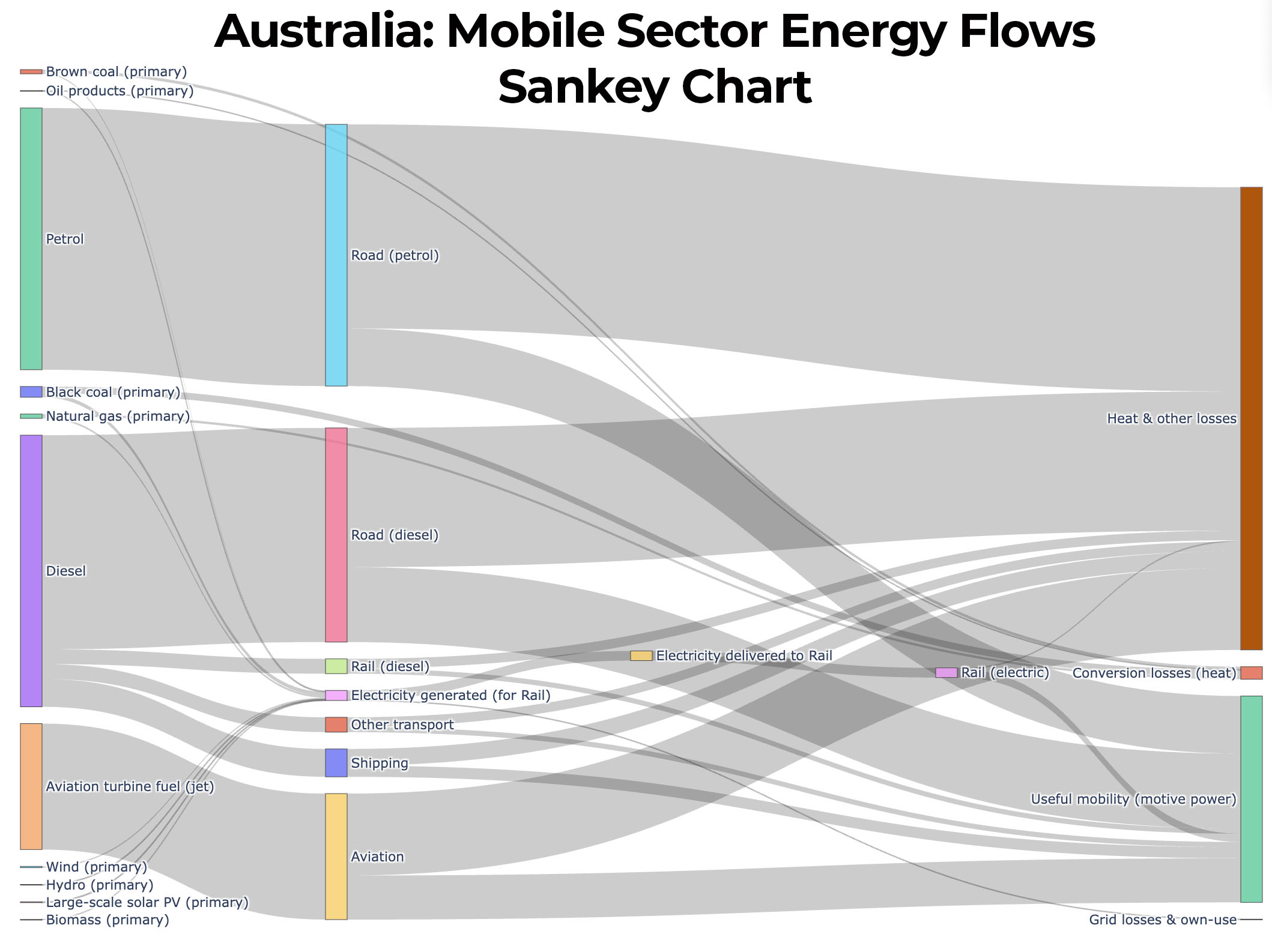
And here is that double pie chart showing fuel mix (outer ring) and imports vs domestic sources (inner pie chart). A tiny proportion of our mobile energy is from electricity and an even tinier proportion from renewables. A whopping 78% of our transportation energy is imported.
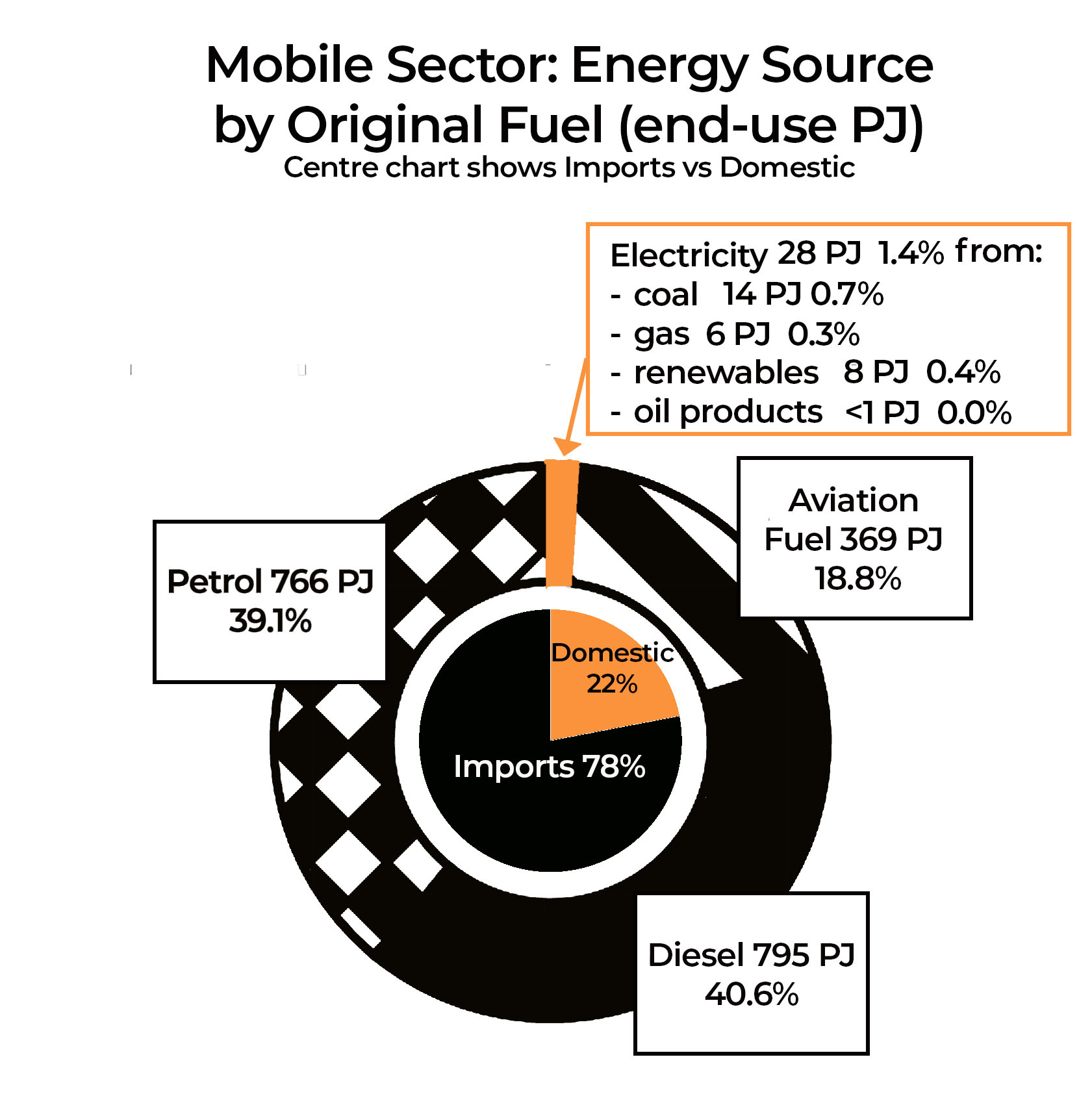
Overall energy self-sufficiency
If we put those two import vs domestic charts together in energy terms we can see what drives Australia's energy imports.
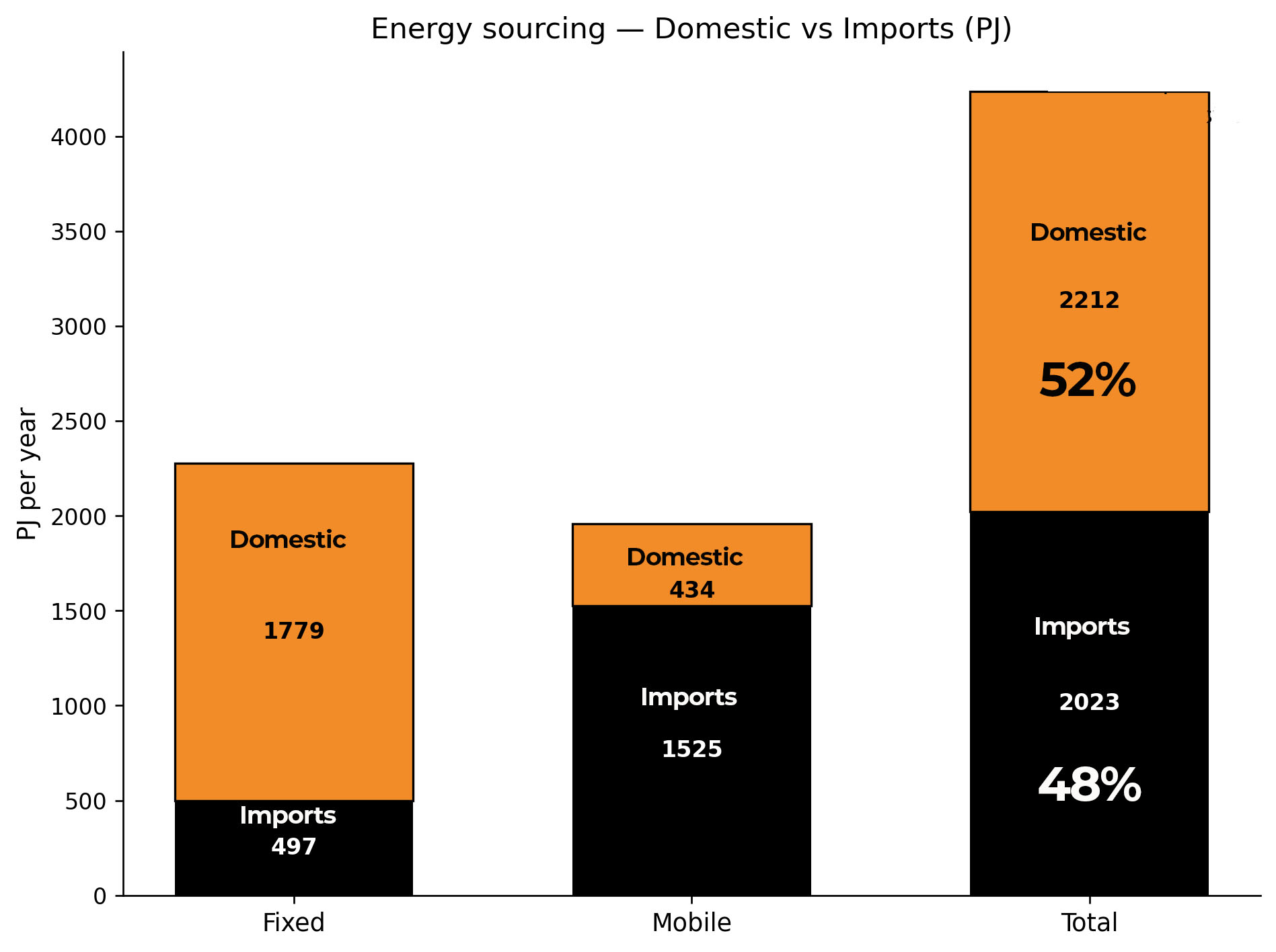
Our fixed-sector energy is mainly domestically sourced. Energy for transport is mainly imported. The energy that moves everything is the energy we mostly import. The total is dragged toward import exposure by the transport sector.
Some are asking: can Australia become self-sufficient in oil?
Maybe, at least partly: at a price.
But even if we could, it’s not obvious why we would want to. Oil self-sufficiency is a commitment to defending the old conversion loop:
extract hydrocarbons → transport them → burn them → convert heat into work
There is a new loop that is steadily eating the old one:
sunlight & wind → electricity → storage → consumption
This isn’t "climate religion". It’s thermodynamic and logistical realism. One system is a pipeline that must be kept fed. The other is a web that can be local, modular, and increasingly self-balancing.
Which one looks more like energy security to you?
The single most effective change we can make
Electrify the mobile fleet.
At the time of writing, EVs are still a small slice of Australia’s registered vehicles. Call it approaching 2% in early 2026 and you’re in the right ballpark.
Here’s the leverage: transport is ~1,759 PJ of final energy. If roughly 79% of the liquid fuel component is import-exposed, then Australia’s “import-vulnerable” energy is around 1,370 PJ per year. (That’s 0.79 × the liquid energy component of 1,731 PJ.)
Now the scenarios (illustrative, not a forecast):
If EVs rise toward 20% of the fleet, and that translates into something like ~15% of transport energy displaced, imports fall by roughly ~200 PJ/year (a 15% reduction).
If EVs rise toward 50%, and that translates into ~40% of transport energy displaced, imports fall by roughly ~550 PJ/year (a 40% reduction).
Two compounding benefits follow:
-
Your fuel stockpile lasts longer for the remaining combustion vehicles. Halve consumption and you roughly double “days of cover”.
-
The replacement energy is overwhelmingly domestic: whatever you think of the grid mix today, the operating energy for an EV is produced here, not shipped here.
Can the grid handle the extra charging load?
The “50% EV” scenario would require about 80 TWh per year, or roughly a 29% increase in Australia’s electricity production, to keep the fleet charged.
Feasible?
If all that extra energy came from solar panels, roughly doubling Australia’s current solar generation would do it. Most of our existing solar fleet is on our rooftops. Is there room for twice as much? Easily.
I haven’t modelled the economics yet, but at current solar panel prices, and given the reduction in oil imports, the economics are likely to be pretty impressive.
Aren’t we swapping Middle East dependence for China dependence?
For the EVs, which Australia currently imports predominantly from China, yes. That’s capital equipment supply chain risk. For the energy to operate the vehicles, no. That distinction matters.
An Internal Combustion Engine (ICE) car imports most of its operating energy continuously for its entire life. An EV imports a machine once, then runs mainly on local energy for a decade. And unlike crude supply chokepoints, vehicle supply can diversify: China makes great EVs, yes, but so does Korea, Japan, Europe, the US. The operating fuel for an ICE cannot diversify that way. It’s a global liquid market tied to chokepoints and geopolitics.
Our future security
The future doesn't arrive with speeches. It arrives in containers, standards, and invoices. And then it feels like it was always obvious.
Energy security isn’t a slogan. It’s a design choice.
Australia’s single biggest energy security upgrade is not another inquiry into energy stock holdings or a new round of hand-wringing about dependence. It’s the structural move that takes the supply valve out of someone else’s hands: Electrify mobility. Build the charging web.
Entropy doesn’t care what you believe. It only cares what you build.
New to this topic? See these Battling Entropy Primers to get you up to speed:
Get more like this
New analysis delivered to your inbox. No spam, unsubscribe anytime.
Take care, Tony
Disclosure: Battling Entropy is my independent commentary. The views expressed are my own and do not represent those of any organisation unless explicitly stated. This is not financial or investment advice.
I also have commercial interests in the energy technology field. I am working on a venture, Petajoule Capital, which is developing People-Powered Energy: one particular approach for the coordination of consumer-owned batteries, EVs and flexible demand. This article discusses issues relevant to that work.
Sources / Further Reading
Sources:
Appendix A — Data Sources, Adjustments and Calculation Methods - BE06 Appendix A
Australian Bureau of Statistics. (2023). Energy account, Australia, 2021–22 (Cat. No. 4604.0). Australian Bureau of Statistics. https://www.abs.gov.au/statistics/industry/energy/energy-account-australia
Bureau of Infrastructure and Transport Research Economics. (2024). Australian transport statistics yearbook 2024. Australian Government. https://www.bitre.gov.au/publications
Department of Climate Change, Energy, the Environment and Water. (2024). Australian energy update 2024. Australian Government. https://www.energy.gov.au/publications/australian-energy-update-2024
Department of Industry, Science and Resources. (2024). Resources and energy quarterly – June 2024. Australian Government. https://www.industry.gov.au/publications/resources-and-energy-quarterly
Department of Climate Change, Energy, the Environment and Water. (2024). Australian petroleum statistics. Australian Government. https://www.energy.gov.au/publications/australian-petroleum-statistics
International Energy Agency. (2023). Australia 2023 energy policy review. International Energy Agency. https://www.iea.org/reports/australia-2023
International Energy Agency. (2024). World energy balances 2024 edition. International Energy Agency. https://www.iea.org/data-and-statistics
International Renewable Energy Agency. (2023). Renewable power generation costs in 2023. IRENA. https://www.irena.org/publications
National Transport Commission. (2023). Electric vehicle uptake in Australia: Technical report. National Transport Commission. https://www.ntc.gov.au
U.S. Energy Information Administration. (2024). International energy statistics. U.S. Department of Energy. https://www.eia.gov/international
Further Reading:
Cherp, A., & Jewell, J. (2014). The concept of energy security: Beyond the four As. Energy Policy, 75, 415–421. https://doi.org/10.1016/j.enpol.2014.09.005
Smil, V. (2017). Energy and civilization: A history. MIT Press.
Smil, V. (2022). How the world really works: The science behind how we got here and where we’re going. Viking.
MacKay, D. J. C. (2009). Sustainable energy—Without the hot air. UIT Cambridge. https://www.withouthotair.com
Discussion
Loading comments...