
Free power at lunch and the democratisation of energy storage
Issue 11: Australia is awash with energy at noon—who gets to store it?
Victoria’s recently announced "free daytime power" plan may look like a consumer giveaway but in fact it is recognition of a market signal. It tells us that midday electricity is now so plentiful that it makes no sense to charge for it. Once that becomes explicit, the real question is not whether power should be free for three hours. It is who gets to store it.
A couple of weeks ago a headline in the Australian Financial Review caught my eye "Victoria to force retailers to offer free power during the day". This followed a Federal government announcement late last year mandating similar tariffs (the state government initiative will be more specific). I am not a fan of government-mandated pricing, particularly in complex markets like electricity involving wholesale markets, retail margins, transmission and distribution charges. But it spurred me into a deeper dive to examine what is going on here and what it means.
The policy starts on 1 October 2026, and what the Allan government has actually said is that retailers will be required to offer a discounted daytime tariff, with the exact time periods and prices to be released in May. So the formal design is narrower than the headline. If midday electricity is really to be “free” in any meaningful sense, the network layer has to cooperate too. At the moment, Victoria has only mandated a retailer offer. That leaves open the obvious question of distribution charges. The precedent to note here is that Victorian distributors have already shown that a zero daytime network usage charge is technically and commercially possible, at least in trial form. CitiPower, Powercor and United Energy’s Daytime Saver tariff has run with a 0.0 c/kWh usage rate from 10am to 3pm, while keeping the fixed cents-per-day charge in place. That is an important detail, because it shows that a “free midday” world can exist, but it is only coherent if the retail and network layers are aligned.
The system is admitting that midday electricity is now so plentiful that it can be given away. The Australian Energy Regulator’s latest market data reinforces this view. Spot prices in the middle of the day are falling, and increasingly becoming negative. The report notes that this shift has been driven by the now familiar pattern of rooftop solar reducing grid demand in the middle of the day as well as driving grid exports, while evening prices remain far more volatile and more likely to spike above $300/MWh (30c/kWh). This is not noise. It is the new shape of the market. A kilowatt-hour of electricity at noon is typically worth some tenths of a cent and often you need to pay someone to take it. In the evening that same kilowatt-hour is worth tens of cents: that's a 100X difference. The only practical way to bridge those two markets is energy storage.
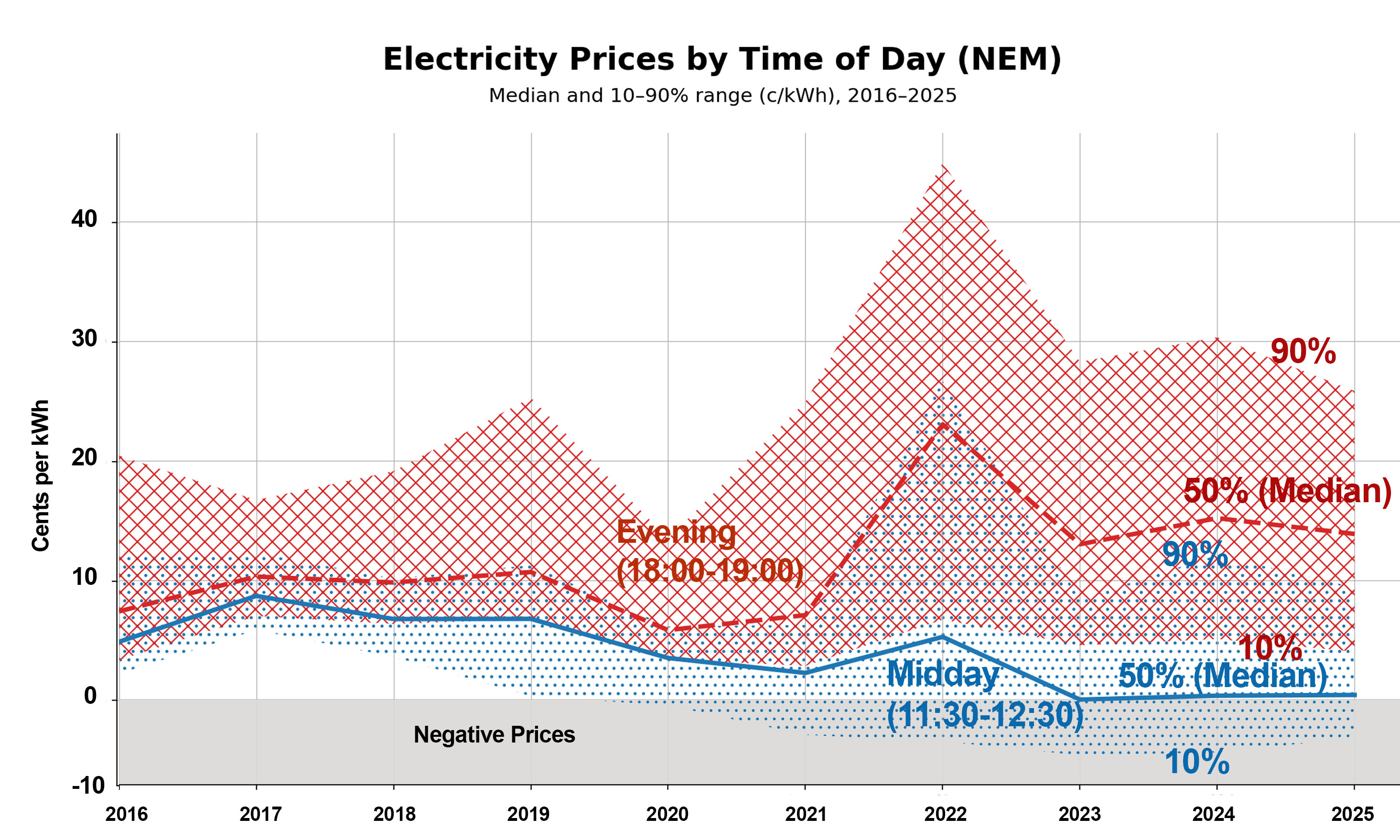
That chart shows 50th percentile prices for noon and evening electricity with 10% and 90% prices shown as shading. Rooftop solar has absolutely crushed the midday market price. In 2025, noon-hour prices were negative 48% of the time. With wholesale prices at these levels and distributors willing to offer zero distribution charges the question becomes not "will zero prices happen?" but "who benefits?".
The Victorian government says it will save families up to 300 dollars a year and up to 1070 dollars if they have solar panels and batteries. That split seems unfair. Free or near-free midday electricity is not especially transformative if the major benefit falls to detached homeowners with rooftop solar and a battery. It becomes much more interesting if it creates a path for people who were largely excluded from the first phase of the energy transition. To have rooftop solar, you generally need to own a suitable roof. That left out renters, apartment dwellers, and plenty of households without the capital or physical space to participate.
But, with a glut of rooftop solar, it is not the panels that is creating the value, it is the battery. If a battery can be charged in the middle of the day at zero cost and used to meet expensive evening demand it is the storage driving that 770 dollars a year difference in savings.
Australia is ideally placed for this because the underlying energy abundance is already here. The Clean Energy Regulator says Australia has the highest uptake of household solar in the world, while the Clean Energy Council reports that rooftop solar contributed 14.2% of electricity generated in Australia in the second half of 2025, with 28.3 GW of installed capacity, more than the country’s coal fleet. At the same time, battery adoption is accelerating fast. The Clean Energy Council says a record 183,245 batteries were sold in the second half of 2025 alone, and the federal government says the Cheaper Home Batteries Program is now expected to help over 2 million Australians install batteries by 2030. In other words, Australia has already pioneered mass adoption of rooftop solar and is now beginning to do the same with home batteries.
But how do we extend the benefits of batteries to renters and apartment-dwellers? Portable and plug-in battery products already exist as consumer electronics but they are small-scale (a few hundred watts maximum) and their output can't be connected through home wiring. What Australia lacks is a simple, safe, mainstream pathway for higher-powered portable storage that can interact meaningfully with household circuits and the grid. Once you move from a portable battery pack charging devices on a bench to a kilowatt-plus scale system charging from the grid and potentially serving household load, the regulatory and safety requirements become much stricter. Energy Safe Victoria is clear that battery energy storage systems must comply with installation standards, and that grid-connected inverter systems must pass an "anti-islanding test". That means they must disconnect from the grid in less than 2 seconds when the power is disconnected. That is essential for safety: if the grid goes down or the main switch is turned off, the battery must not keep energising the local wiring and send power back onto lines that workers believe are dead.
I envisage something like a 2–5 kWh plug-in unit that meets safety and anti-islanding requirements but doesn't need a full electrical installation process. The economic case for creating a safe and standardised pathway for this personal energy storage is compelling. If midday electricity is available at close to zero marginal cost, then even relatively modest storage can capture real value by shifting that energy into the evening peak. For households without roofs, this begins to look like the storage equivalent of what rooftop solar once did for owner-occupiers. It offers a way to participate in the economics of self-provision without first having to become a generator.
Europe is already inching in this direction, although for different reasons (urban density rather than a glut of daytime energy). In Germany, the VDE standards body has introduced the first product standard for plug-in solar devices, including clear technical requirements and new connection options through household sockets under defined safety conditions. That is mainly about “balcony solar”, but it is more significant than it looks. These systems plug directly into a standard household circuit via a microinverter, synchronising with the grid and injecting power into the same wiring that normally only draws from it. The effect is simple but powerful: local generation first offsets local demand, and only the surplus flows back through the meter to the wider grid. No rewiring, no dedicated connection point—just a reversal of flow within existing infrastructure.
That shift matters because it redefines the edge of the system. Instead of treating apartments and small consumers as passive endpoints, it turns them into active participants using the same circuits they already have. It also normalises the idea that energy can be produced, consumed, and exchanged at very small scales without heavy integration overhead. In other words, the grid is no longer something you connect to at a single point; it becomes something you interact with continuously from within.
Australia’s opportunity is potentially far larger because our problem is the sheer scale of midday surplus. Europe is exploring how to let more people plug into the energy transition. Australia has the chance to let way more people share its abundance.
This is where battery coordination becomes essential. A battery that charges cheaply at noon and discharges at 7pm is already useful to its owner. A fleet of batteries that can do that in a coordinated way is useful to the entire system. That is true for full-size household batteries, and it would be just as true for any new generation of personal energy storage. The point of coordination is not to confiscate customer value. It is to make the batteries more useful, more bankable and more system-relevant. A well-designed virtual power plant (VPP) program can help a battery fleet soak up excess midday energy, avoid pushing local feeders into stress, and then discharge into the evening peak when the value to both households and the grid is highest. One million isolated batteries will help the grid. One million batteries that can see and respond to actual network and market conditions will help much more.
There is a broader system reason to care. Midday abundance and evening scarcity are now two sides of the same problem. The more storage Australia deploys, the more of that cheap midday energy can be shifted into the evening when it is actually scarce and valuable. That reduces pressure on peaking plant and softens the evening ramp. Free midday energy travels over a grid which is relatively empty. By the evening, those wires are full. Building out the system to accommodate that evening peak must be paid for. That is the path we have been on, and consumers are feeling the pain. If we move that energy through the emptier midday grid to where it will be used in the evening, we optimise the system. Individual behaviour charging batteries at cheap noon prices and discharging in the expensive evening peak can transform the system as a whole. Adam Smith, take a bow.
So what should happen next? First, Victoria should publish the full tariff stack and be frank about whether “free” really means free, or merely discounted retail energy sitting on top of unchanged network charges. Simply, what will each kilowatt-hour cost the consumer? Second, regulators and safety bodies should begin thinking seriously about personal energy storage: a new standardised category between a portable consumer battery and a fully installed residential battery energy storage system. Third, battery coordination has to be part of the design from the beginning. A new class of smaller-scale storage products would be much more valuable if it could participate in trusted, auditable VPP-style coordination rather than just sitting as another isolated appliance in the home.
Germany is a useful precedent. Once the government simplified the rules and the standards system created a clear pathway for “plug-in solar”, balcony systems stopped looking like a hobbyist workaround and started looking like a retail product. IKEA now sells them in Germany, which tells you a lot: retail chains mostly supported the category once it was legitimised. Electricity retailers were generally neutral to mildly positive. The real friction came not from commerce, but from engineers, standards bodies and connection conservatives debating safety, plugs and power limits. That is encouraging for Australia because it suggests a way through. In some ways, an indoor, battery-only unit is a simpler proposition: it avoids outdoor electrical work, external mounting and weather exposure, and should be easier to standardise and certify than Germany’s balcony-mounted solar systems. If Germany, with its famously exacting standards, can get plug-in energy systems onto retail shelves, Australia should be able to do the same. And we have a far stronger reason to: managing our over-abundance of midday energy.
Australia has already shown the world what mass adoption of rooftop solar looks like, and it is now beginning to do the same with home batteries. Extending that logic to smaller-scale, portable battery storage would be the next step. It would bring renters, apartment dwellers and everyone left out of the rooftop-solar boom into the economics of energy storage. That would not just be another technology trend. It would complete the democratisation of energy.
New to this topic? See these Battling Entropy Primers to get you up to speed:
Get more like this
New analysis delivered to your inbox. No spam, unsubscribe anytime.
Take care, Tony
Disclosure: Battling Entropy is my independent commentary. The views expressed are my own and do not represent those of any organisation unless explicitly stated. This is not financial or investment advice.
I also have commercial interests in the energy technology field. I am working on a venture, Petajoule Capital, which is developing People-Powered Energy: one particular approach for the coordination of consumer-owned batteries, EVs and flexible demand. This article discusses issues relevant to that work.
Sources / Further Reading
AER (2025), State of the Energy Market 2025 – National Electricity Market chapter https://www.aer.gov.au/system/files/2025-08/State%20of%20the%20energy%20market%202025%20-%20Chapter%202%20-%20National%20Electricity%20Market.pdf
Victorian Government (2026), Three hours of free power every day https://www.premier.vic.gov.au/three-hours-free-power-every-day
Powercor (2022), Residential Daytime Saver trial tariff factsheet https://media.powercor.com.au/wp-content/uploads/2022/02/28084617/Residential-Daytime-Saver-Trial-Tariff-factsheet.pdf
AER (2024), Powercor tariff trial notification 2022–23 https://www.aer.gov.au/system/files/2024-03/Powercor%20-%20Tariff%20trial%20notification%20-%202022-23.pdf
Clean Energy Council (2026), Rooftop solar and storage report (July–December 2025) https://cleanenergycouncil.org.au/news-resources/rooftop-solar-and-storage-report-july-to-dec-2025
Clean Energy Regulator (2025), Rooftop solar installations data https://cer.gov.au/schemes/renewable-energy-target/small-scale-renewable-energy-scheme/small-scale-renewable-energy-systems/rooftop-solar
DCCEEW (2026), Cheaper Home Batteries Program https://www.dcceew.gov.au/energy/programs/cheaper-home-batteries
Energy Safe Victoria (2025), Solar for apartments – guidance https://www.energysafe.vic.gov.au/sites/default/files/2025-03/Guidance-%E2%80%93-Solar-for-Apartments-v1.0.pdf
ACCC (n.d.), Lithium-ion batteries safety guide https://www.productsafety.gov.au/consumers/be-safe-around-the-home/safely-use-batteries-and-technology/lithium-ion-batteries-guide
AEMO (2026), NEM dispatch price data (2016–2025), analysis by author
Discussion
Loading comments...