
Tesla Cybercab Wireless Charging Gamifies the Grid
Issue 07: Nikola's ghost, Elon's taxis, and the grid-entangled economics of autonomous EV fleets
Tesla's FCC-approved wireless Cybercab charging lets robotaxis arbitrage ERCOT's volatile nodal prices — turning idle charging into a grid asset.
Tesla’s Second Attempt at Wireless Power
Nikola Tesla spent the 1890s trying to push electricity through the air and deliver wireless power to the globe. He built coils at Colorado Springs. He designed and built a huge tower in New York, rather eerily named Wardenclyffe, to transmit power without wires. The physics was based on sound principles but they didn't scale. The business model didn't either.
Mr Tesla’s wireless vision was not fantasy. Inductive coupling is real physics. Two coils tuned to the same frequency can exchange energy across an air gap with respectable efficiency. That's how wireless phone chargers work, and it is the principle behind modern inductive EV pads. What failed was the leap from near-field resonance to global transmission. Once energy radiates freely into space, it spreads, attenuates, and dissipates. The Earth is not a lossless resonator. It is a resistive, heterogeneous medium. Power injected into it mostly becomes heat. The equations were not wrong. The losses were unforgiving.
Well over a century later, the idea returns in more prosaic form. The U.S. Federal Communications Commission (FCC) has granted Tesla Inc. a waiver allowing it to use ultra-wideband (UWB) radio technology in a wireless charging system for its upcoming Cybercab. A Tesla robotaxi that can dock itself over a ground pad and charge without a plug. The romance is a little less and the problem is different, but the business model may stack up better for Elon than for Nikola.
The recent FCC decision is not about charging
The recent FCC action is easy to misread. It is not a sweeping approval of wireless vehicle charging. It is permission for fixed outdoor ultra-wideband positioning infrastructure. In plain English: Tesla can now place short-range radios in charging pads so autonomous vehicles can reliably align themselves before charging begins.
Regulation rarely blesses a vision. It clears a bottleneck. This clears a real one. If autonomy is the product, charging cannot require a human. A robotaxi that needs someone to plug it in is not autonomous.
Alignment is the bottleneck
Inductive charging itself is not new. We have moved energy across air gaps for decades. But fleet charging is not phone charging.
A robotaxi fleet lives and dies on minutes. It needs predictable docking, predictable transfer, predictable uptime. Efficiency depends on alignment as does heat and failure rates. A human can plug in a cable while parked crooked. A robotaxi can't rely on that human. It must find the pad, centre itself, and repeat the process thousands of times in rain, dust, glare, and uneven pavement.
Wireless charging is not about convenience. It is about making charging a programmable state in the autonomy loop. That is what the FCC decision enables.
Austin is ERCOT. ERCOT is volatility
If, as seems likely, the first serious Cybercab geography is Austin, it sits inside the Texas wholesale electricity market ERCOT.
ERCOT dispatches on a five-minute engine and settles financially on a fifteen-minute cadence. Prices can collapse toward zero during renewable surges and spike dramatically during scarcity. Importantly, ERCOT is also nodal: it calculates prices at over 18,000 nodes every five minutes, reflecting the marginal cost of supplying power at each point on the Texas grid. Even within the Austin metro footprint (including Travis, Williamson, Hays, Caldwell and Bastrop counties) there are well over a thousand local pricing points reflecting congestion, losses, and constraint geometry. On an ordinary day these prices differ by only a few dollars per megawatt-hour. During scarcity or constraint events they can diverge by hundreds or even thousands of dollars. Here is Greater Austin on a high stress day 20 August 2023 at 7.45pm CT.
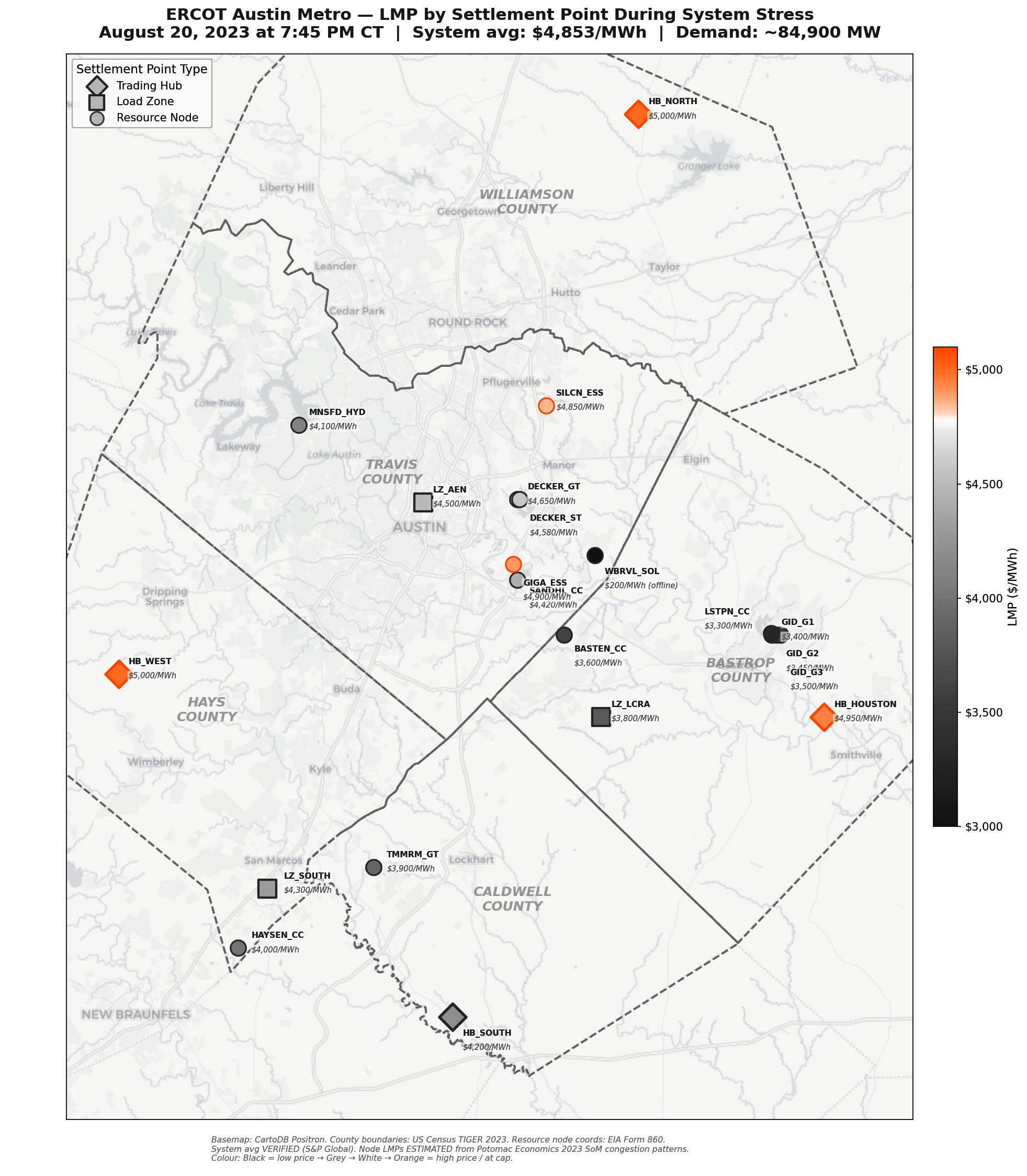
Only prices at major nodes are shown on the map: trading hubs, load zones and resource nodes. There are a lot more intermediate points than those shown, all with individual prices. ERCOT calculates prices at over 1,000 electricity bus nodes in the Austin area every 5 minutes. The difference in electricity price across Austin at this one point in time was US$1700/MWh, or $1.70 per kWh.
So, the Texas grid does not have one price. It has a texture. That texture matters if you can move. Taxis are not wires. But they move. It would be absurd to haul batteries around a city as a primary way of transporting electricity. Transmission lines exist for a reason. But robotaxis are already hauling batteries around for another reason. They are transporting passengers.
That is where the economics become interesting.
If charging is autonomous and dispatchable, and if Tesla structures its commercial relationships to expose its load to wholesale price signals rather than flat retail tariffs, then charging stops being refuelling. It becomes optimisation. The fleet controller is already solving for passenger demand, utilisation, deadheading, and positioning. Add an energy price term to that objective function. Suddenly geography matters.
You do not move cars to move electricity. You move cars to serve riders. But once they are moving anyway, you can bias where and when they charge.
That is not replacing transmission. It is extracting margin from volatility.
Tesla will not be a retail price-taker
For most electricity users this level of complexity would be hidden behind their electricity supplier. As the largest company headquartered in Texas, Tesla would face few structural barriers to becoming a Qualified Scheduling Entity (QSE) in ERCOT. A QSE is the legal and operational interface to the wholesale market. It submits schedules, receives dispatch instructions, manages imbalances, and settles financially. The barrier is not technological. It is institutional: credit, compliance, collateral, governance. Those are all easily manageable at Tesla’s scale.
Tesla already runs automated vehicle-to-grid (V2G) systems today. The Powershare Grid Support program for Cybertrucks in Texas shows the software and market integration are real. The robotaxi fleet would simply be that capability in constant motion, at massive scale, and wireless.
The deeper question is not access. It is risk. ERCOT is famous for volatility. Prices can be benign for weeks and then violent for hours. Can Tesla manage that exposure?
Volatility changes character when you are long storage
If you are a pure load, volatility is dangerous. If you are long generation, low prices can inflict the death of a thousand cuts. But if you are long storage and flexibility, volatility changes meaning.
Tesla has some powerful levers to convert volatility from a risk to an opportunity. It has fixed storage at its depots and mobile storage in its robotaxis (and EVs). It is great at power electronics, control hardware and real-time optimisation software. And now it has human-independent charging infrastructure.
You see where I'm heading: that portfolio reshapes volatility exposure. High prices are no longer a cost. They are an opportunity to discharge or defer charging. Low prices are no longer just luck. They are an opportunity to absorb energy and reposition.
In that configuration, wholesale volatility stops being purely a threat and becomes something to optimise around. Market dispersion becomes a stochastic revenue opportunity with bounded downside, provided duration limits and operational execution are respected. In plain English, you'll make much more money than you'll lose provided you don't step outside some knowable boundaries.
Flexibility converts price risk into operational and spread risk. It does not abolish risk. It shifts it into domains governed by software, duration, and execution — precisely the domains where Tesla’s integration of hardware and control systems gives it structural advantage.
The downside remains real
That posture only holds if execution is disciplined. Storage has limits. If scarcity lasts longer than fleet and depot duration, the hedge evaporates and load becomes exposed. If congestion appears where your assets are not, you cannot teleport batteries to the constrained node. If telemetry fails or dispatch instructions are missed, penalties apply. If too much storage enters the market, spreads compress and volatility declines.
Flexibility does not remove risk. It changes its shape. The question becomes not “what is the price?” but “how well can you execute against dispersion?”
What if power flows both ways?
The story sharpens further if wireless charging becomes wireless V2G. Tesla has already proven automated bidirectional capability in Texas: since February 2026, Cybertruck owners in select ERCOT markets can opt into the Powershare Grid Support program and automatically discharge their 123 kWh batteries back to the grid during high-price events, earning bill credits — all software-controlled, no human in the loop.
A robotaxi fleet would take this to fleet scale. If cars can both charge and discharge over wireless pads, the fleet is no longer just flexible load. It becomes true mobile storage. Energy flows both ways. A car can absorb power at one time and potentially release it later. The fleet becomes a distributed, self-positioning buffer.
In practice, bidirectional wireless transfer introduces higher engineering thresholds: protection schemes, anti-islanding safeguards, metering accuracy, certification, and round-trip efficiency constraints. Losses matter more when you are cycling for margin. But conceptually, the shift is profound. The fleet stops being a passive consumer of grid conditions. It becomes a dynamic participant in them. At small scale, a few hundred robotaxis, the impact on the grid is negligible — but a fleet of tens of thousands could make a real difference in grid stability and revenue terms, particularly in a crunch.
Nikola’s ghost
Nikola Tesla imagined free wireless energy. He failed because the physics hit limitations. Elon’s version is different. It is not about free energy. It is about programmable energy. The FCC did not approve a dream. It removed a friction point to its implementation.
Now the question is whether a fleet of autonomous taxis, sitting atop thousands of pricing nodes in a volatile nodal market, can turn software into an energy asset.
In ERCOT, prices move in space as well as in time and flexibility can pay very well.
If Tesla is as long storage and control as it appears, volatility is not the storm.
It is the wind.
New to this topic? See these Battling Entropy Primers to get you up to speed:
Get more like this
New analysis delivered to your inbox. No spam, unsubscribe anytime.
Take care, Tony
Disclosure: Battling Entropy is my independent commentary. The views expressed are my own and do not represent those of any organisation unless explicitly stated. This is not financial or investment advice.
I also have commercial interests in the energy technology field. I am working on a venture, Petajoule Capital, which is developing People-Powered Energy: one particular approach for the coordination of consumer-owned batteries, EVs and flexible demand. This article discusses issues relevant to that work.
Sources / Further Reading
CartoDB. (n.d.). Positron basemap tiles [Map tiles]. CARTO. Map tiles by CARTO, under CC BY 3.0; map data by OpenStreetMap contributors, under ODbL.
Electric Reliability Council of Texas. (2023). Settlement points list and electrical buses mapping (NP4-160-SG) [Data product]. https://www.ercot.com/
Electric Reliability Council of Texas. (2023). ERCOT nodal protocols. Section 6: Adjustment period and real-time operations. https://www.ercot.com/mktrules/nprotocols/current
Electric Reliability Council of Texas. (n.d.). Qualified Scheduling Entities (QSEs). Retrieved February 25, 2026, from https://www.ercot.com/services/rq/qse
Electric Reliability Council of Texas. (n.d.). Real-Time Market (RTM). Retrieved February 25, 2026, from https://www.ercot.com/mktinfo/rtm
Electric Reliability Council of Texas. (n.d.). Real-Time Market: System-wide price reporting (15-minute settlement interval posting). Retrieved February 25, 2026, from https://www.ercot.com/mktinfo/rtm
Electric Reliability Council of Texas. (n.d.). Market prices. Retrieved February 25, 2026, from https://www.ercot.com/mktinfo/prices
Electric Reliability Council of Texas. (n.d.). Settlement Point Prices at Resource Nodes, Hubs and Load Zones (NP6-905-CD). Retrieved February 25, 2026, from https://www.ercot.com/mp/data-products/data-product-details?id=NP6-905-CD
Federal Communications Commission. (2026). DA 26-168: Order granting waiver related to Tesla UWB positioning system for wireless charging (DA-26-168A1). https://docs.fcc.gov/public/attachments/DA-26-168A1.pdf
McCormick, P., & D’Amico, S. (n.d.). The Electric Slide: Electric Stack technology cost curves (1990–2024). Not Boring. Retrieved February 25, 2026, from https://electricslide.notboring.com/
McCormick, P. (n.d.). Not Boring (author archive and “The Electric Slide” essay listing). Substack. Retrieved February 25, 2026, from https://www.notboring.co/t/not-boring-world
Modo Energy. (n.d.). Qualified Scheduling Entities in ERCOT and ancillary services participation (explainer). Retrieved February 25, 2026, from https://modoenergy.com/research/en/ercot-ancillary-services-explainer
Modo Energy. (n.d.). How do power markets in Texas work? (ERCOT Energy Academy). Retrieved February 25, 2026, from https://modoenergy.com/research/en/ercot-energy-academy-power-markets-real-time-day-ahead-sced-ordc-qse-lse-ancillary-services-price-adders-system-lamdba-locational-marginal-prices
Potomac Economics. (2024, May). 2023 State of the Market report for the ERCOT electricity markets. Independent Market Monitor for ERCOT. https://www.potomaceconomics.com/document-library/
S&P Global Commodity Insights. (2023, August 21). Heat wave pushes Texas grid to near-record levels. S&P Global Market Intelligence.
Teslarati. (2026, February 19). Tesla wins FCC approval for wireless Cybercab charging system. https://www.teslarati.com/tesla-fcc-waiver-uwb-wireless-cybercab-charging/
U.S. Census Bureau. (2023). TIGER/Line shapefiles: County boundaries [Geospatial data]. https://www.census.gov/geographies/mapping-files/time-series/geo/tiger-line-file.html
U.S. Energy Information Administration. (2024). Form EIA-860: Annual electric generator report [Data set]. U.S. Department of Energy. https://www.eia.gov/electricity/data/eia860/
VIOTAS. (2023). ERCOT price cap analysis: August 2023 heat event. VIOTAS Energy Insights.
Discussion
Loading comments...