Battling Entropy Primer
VPPs explained — and why so few people join one
Primer #07: Battery aggregation, Virtual Power Plants (VPPS), dispatch rights, and where the value goes
Australia has plenty of home batteries but very little coordination. Traditional VPPs offer limited, opaque value and low participation. The missed opportunity is trusted, simple coordination that unlocks network savings and lowers electricity bills. "Old fashioned" integrated utilities in other markets use VPPs far more successfully to defer network build as well as trade on th emarket.
Australia has a lot of batteries.
In the space of a year, with the tailwind of an unusually inspired government program, our households have installed many gigawatt-hours of storage capacity. That should matter. A battery is not just a backup device or a way to store solar. In the right circumstances, it can support the grid, reduce costs, and behave like part of the system itself.
A virtual power plant, or VPP, is the idea that all of these small batteries — sitting in garages, on walls, and alongside rooftop solar — can be coordinated so they act together. But despite the scale of what has been installed, very little of it is actually working that way. To understand why, it helps to start from the beginning.
What is a VPP?
A virtual power plant is simply a group of small energy devices that are controlled together so they behave like a larger power station. Instead of one generator in one place, you have thousands of smaller assets spread across homes and businesses:
- batteries
- rooftop solar systems
- electric vehicles
- hot water systems
- pool pumps
- air conditioners
Individually, these devices are small. But if they are coordinated, they can act together — increasing or decreasing demand, storing energy, or supplying it back to the grid.
The key word is coordination. A VPP is not defined by the devices. It is defined by who controls them, and when.
What does a VPP actually do?
At its simplest, a VPP tries to use these distributed devices to make money or reduce costs by responding to the electricity system.
There are three main ways this happens.
- Buying low, selling high
Electricity prices change constantly. Sometimes power is cheap — for example, in the middle of the day when solar generation is high. Sometimes it is expensive — typically in the evening when demand rises and solar disappears. A battery can take advantage of this.
- Charge when electricity is cheap
- Discharge when electricity is expensive
This is called arbitrage. It is the most intuitive value stream in a VPP.
- Helping keep the system stable
The grid has to stay balanced at all times. If supply and demand drift apart, frequency moves and the system becomes unstable. Batteries are very good at responding quickly. A VPP can use them to inject or absorb energy in seconds to help stabilise the system. This is known as frequency control.
It is less visible than arbitrage, but sometimes more valuable.
- Reducing peaks
The grid is built for peaks — those short periods when demand is highest. If enough batteries discharge at the right time, they can reduce those peaks. That can lower wholesale prices and reduce the need for additional generation.
This is sometimes called capacity or peak demand value.
- The (largely missing) fourth value: reducing network investment
There is a fourth use for batteries that is less discussed in Australia but potentially even more important.
Electricity networks — the poles, wires, transformers and substations — are designed to handle peak demand in specific locations. When those local peaks grow, networks traditionally respond by upgrading infrastructure. That is expensive. And those costs are passed through to consumers. The Australian regulatory system locks in the capital cost of those upgrades as a consumer charge over the next 40 years.
But a battery sitting on the right street, discharging at the right time, can reduce that peak locally. If enough batteries on a feeder respond together, they can defer or even avoid network upgrades altogether.
This is called network flexibility.
It is one of the most valuable potential uses of distributed batteries. And, here in Australia, one of the least realised.
How VPPs actually work today
In practice, most VPPs operate through a simple arrangement.
A household agrees to let a provider — usually a retailer or aggregator — use part of their battery under certain conditions. In exchange, the household receives some payment or bill credit.
The provider then uses those batteries:
- to trade in wholesale markets
- to manage its own risk
- to participate in system services
From the household’s perspective, this is a trade:
some control → for some value
Why Australian VPPs are not widely trusted
On paper, this should be attractive. In reality, participation remains low. The reasons are not hard to understand.
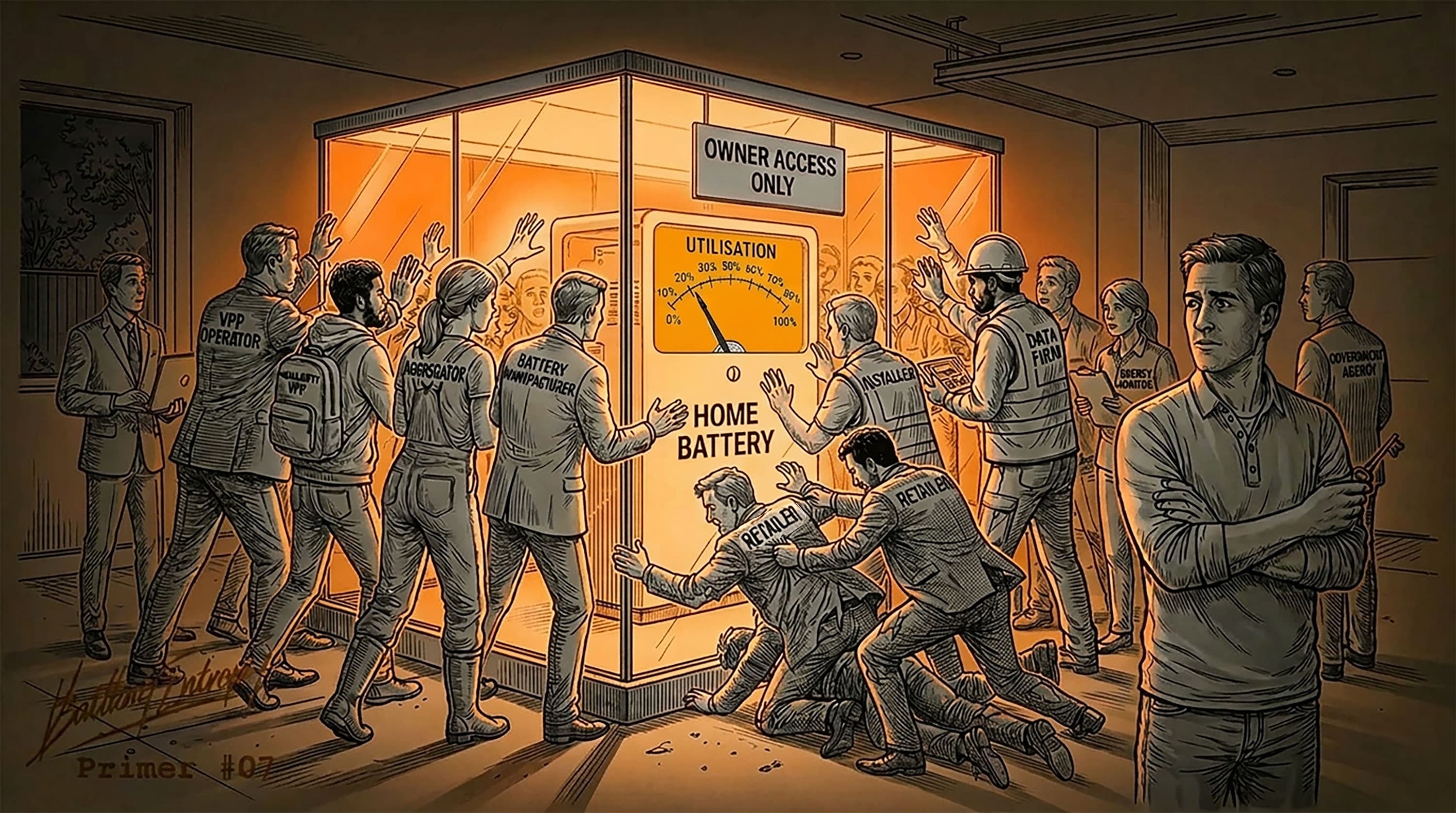
First, control is being traded away. People often install batteries to gain independence — to rely less on retailers, not more. A VPP asks them to give some of that control back.
Second, the value is unclear. The system value created by a battery is complex and often invisible. Households typically see a modest credit or payment, without a clear link to how that value was generated.
Third, the sharing of value looks decidedly unfair. Studies (including by the Australian consumer watchdog, the ACCC) show that only part of the value created flows back to households, with the rest retained by operators. In fact, the ACCC's said “The Australian Energy Market Commission found that, on average, virtual power plant operators pass through around 50% of the value they generate from consumer energy resources to customers” citing the Energeia report referenced below. In effect, VPP operators are saying "give me the use of your asset to make money and I'll give you half of the proceeds". No wonder battery owners aren't lining up to sign.
Fourth, the contracts are complicated. Rules about when a battery can be used, how much reserve is kept, and how payments are calculated are not always easy to understand or compare.
Taken together, this creates a simple outcome: the great majority of households with batteries are choosing not to participate in VPPs.
An exception
There is an important exception to this model. An electricity retailer called Amber Electric takes a different approach. Instead of taking control of the battery and offering a fixed reward, it exposes customers directly to wholesale electricity prices and uses software to automate battery operation around those prices.
This changes the relationship.
- The customer keeps control
- The value is more visible
- The upside is larger
But there is a trade-off.
Wholesale prices are volatile. Bills can vary. The system is less predictable.
Amber therefore works best for customers who are:
- engaged
- comfortable with variability
- willing to accept some risk
That is not most households. Amber shows that higher value is possible when transparency and control are preserved. But it also shows why that model has not yet become mainstream. Most people want simplicity. They don't want to feel like electricity traders.
Why the network value is still missing
Even where VPPs exist, they are rarely delivering the most valuable outcome: coordinated response at the local network level.
The problem is not the number of batteries. It is where they are, and who controls them.
As we discuss in The NEM 101, Australia’s electricity system is fragmented:
= retailers manage customers
- networks manage infrastructure
- aggregators manage subsets of devices
As a result, even if there are many batteries in total, there may not be enough coordinated batteries on a particular feeder (the wires that run down a street to deliver electricity) when they are needed.
This is why national scale is often locally irrelevant. A battery on the wrong street does not help.
The underlying problem
The issue with VPPs is not the concept. The concept is sound.
The issue is that:
- households do not fully trust the arrangements
- the value is not clearly visible
- control is fragmented across many parties
- coordination does not occur where it matters
The result is a system full of batteries that does not behave like one system when needed.
The takeaway
A virtual power plant is an attempt to turn many small devices into something that behaves like infrastructure.
Australia has already built much of the hardware for that system and it continues to be rolled out at a cracking pace. What is missing is:
- coordination
- transparency
- and, most importantly, trust
Until those exist, most batteries will continue to operate individually — even though, collectively, they could do much more.
Take care, Tony
Further reading
Australian Competition and Consumer Commission. (2025). Inquiry into the National Electricity Market: July 2025 report. ACCC. Australian Energy Market Commission. (2025). Energeia finds that CER flexibility could deliver $45B in benefits by 2050. AEMC. Energeia. (2025). Benefit analysis of load-flexibility from consumer energy resources: Final report. Prepared for the Australian Energy Market Commission. Amber Electric. (n.d.). Wholesale electricity prices: Save more with smart energy. Solar Choice. (2026). Amber Electric VPP review: How SmartShift works. AGL. (n.d.). Virtual Power Plant. AGL Energy. Origin Energy. (n.d.). Origin Loop virtual power plant. Origin Energy. Tesla. (n.d.). Tesla Energy Plan. Tesla Australia. NSW Government. (n.d.). Virtual Power Plant incentive. NSW Department of Climate Change, Energy, the Environment and Water. U.S. Department of Energy. (2023). Pathways to commercial liftoff: Virtual power plants. DOE. U.S. Department of Energy. (2025). Pathways to commercial liftoff: Virtual power plants — 2025 update. DOE. Australian Energy Council. (2025). Competition a key to VPP development: ACCC report.