Battling Entropy Primer
Network Charges and the RAB 101
Primer #12: How do the costs of transmission and distribution get paid and by who?
Network charges pay for the physical grid. "The RAB" is the regulated asset base - the value of the grid assets customers are paying for. When approved assets are added to the RAB, customers usually pay for them over decades through depreciation and an allowed return. That model is necessary for monopoly infrastructure, but dangerous if every problem becomes a building program.
Most people think their electricity bill is mainly about electricity.
That sounds obvious, but it is increasingly wrong.
One part of the bill is the energy itself: the electricity generated by coal, gas, hydro, wind, solar and batteries. This is the part that moves quickly. It spikes on hot evenings when demand is high, collapses at midday when rooftop solar floods the system, and sometimes even goes negative.
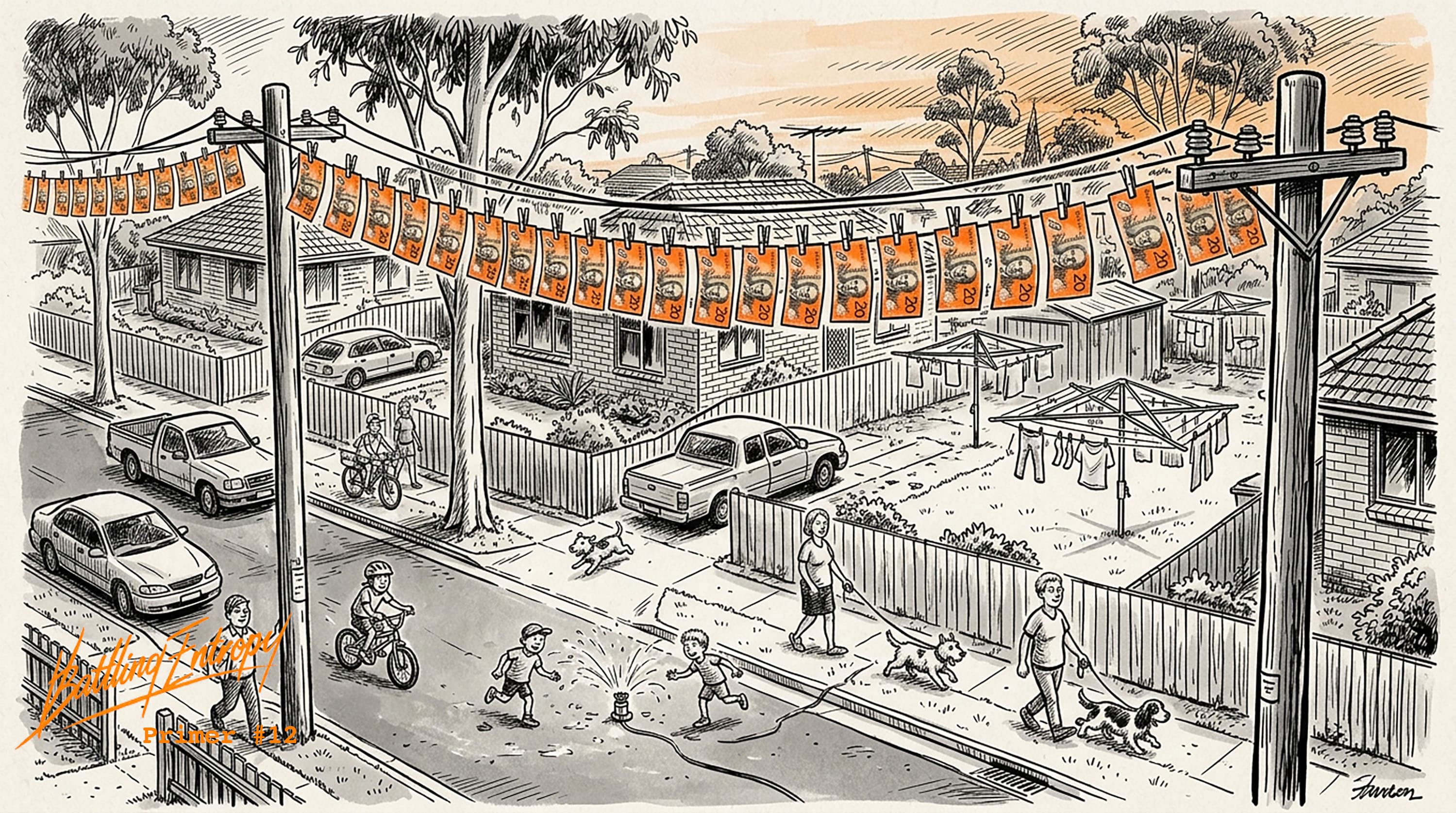
Another part of the bill is the network: the poles, wires, substations and transformers that move electricity from where it is produced to where it is used. This part moves slowly. It does not care very much whether wholesale prices were high last Thursday or negative last Sunday. Once the network has been built, customers pay for it over decades.
That is the first thing to understand about network charges. They are not the price of electricity. They are the price of having the electrical road available.
The two main network businesses
Electricity networks come in two broad layers.
Transmission networks are the big highways. They move electricity long distances at high voltage from large generators, renewable energy zones, interconnectors and storage projects toward major load centres. In Australia's National Electricity Market, transmission businesses are usually called TNSPs, or transmission network service providers.
Distribution networks are the local roads. They take electricity from the transmission grid and move it through suburbs, towns, industrial areas and rural lines to homes and businesses. These businesses are usually called DNSPs, or distribution network service providers.
Transmission is the high-voltage spine. Distribution is the street-level body.
Both are natural monopolies. It would make no sense to build five competing sets of power poles down the same suburban street. So instead of competing like normal businesses, network companies are regulated. They are allowed to recover efficient costs, plus an allowed return on capital, under rules overseen by the Australian Energy Regulator.
That regulatory bargain is the foundation of the network charge on your bill.
What is the RAB?
RAB stands for regulated asset base.
It is one of the most important and least understood pieces of electricity jargon.
The National Electricity Rules define the regulatory asset base for a distribution system as the value of the assets used by the distribution network service provider to provide standard control services. In plain English: it is the regulated value of the poles, wires, transformers, substations, control systems and other network assets that customers are paying for.
Think of the RAB as the electricity network’s mortgage book.
When a network business builds an approved asset, that asset is added to the RAB. Customers then pay for it over time. The network business is allowed to recover the cost of the asset through depreciation, and to earn an allowed return on the undepreciated value of the asset. The AER describes the RAB as a foundation for determining a network service provider’s revenue requirements, including return on capital and return of capital, or regulatory depreciation.
This is not in any way inherently sinister. It is how we finance long-lived monopoly infrastructure.
If a suburb needs a new substation, someone has to pay for it. If the asset will serve customers for forty years, it makes sense for customers to pay for it over time rather than all at once. A regulated asset base is the machinery that does that.
The problem is what happens when the machinery becomes too comfortable with building.
How network revenue is set
Every five years or so, the regulator assesses how much revenue each network business should be allowed to recover from customers.
The process is complicated, but the basic building blocks are simple.
The regulator allows revenue for:
- operating and maintenance costs
- depreciation of existing assets
- a regulated return on the asset base
- tax and incentive adjustments
- approved new investment
The network then recovers that allowed revenue through tariffs charged to retailers, who pass those costs through to customers.
This is why network costs can feel disconnected from wholesale electricity prices. If wholesale energy prices fall because there is lots of cheap solar and wind, the network still has to recover its allowed revenue. The wires were still built. The transformers are still there. The RAB still exists.
The Australian Energy Regulator’s 2025–26 approval of distribution network charges noted that network charges were mostly increasing, with drivers including the revenue path set in determinations, updates to the regulated rate of return and inflation.
That sentence sounds bureaucratic. It is also the entire point. Network charges are driven by regulated revenue mechanics, not just by the daily price of electricity.
The network charge is not one thing
When people talk about “network charges”, they often treat them as one blob. They are really a bundle of costs and price signals.
Some charges recover transmission costs. Some recover distribution costs. Some are fixed daily charges. Some are usage charges based on kilowatt-hours. Some are demand charges based on peak kilowatts. Some tariffs vary by time of day. Some are designed for households. Others are designed for large businesses.
This matters because different tariff structures create different incentives.
-
A flat per-kWh network tariff says: use less energy from the grid and pay less network cost.
-
A fixed daily network charge says: stay connected and pay, regardless of how much you use.
-
A demand charge says: your highest peak matters.
-
A time-of-use network tariff says: using the network at congested times costs more.
-
A dynamic network tariff says: the value of import or export changes with local network conditions.
None of these is perfect. A tariff that is economically efficient may be hard for households to understand. A tariff that is simple may send poor signals. A tariff that protects vulnerable customers may weaken incentives. A tariff that strongly rewards flexibility may mostly benefit people who can afford flexible assets.
Network pricing is hard because it is trying to do several things at once: recover sunk costs, signal future costs, protect customers, encourage efficient use and maintain political legitimacy.
That is a lot to ask of a bill.
Why network charges do not follow wholesale prices
The great promise of solar, wind and batteries is cheap energy.
That promise is real. When the sun is shining and the wind is blowing, the marginal cost of generating electricity can be extremely low. Wholesale prices can fall sharply. Sometimes they go negative.
But a future built only on cheap energy can still produce expensive bills if the network is not used intelligently.
If every household charges its EV at the same time in the evening, the network needs more capacity. If every rooftop solar system exports at the same time at midday, local voltage rises and feeders can hit export limits. If every local constraint is solved by thicker wires and larger transformers, the RAB grows.
What is a non-network solution?
A non-network solution is a way of solving a network problem without building traditional network infrastructure.
If a feeder is overloaded for a few dozen hours each year, the traditional answer might be to upgrade the feeder. But if batteries, flexible loads, EV chargers, hot-water systems or commercial demand response can reliably reduce the peak during those hours, the network upgrade may be deferred or avoided.
That is a non-network solution. The idea sounds obvious. In practice it is difficult. It is the subject of many Battling Entropy posts.
The simple version
Network charges pay for the physical grid.
The RAB is the regulated value of the grid assets customers are paying for.
When approved assets are added to the RAB, customers usually pay for them over decades through depreciation and an allowed return. That model is necessary for monopoly infrastructure, but dangerous if every problem becomes a building program.
The future electricity system will still need poles, wires and transformers.
The goal is not to stop building. The goal is to stop building by reflex.
Take care, Tony
Further reading
Australian Energy Regulator. (2025). AER approves 2025–26 network charges for electricity distributors.
Australian Energy Market Commission. (n.d.). National Electricity Rules, clause 6.5.1: Regulatory asset base.
Australian Energy Regulator. (2024). Draft decision attachment 2: Regulatory asset base, Directlink 2025–30 transmission revenue proposal.
Grattan Institute. (2018). Down to the wire: A sustainable electricity network for Australia.
Institute for Energy Economics and Financial Analysis. (2024). Reforming the economic regulation of Australian electricity distribution networks.