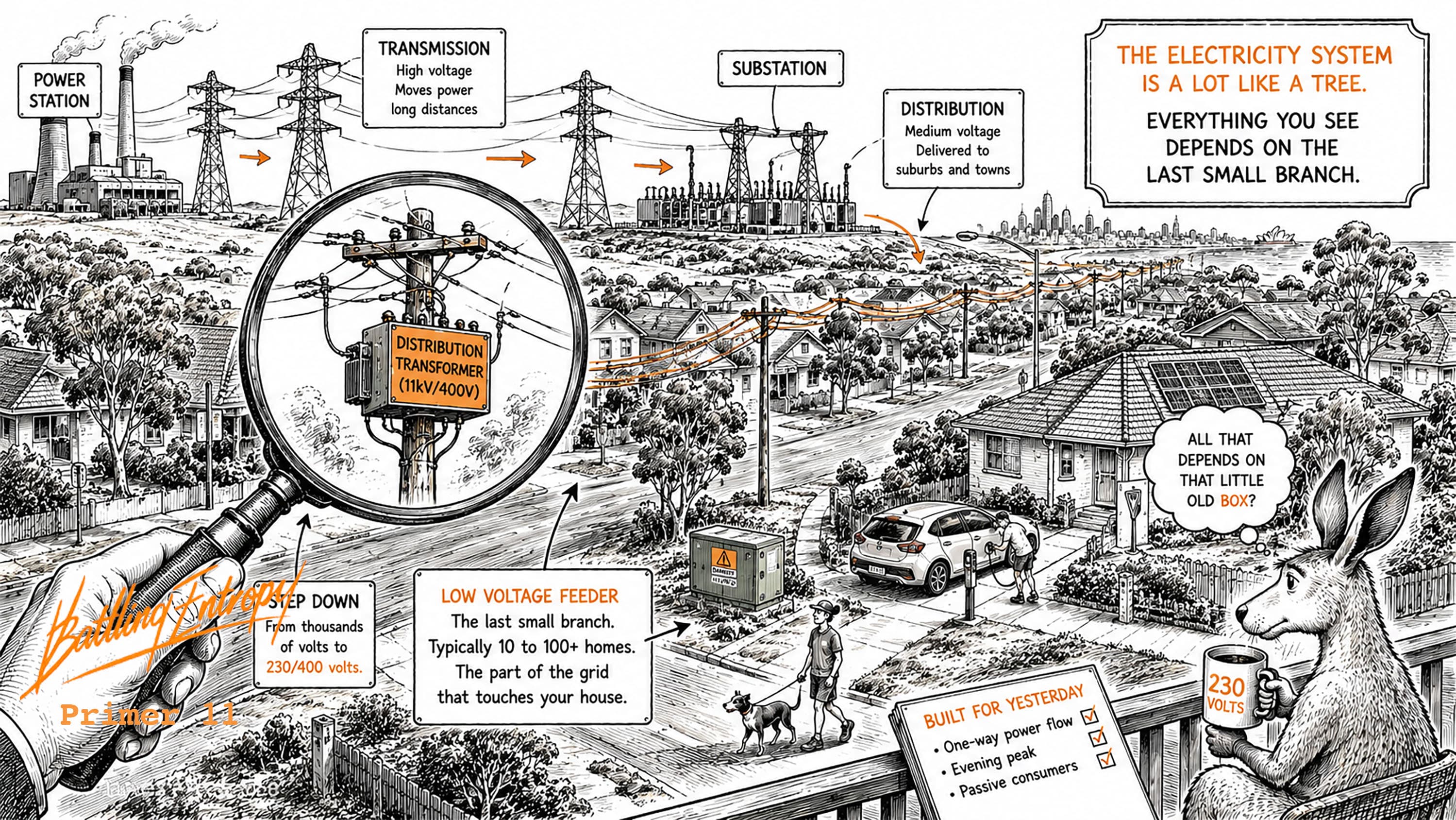
Battling Entropy Primer
What is a low voltage feeder?
Primer #11: The street-level part of our electricity grid, and why it matters even more today.
A low voltage feeder is the local street-level circuit that carries electricity between a distribution transformer and a group of customers — usually anything from a few homes to about a hundred — and it is becoming one of the most important stress points in Australia’s changing electricity system.
Most people think of the electricity grid as transmission towers, power stations and giant substations. Those things matter, of course, but they are not the part of the grid that actually touches your house. The part that reaches your home is much smaller and more local: the street circuit of wires or underground cables that runs from a nearby distribution transformer to the homes around it.
That street circuit is a low voltage feeder, also known as a local feeder, street feeder or low voltage network.
It is not glamorous. It is not usually visible in market reports. It is not where the National Electricity Market sets prices. But increasingly, it is where the real stress in the electricity system shows up first.
The last small branch of the grid
Electricity reaches homes in stages. Large generators and transmission lines move power across long distances. Distribution networks then carry it through suburbs, towns and rural areas at lower voltages. Somewhere near your street, a distribution transformer steps the voltage down again to the level used by ordinary homes and small businesses.
In Australia, that final supply is typically described as 230/400 volts: around 230 volts from one phase to neutral, and around 400 volts between phases in a three-phase supply. From the transformer, electricity flows along low voltage conductors to customer meters. That final circuit is the low voltage feeder.
In old suburbs, the feeder may be the familiar set of wires strung between poles along the street. In newer estates, it may be an underground cable running under the footpath. In rural areas, it may be a much thinner, longer spur serving only a small number of customers. However it is built, a low voltage feeder is the last small branch of the electricity system before electricity enters the home.
How many houses are on one?
There is no single answer, because a low voltage feeder is not a standard suburb-sized unit. It is a local engineering object, and its size depends on housing density, suburb age, whether the network is overhead or underground, transformer size, cable size, local air-conditioning load, solar uptake, and whether the customers are single houses, townhouses, apartments or small businesses.
As a rough Australian rule of thumb, a low voltage feeder is often a street-scale circuit. It may serve a handful of rural homes, a short street of 10–30 houses, several suburban streets with 50–100 homes, or, in dense urban and underground networks, more than 100 customer connections.
The important point is not the exact number. The important point is scale. A low voltage feeder is not “Sydney” or “Victoria” or even “Blacktown”. It is much smaller than that. It may be one side of one street. That is why feeder problems can be so local: one street can be overloaded or voltage-constrained while the next street is fine.
Above ground or underground?
Australia has both overhead and underground low voltage networks. Older suburbs and regional areas are often overhead, with wooden or concrete poles, crossarms, conductors, service lines and pole-top transformers. Newer suburbs are much more likely to be underground, with green pad-mounted transformers, underground cables and service pillars.
By line length, Australia’s distribution system is still mostly overhead. The AER’s 2025 State of the energy market reports that the electricity distribution networks it regulates had 764,095 km of distribution line length at 30 June 2024, of which 633,451 km was overhead and 130,644 km was underground. That is roughly 83% overhead and 17% underground by circuit length.
That national number needs careful interpretation. It is line length, not feeder connection count. Long rural networks add a lot of overhead kilometres. New urban subdivisions may be mostly underground even though Australia as a whole remains overhead by distance.
Still, the broad pattern is clear. Old suburbs are often overhead. New suburbs are often underground. Rural and regional networks are overwhelmingly overhead. CBDs and dense urban pockets are often underground or mixed.
Overhead networks are easier to see, easier to repair and generally cheaper to build. Underground networks are neater, less exposed to storms and falling branches, and often preferred in new developments, but they are more expensive and harder to dig up when capacity has to be upgraded.
Why they were built this way
The low voltage network was designed for a simpler world. Power flowed one way: from generator to transmission line, from transmission line to distribution network, from distribution transformer to house.
For most of the twentieth century, homes were passive consumers. They had lights, fridges, ovens, heaters, televisions and, later, air-conditioners. Network planners were mostly trying to answer one question: how much power will these houses need at the evening peak? Feeders were built to handle expected maximum demand, with safety margins, voltage limits and reliability standards.
The system was not designed around millions of small generators exporting electricity from rooftops. It was not designed for every second garage to contain an EV. It was not designed for entire streets to swing from exporting solar at lunchtime to charging vehicles at dinner.
The old assumption was passive demand. That assumption has broken.
What has changed?
Three things have changed at once.
First, rooftop solar has turned millions of homes into small generators. On sunny days, electricity can flow backwards from houses into the low voltage feeder. That can push voltage up, overload parts of the local network, or force solar inverters to reduce output.
Second, household electricity use is changing. Electric vehicles, induction cooking, heat pumps, pool pumps and larger air-conditioners can all increase local demand. The issue is not just total annual energy. It is when the load arrives. A few neighbours charging EVs at the same time can matter more to a feeder than thousands of kilowatt-hours spread gently across a month.
Third, the distribution system is becoming more dynamic. A feeder that was once boring can now experience midday solar export, evening demand spikes, voltage rise, voltage drop, phase imbalance, transformer loading, export limits and thermal constraints.
The AER describes the shift plainly: distribution networks have traditionally moved electricity one way to consumers, but rooftop solar and other consumer energy resources are creating two-way flows along the networks. It also notes that batteries are expected to grow as solar generation increasingly needs to be stored for later use.
That change is happening at the very bottom of the system: on feeders.
Why low voltage problems are so local
Wholesale electricity markets are regional. Distribution physics is local. A wholesale price in Australia applies across an entire state. A low voltage feeder may cover one street.
That mismatch matters because a feeder has physical limits. It can only carry so much current before conductors or transformers heat up. It must keep voltage inside an acceptable range. It must stay safe under fault conditions. It must remain manageable for protection equipment.
Those limits are local. A suburb can look fine on average while one feeder is struggling. A street with high rooftop solar can hit export limits before a nearby street does. A transformer serving homes with large air-conditioners and EV chargers can be stressed even if the wider zone substation is comfortable.
This is why “the grid” is a misleading phrase. There is no single grid problem. There are thousands of local grid problems. The low voltage feeder is where many of them begin.
Why upgrading them is expensive
A low voltage feeder sounds small, but upgrading one can be surprisingly hard. If the feeder is overhead, upgrading may mean new conductors, new poles, new transformers, changed clearances and planned outages. If it is underground, upgrading may mean trenching streets, digging up footpaths, navigating gas, water, telecoms and drainage assets, replacing cables, and restoring the road surface afterwards.
In both cases, the new assets last for decades. That is the economic sting. Once a network upgrade is built, it enters the regulated asset base. Customers then pay for it over time through network charges.
So the key question is not simply: can we build more network? Usually, yes. The better question is: are we sure this is the cheapest long-term way to solve a local, time-specific problem?
Sometimes the answer will be yes. Sometimes it will not.
The quiet importance of the feeder
The low voltage feeder used to be boring infrastructure. That was a compliment. It did its job quietly.
But the energy transition has moved down the voltage stack. The action is no longer only in coal stations, wind farms, big batteries and transmission lines. It is also in garages, rooftops, driveways and suburban streets.
That makes the feeder newly important. It is where household solar exports first meet network limits. It is where EV charging becomes a local peak. It is where voltage problems emerge before anyone notices them at system level. It is where the old one-way grid becomes a two-way grid.
A low voltage feeder is not the whole electricity system. But for your house, it is the part that matters most.
Take care, Tony
Further reading
Australian Energy Regulator. State of the energy market 2025 – Chapter 3: Electricity networks.
Australian Energy Market Operator. Fact sheet: Australia’s National Electricity Market.
Australian Energy Market Commission. Energy system explained.
Battling Entropy Primer #01: The NEM 101.
Battling Entropy Primer #08: What’s in a price?