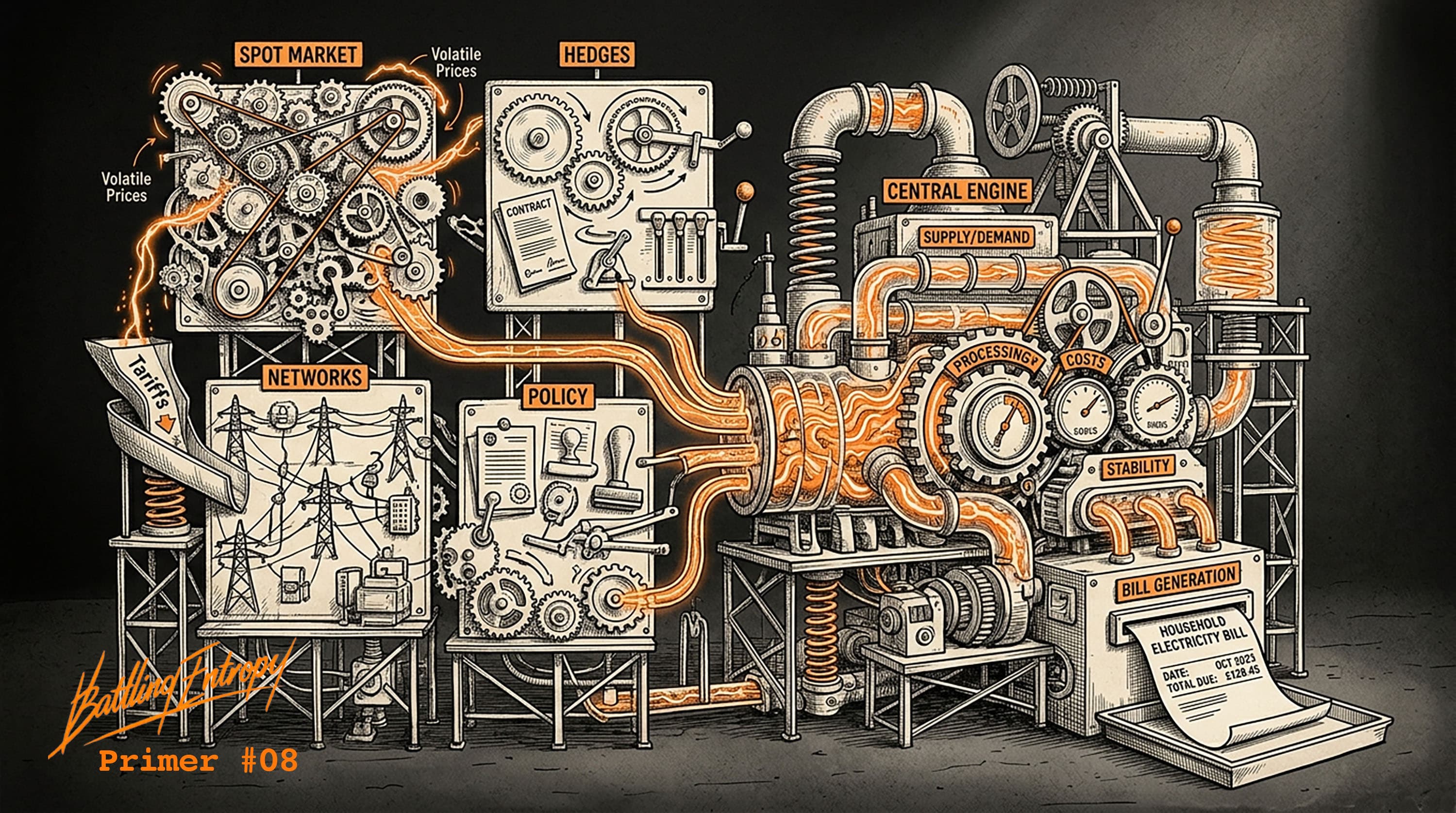
Battling Entropy Primer
What's in a price?
Primer #08: How electricity prices are set on the NEM and on your bill
Spot prices, forward contracts, price hedges, network charges, tariffs, and why your electricity bill is not just what the wholesale market charges.
Electricity prices look simple from the outside. You use power, your retailer sends a bill, and the bill has a few numbers on it: a daily supply charge, a usage rate, maybe a controlled-load rate, maybe a solar feed-in credit. It feels like electricity has a price in the same way petrol has a price — a single number that reflects what it costs.
It does not work like that.
An electricity bill is not a single price. It is the end product of several markets, regulated cost-recovery systems, risk-management decisions, policy schemes, forecasts, and retail packaging choices. The number on the bill is what arrives after all of those layers have been folded together. That is why wholesale prices can fall without bills falling immediately, why two neighbours can pay different prices for the same electricity, and why a household with solar and a battery can sometimes feel like it is playing a completely different game from a household without either.
This primer follows the price from the power station to the bill. The aim is not to explain every rule in the National Electricity Market, but to show how the main layers fit together.
In Primer #01 we introduced the cast of characters in the National Electricity Market — AEMO running the system, generators producing electricity, networks moving it, and retailers selling it to customers.
This primer picks up from there and asks a different question: how does all of that turn into a price?
The important thing to understand is that these players do not all get paid in the same way. Generators are exposed to the wholesale market. Networks recover regulated revenue through network charges. Retailers assemble costs and risks into tariffs. Consumers see the retail result. It helps to walk through that step by step.
We'll begin in the wholesale market.
The NEM is both a wholesale electricity market and a physical power system. The job of the wholesale market is deceptively simple: match supply and demand continuously.
Until very recently electricity was difficult to store at large scale, so generation and consumption have to remain in balance moment by moment. Too much generation is a problem. Too little generation is a problem. The system has to clear, physically and financially, all the time.
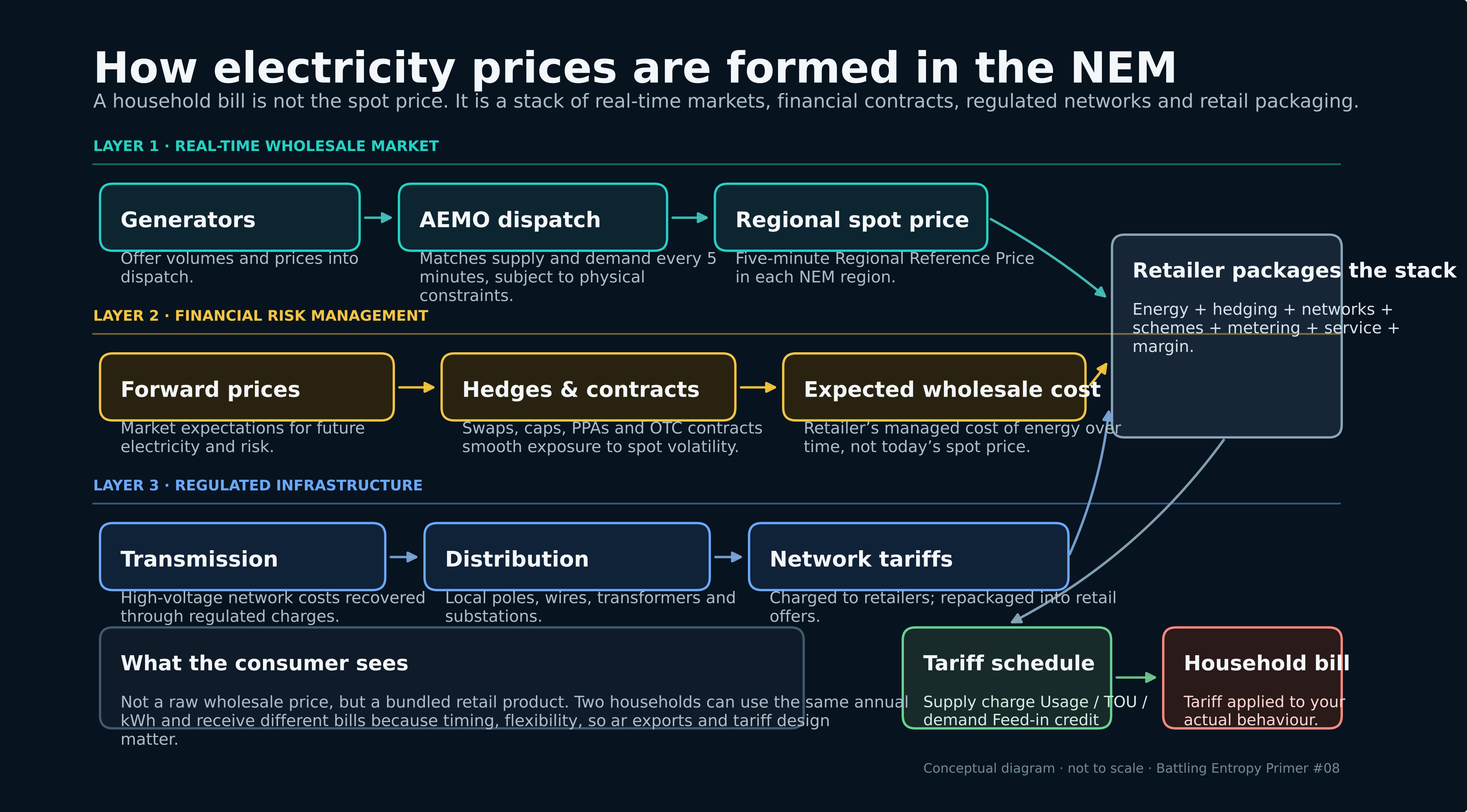
Generators submit offers to AEMO saying how much electricity they are willing to produce and at what price. AEMO’s dispatch systems then decide which generators should run, taking account not only of price but also of physical constraints: transmission limits, security requirements, interconnector flows, ramp rates, and other operational realities. AEMO describes this as a centrally coordinated dispatch process that pools generation, dispatches the required quantities of electricity, determines the spot price, measures electricity use and financially settles the market.
The wholesale price is not set once a day. It is formed every five minutes. Since the introduction of five-minute settlement, transactions in the NEM are calculated for each five-minute period, with AEMO publishing five-minute data and market participants submitting bids and offers in five-minute form.
That five-minute price is usually what people mean when they talk about the spot price. More precisely, each NEM region has a Regional Reference Price. There is not one national price for electricity. Queensland, New South Wales, Victoria, South Australia and Tasmania can all have different regional prices at the same time, because each region has different demand, generation, interconnector flows and constraints. AEMO’s live dashboard shows this in real time, with five-minute dispatch prices, demand, generation and interconnector flows by region.
The spot price is powerful because it is the market’s real-time signal. When demand is high, supply is tight or transmission is constrained, the spot price can rise sharply. When there is abundant solar, low demand or excess generation, it can fall very low, even below zero. Negative prices sound strange, but they simply mean that, at that moment, the system has more generation than it wants at that location and time, and some generators are willing to pay to stay online or keep producing.
But almost no ordinary household pays the raw five-minute spot price directly. Most people buy a retail product, not wholesale electricity. The retailer stands between the household and the wholesale market.
This is where forward prices and hedges enter the story.
The spot market is volatile. A retailer that simply bought all its electricity at spot prices and sold it to customers at fixed tariffs would be taking a large risk. If wholesale prices spiked and the retailer had not protected itself, it could lose a lot of money very quickly. Generators face the opposite problem. They may want certainty over future revenue so they can finance assets, plan maintenance and manage risk.
So retailers, generators and other market participants use contracts. These contracts do not usually change the physical flow of electricity. The electricity still flows through the spot market. The contracts change the parties' financial exposure to the spot price.
A simple hedge can be thought of as insurance against price volatility. A retailer and generator might agree on a fixed price for a future block of electricity. If the spot price ends up higher than that contract price, one side pays the difference. If it ends up lower, the other side pays. The generator still receives spot revenue through the market settlement process, and the retailer still pays spot costs, but the hedge changes the net financial result.
There are many forms of hedge: swaps, caps, options, power purchase agreements and over-the-counter contracts. Some are traded on exchanges such as the ASX. Others are negotiated bilaterally. The common purpose is to turn volatile spot exposure into something more manageable. The AEMC notes that NEM participants buy and sell almost all electricity through the wholesale spot market, while their financial relationships primarily arise from contracts used to hedge exposure to the spot price.
Forward prices are therefore not the same thing as spot prices. They are often confused, but they describe different things. A spot price is what electricity is worth in a region in a particular five-minute interval. A forward price is the price of risk over a future period. It reflects expectations about supply, demand, outages, fuel costs, weather, policy, storage, transmission, contract liquidity and the market’s appetite for risk. It is not a perfect forecast. It is a price for certainty.
This distinction matters because retail tariffs are usually based less on today’s spot price than on a retailer’s expected cost of serving customers over time. If wholesale prices fall this week, bills do not instantly fall, because retailers may already have bought hedges months or years ahead. If wholesale prices spike briefly, most households do not see that spike directly, because the retailer has packaged and smoothed the exposure. Retailers are not just selling energy; they are selling insulation from volatility.
Wholesale energy, however, is only one part of the bill. And yet this is where most explanations stop.
Electricity also has to move. Power stations connect to the transmission network, the transmission network connects to distribution networks, and distribution networks connect to homes and businesses. These networks are expensive, long-lived monopoly infrastructure. Customers cannot choose a different set of poles and wires in the way they can choose a retailer, so network revenues are regulated.
Every year, electricity distribution businesses submit pricing proposals to the AER. These proposals set out the network tariffs they intend to charge in order to recover their regulated revenues, transmission network charges and certain jurisdictional scheme costs. The AER checks these proposals against the National Electricity Rules and the distributor’s five-year revenue determination.
Those network charges are not usually billed directly to households by the network company. They are charged to retailers. The retailer then decides how to reflect them in retail offers. The AER is explicit about this: distribution network tariffs are charged to the retailer, and the final price charged to the end user depends on how the retailer responds to those network price signals and repackages them in its retail offer.
This is one of the most important hidden steps in the bill. The network may charge the retailer using a tariff that includes fixed charges, time-of-use charges, demand charges or export-related components. The retailer may pass those signals through fairly directly, or it may smooth them into a simpler flat tariff. The customer usually sees the retail packaging, not the underlying network tariff.
That packaging matters. A flat retail tariff hides the changing cost of using the network at different times. A time-of-use tariff reveals some of that variation. A demand tariff charges for peak usage. A controlled-load tariff offers cheaper electricity for appliances such as hot water that can be run at certain times. A solar feed-in tariff pays for exported electricity, though often at a much lower rate than the import tariff because exported midday solar is not the same product as firm evening supply.
A retailer assembling a tariff is therefore combining several cost layers. It needs to recover wholesale energy costs, hedging costs, network charges, environmental and jurisdictional scheme costs, metering costs, customer service costs, billing systems, bad debt, prudential requirements, regulatory compliance, acquisition costs and margin. It also has to decide how much risk to carry itself and how much to pass through to customers.
The resulting tariff schedule is essentially a translation exercise. A retailer takes a complicated stack of wholesale, network, policy and business costs and turns it into something a household can understand well enough to sign. That may be a simple flat rate, a time-of-use plan, a demand tariff, a wholesale pass-through product, a solar-and-battery plan, or a plan bundled with an EV charger or battery optimisation service.
The bill is then the tariff applied to behaviour.
A typical household bill includes a fixed daily supply charge and a variable usage charge. If the customer is on time-of-use pricing, usage is split into peak, shoulder and off-peak periods. If the customer has controlled load, hot water or another controlled appliance may be billed separately. If the customer has solar, exports appear as feed-in credits. If the customer is on a demand tariff, there may be a charge linked to the highest demand recorded during a period. Discounts, concessions, rebates and GST are then applied.
This is why two customers using the same annual amount of electricity can have different bills. One may use most electricity at peak times, while another uses it overnight. One may have solar exports, while another does not. One may have a battery reducing evening imports. One may be on an old flat tariff, another on a time-of-use tariff, and another on a wholesale pass-through product. The annual kilowatt-hours matter, but the shape of those kilowatt-hours increasingly matters more.
For consumers, the first lesson is that the retail bill is not the wholesale price. It is a bundled product. That product includes energy, networks, risk management, retail costs and policy costs. When people say “wholesale prices are down, why are bills still high?”, the answer is usually that wholesale prices are only one layer, retail tariffs lag spot markets, and other components — especially network costs — can move in the opposite direction.
The second lesson is that retailers are not all selling the same thing, even when they all sell “electricity”. A standard flat tariff sells simplicity and certainty. A time-of-use tariff sells some exposure to timing. A wholesale pass-through product sells much more exposure to the real market. A battery-optimised product sells automation and risk sharing. The right product depends not only on price but on how much attention, flexibility and risk a household is willing to take.
The third lesson is that flexibility is becoming valuable. If a household can shift consumption away from expensive periods, use solar locally, charge a battery when energy is cheap, or reduce demand when the local network is stressed, it can change its cost profile. This is not just about saving energy. It is about using energy at better times and, eventually, in better places.
The fourth lesson is more uncomfortable. The electricity system is moving from average pricing toward sharper signals, but consumers do not all have the same ability to respond. A homeowner with solar, a battery, an EV and smart controls can change their load shape. A renter in an inefficient apartment may have very little flexibility. If tariffs become more cost-reflective without care, they can reward households with flexible assets while leaving others more exposed.
That is the tension at the heart of electricity pricing. More accurate prices can make the system more efficient, but more complex prices can be harder to understand and less fair if people cannot respond. Simpler prices are easier to live with, but they can hide the real cost of peak demand and local network constraints. Retailers, regulators and policymakers are constantly balancing those goals, often imperfectly.
The final point connects this primer to the rest of the series. The NEM is very good at setting a wholesale price every five minutes for each region. It is much less good at showing the value of electricity at a particular street, feeder or transformer. Yet that is where more and more of the future problem lives. Rooftop solar, home batteries, EVs and electrified appliances operate in distribution networks, not just in the wholesale market.
So when a bill arrives, it is worth remembering what it represents. It is not simply the cost of electrons moving through the system. It is the price of generation, delivery, risk, regulation, policy and retail packaging, compressed into a few lines. The bill is where the whole system becomes personal.
And as the system becomes more distributed, more volatile and more flexible, the bill will increasingly reward not just how much electricity we use, but when we use it, how we manage it, and whether the market can see the value we create.
Take care, Tony
Further reading
Australian Energy Market Operator. National Electricity Market fact sheet. Australian Energy Market Operator. Dispatch information. Australian Energy Market Operator. What is 5-Minute Settlement? Australian Energy Market Commission. Spot and contract markets. Australian Energy Market Commission. Financial relationships in the National Electricity Market. Australian Energy Regulator. Annual network pricing. Australian Energy Regulator. Implementing tariff reform. Australian Energy Regulator. State of the energy market 2025.