Battling Entropy Primer
MW vs MWh (and why the difference matters)
Primer #04: The terminology critical to understanding electricity markets
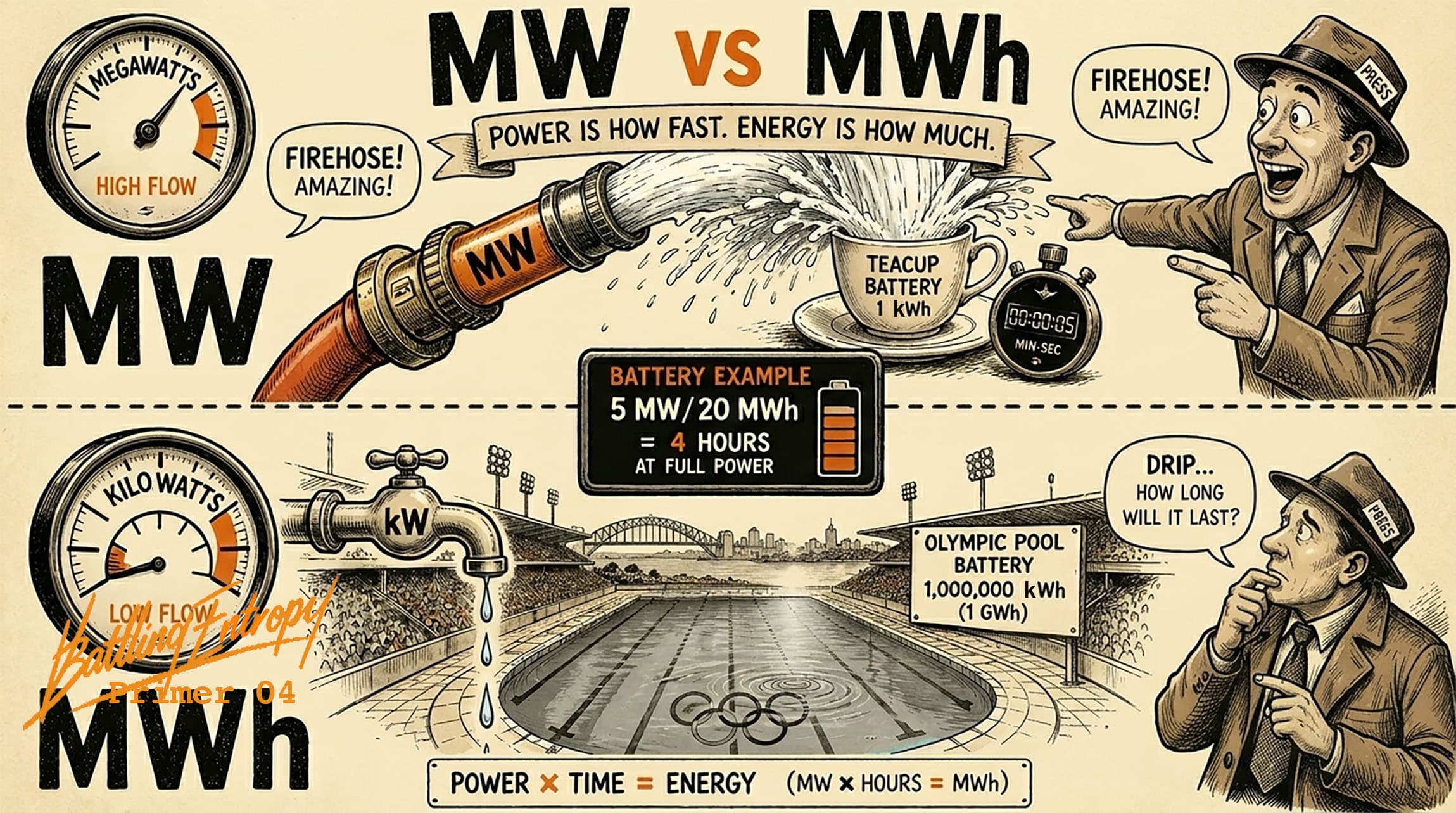
Megawatts (MW) measure power (the rate of energy flow) while Megawatt-hours (MWh) measures energy (the quantity). Think of power (MW) as the tap, energy (MWh) as the pool. Electricity generation is quoted in MW; bills are charged in MWh; batteries need both numbers because the ratio gives duration.
MW vs MWh: power, energy, and why the difference matters
MW measures power. MWh measures energy. A megawatt (MW) is a rate — how fast electricity is being delivered. A megawatt-hour (MWh) is a quantity — how much electricity has been delivered. Multiply MW by hours and you get MWh. The two are not interchangeable, and confusing them is the single most common error in energy reporting.
This primer explains what MW and MWh actually measure, how to convert between them, why batteries need both numbers, and how to spot the mistakes that change the meaning of a sentence by a factor of ten.
Quick answers
- What does MW stand for? Megawatt — a unit of power equal to one million watts.
- What does MWh stand for? Megawatt-hour — a unit of energy equal to one megawatt of power sustained for one hour, or 3.6 gigajoules.
- What is the difference between MW and MWh? MW is the rate of energy transfer (the "tap"). MWh is the total quantity of energy delivered (the "pool"). Power × time = energy.
- How do I convert MW to MWh? Multiply by the number of hours. A 5 MW generator running for 4 hours produces 5 × 4 = 20 MWh.
- Why are batteries described with two numbers (MW and MWh)? Power (MW) sets how fast a battery can charge or discharge. Energy (MWh) sets how much it can store. The ratio is the duration — a 100 MW / 400 MWh battery is a 4-hour battery.
- Is MWh the same as "MW per hour"? No. MWh means megawatt-hours (megawatts × hours). "MW per hour" would be a rate of change of power, which is a different concept entirely.
- What is a kWh in MWh? 1 MWh = 1,000 kWh. A typical Australian household uses around 15 kWh per day, or 0.015 MWh per day.
The simplest way to think about it
Imagine filling a swimming pool from a tap.
- The tap has a flow rate. Litres per second. That is power — how fast water arrives.
- The pool has a volume. Litres. That is energy — how much water is in it.
If you know the tap's flow rate and how long it has been running, you can multiply the two to get the volume in the pool. Five litres per second × ten seconds = fifty litres.
Electricity works the same way.
- Power is the rate at which energy is being transferred. Measured in watts (W), kilowatts (kW), megawatts (MW) and so on. Think of this as the size of the tap, or the flow rate of the water.
- Energy is the quantity of work that has been done. Measured in kilowatt-hours (kWh), megawatt-hours (MWh) and so on. This is the volume in the pool.
The relationship is identical to the plumbing example. Power × time = energy. A 5 kW solar panel running at full output for 1 hour delivers 5 kWh of energy. The same 5 kW panel running at full output for 4 hours delivers 20 kWh.
This is why a battery is described with two numbers, not one. A typical home Powerwall is "5 kW / 13.5 kWh". The 5 kW tells you how fast it can deliver energy (the tap). The 13.5 kWh tells you how much it holds (the pool). At full output, that battery will run for 13.5 ÷ 5 = 2.7 hours before it is empty. That ratio is sometimes called the duration of the battery, and it is a key design choice. A 5 kW / 20 kWh battery has the same tap but a bigger pool — it lasts four hours.
Joules and where they fit
Joules are the underlying SI unit of energy. One joule is a small amount of energy — roughly the work done in lifting a small apple one metre against gravity. The kilowatt-hour you see on your electricity bill is just a more convenient package of joules.
The conversion is exact:
- 1 watt = 1 joule per second
- 1 kilowatt-hour = 1,000 watts × 3,600 seconds = 3,600,000 joules = 3.6 megajoules (MJ)
So when your bill says you used 25 kWh today, you used 90 megajoules of energy. Either number is correct; kWh is just more commonly used (and easier to relate to appliances rated in kilowatts).
Engineers in some industries (notably gas, oil and heat) work natively in joules — petajoules in particular for national-scale energy budgets. Electrical engineers and the public almost always work in kWh and its multiples. Both are correct. Neither is more scientific than the other. Battling Entropy uses Joules when comparing different types of energy.
The SI prefix family
Knowing the prefixes lets you read any energy figure without converting in your head.
| Prefix | Symbol | Multiplier | Example |
|---|---|---|---|
| kilo | k | 10³ (thousand) | 5 kW = a small home solar system |
| mega | M | 10⁶ (million) | 100 MW = a large gas peaker |
| giga | G | 10⁹ (billion) | 35 GW = the entire NEM peak demand |
| tera | T | 10¹² (trillion) | 200 TWh = annual NEM electricity generation |
| peta | P | 10¹⁵ (quadrillion) | 6,200 PJ = total Australian primary energy consumption per year |
The same prefixes apply to both power (W) and energy (Wh or J).
A useful way to read figures: each step up is a thousand-fold jump. A gigawatt is a thousand megawatts is a million kilowatts. If a journalist talks about a "100 MW solar farm", that is the same scale of power output as one Snowy 2.0 turbine unit. If they talk about a "200 TWh of generation", that is the entire NEM's annual output.
A reference scale
Concrete examples make the units stick. These figures are typical of an Australian context in 2026:
| Asset | Power | Energy |
|---|---|---|
| LED light bulb | 10 W | — |
| Domestic kettle | 2.4 kW | — |
| Tesla Powerwall 3 | 11.5 kW | 13.5 kWh |
| Average household daily use | — | 15 kWh/day |
| Average household annual use | — | 5,500 kWh/year |
| Rooftop solar (typical) | 6.6 kW | (generates ~25 kWh on a sunny day) |
| Utility-scale solar farm (medium) | 100 MW | (generates ~250 MWh on a sunny day) |
| Hornsdale Power Reserve (SA battery) | 150 MW | 194 MWh |
| Waratah Super Battery (NSW) | 850 MW | 1,680 MWh |
| Eraring coal station (per unit) | 660 MW | (runs continuously) |
| Snowy 2.0 (under construction) | 2,200 MW | 350,000 MWh = 350 GWh |
| NEM peak demand (summer evening) | ~35 GW | — |
| NEM annual electricity generation | — | ~200 TWh |
| Australian total primary energy use (annual) | — | ~6,200 PJ |
Notice how, for non-storage assets like solar farms or coal stations, only the power matters in the headline figure (energy is whatever they happen to generate). For storage assets, both numbers matter, and the ratio between them tells you the duration.
Why batteries are described with two numbers
Most other generators are described with one number — the nameplate power. A 100 MW solar farm is a 100 MW solar farm. The energy it produces depends on the weather and the operator's dispatch decisions, but the rated capacity is one figure.
Batteries are different because they are storage devices, not energy sources. A battery has both a tap (how fast it can charge or discharge, in MW) and a pool (how much it can hold, in MWh). The two are independent design choices, set by the battery cells (energy) and the inverter (power). A developer can build the same MWh battery with different MW inverters depending on what role it is meant to play.
- 2-hour batteries (MW × 2 = MWh): optimised for fast frequency response and shallow daily cycling. Most early Australian utility batteries are in this class. Cheaper per MW.
- 4-hour batteries: the new standard, suited to evening peak shifting. Most committed batteries in the NEM 2024–2027 pipeline are 4-hour.
- 8-hour or longer: for multi-day storage. Lithium economics break down past about 8 hours, which is why pumped hydro becomes preferred at this duration (Snowy 2.0 is roughly a 175-hour duration project — 2,200 MW × 175 hours = 350 GWh).
When reading about a new battery project, look for both numbers. "A 100 MW battery" tells you the inverter size. "A 100 MW / 400 MWh battery" tells you it is a 4-hour system. The MWh figure is what determines how long it can carry the system through evening peak.
Why this matters for cost
Battery costs split into two largely independent components. The cells (and the racks that hold them, and the cooling, and the safety equipment) scale with energy capacity — they are priced per MWh. The inverters, transformers and grid-connection equipment scale with power capacity — they are priced per MW. Total project cost is roughly:
Total cost ≈ ($/MWh × MWh of energy) + ($/MW × MW of power) + fixed site costs
For lithium batteries in 2026, the per-MWh component dominates. Going from a 4-hour battery to an 8-hour battery almost doubles the total cost because you need twice the cells.
For pumped hydro, the maths is the opposite. The expensive part is the civil engineering — the tunnels, the dams, the underground power station. The pump-turbine units that determine MW are a relatively small share of total cost. Adding more energy capacity (a bigger upper reservoir) is cheap relative to adding more power capacity. This is why pumped hydro is uniquely well-suited to long-duration storage and lithium is uniquely well-suited to short-duration cycling.
Common reporting mistakes
A handful of recurring errors to look out for:
- Quoting MWh as if it were MW. "A 1 GWh battery" tells you nothing about how fast it can deliver power. Look for both numbers.
- Comparing energy to power. "The new battery is bigger than a coal station" comparing 800 MWh to 660 MW is comparing a bucket to the flow from a tap. They are different creatures.
- Confusing AC and DC ratings for solar. Rooftop solar is often quoted at the panel DC nameplate, which is 10–20 percent higher than the AC inverter output that actually flows to the grid. Both are valid figures but they answer different questions.
- Using kWh when MWh is meant (or vice versa). A factor-of-1,000 typo is easy to make and easy to miss.
A worked example
A news article describes a "200 MW battery" being installed in regional NSW.
What questions should you ask before interpreting that figure?
- What is the energy capacity in MWh? Without this, you do not know whether the battery can run for 30 minutes or 8 hours at full output.
- Is it 200 MW AC or DC? For batteries, AC is the relevant figure because that is what flows to the grid.
- What is the duration? MWh ÷ MW gives you the hours-at-full-output figure. A 200 MW / 400 MWh battery is 2-hour duration; a 200 MW / 1,600 MWh battery is 8-hour duration. They are very different system assets despite sharing the same headline number.
If the article does not answer questions 1 and 3, it has not actually told you what the battery does. Many articles do not. The journalist is not necessarily wrong; they may have been given an incomplete spec sheet. But you, as a reader, now know what is missing.
Take care, Tony
Further reading
Further reading
- AEMO. (n.d.). Energy explained. https://aemo.com.au/learn
- Bureau of International Weights and Measures. (2019). The International System of Units (SI), 9th edition. https://www.bipm.org/en/publications/si-brochure
- International Energy Agency. (2024). Battery Storage Technical Report. https://www.iea.org