Battling Entropy Primer
Snowy 2.0 (warts and all)
Primer #02: Australia's pumped-hydro long-term storage project
Snowy 2.0 is a 2,200 MW pumped hydro project under construction in NSW, storing 350 GWh — over 30 times the entire NEM grid-battery fleet. It has been a lot slower and more expensive than planned. It is the key critical path item for the renewable transition, was originally planned for completion in 2021 and is now due late 2028. Cost has gone from $2 billion (2017) to $12 billion-plus, with all-in lifecycle estimates near $42 billion.
Snowy 2.0: what it is, what it does, and why it matters
Snowy 2.0 is a pumped hydro project under construction in the Snowy Mountains in southern New South Wales. When it is finished it will be one of the largest pumped storage facilities in the world. It will also, on the most recent estimates, be one of the most expensive infrastructure projects in Australian history. This primer explains the engineering, the economics, the cost story, and why a single project still being built has become the calendar-mover for the entire National Electricity Market's transition out of coal.
What it is, physically
Snowy 2.0 connects two existing reservoirs in the Snowy Mountains Hydro-Electric Scheme. The upper reservoir is Tantangara at an elevation of about 1,229 metres above sea level. The lower reservoir is Talbingo at about 543 metres. The vertical drop between them, the so-called "head", is around 700 metres.
To turn that head into electricity, the project is constructing 27 kilometres of waterway tunnels and a vast underground power station 800 metres below the surface near Lobs Hole. The power station houses six reversible pump-turbine units of approximately 367 megawatts each, for a combined nameplate capacity of 2,200 MW.
When the system runs at full output, it can sustain that 2,200 MW for around 175 hours before the upper reservoir empties. That gives a usable energy storage capacity of roughly 350 GWh. To put that in context: the entire fleet of grid-scale lithium batteries operating in the National Electricity Market in early 2026 totals about 11.5 GWh of energy storage. Snowy 2.0 in a single project is more than 30 times larger.
The project does not generate "new" electricity. It is a battery. It pumps water from Talbingo to Tantangara when electricity is cheap and abundant (typically the middle of the day, when surplus solar drives wholesale prices down) and releases water back through the turbines to generate when electricity is expensive (typically the evening peak, and during multi-day weather events that knock out wind output).
Why it was built
Snowy 2.0 was announced by then Prime Minister Malcolm Turnbull in March 2017. The political context was the immediate aftermath of the September 2016 South Australian state-wide blackout, which had focused national attention on grid reliability and storage. The technical context was the looming retirement of Australia's coal fleet, which began with Hazelwood in 2017 and continues through the next decade.
Pumped hydro at Snowy 2.0's scale fills a specific gap. Lithium-ion batteries dominate the 1-to-4-hour storage range, and their economics are excellent for daily cycling. Beyond about 8 hours of duration, the economics break down: every additional kilowatt-hour of lithium storage requires another expensive kilowatt-hour of cells. Pumped hydro flips this. Adding more energy capacity means a bigger upper reservoir, which is mostly civil engineering at relatively low marginal cost. For multi-day, weather-driven storage requirements, pumped hydro is the cheapest mature technology available, and Snowy 2.0 is sized for exactly that role.
If commissioned on its current schedule, Snowy 2.0 will be the calendar-mover for the National Electricity Market's transition. AEMO's Step Change scenario in the Integrated System Plan assumes Snowy 2.0 is fully operational from 2028, providing the deep storage that allows the system to operate overnight from the previous day's wind and solar without coal. Without it, the structurally renewable grid date drifts toward 2040.
How pumped hydro works, briefly
Two reservoirs at different elevations are connected by waterway tunnels and a power station. When electricity is cheap, the system runs as a pump: it consumes power from the grid, lifts water from the lower reservoir to the upper one, and stores the energy as gravitational potential. When electricity is expensive, the system runs as a generator: water flows back down through the same machines (now operating as turbines), spins the generators, and feeds power to the grid.
Round-trip efficiency for modern pumped hydro is typically 75 to 80 percent. Twenty to 25 percent of the energy is lost to friction, heat, and the imperfect efficiency of the pump-turbine cycle. That sounds like a lot until you compare it to the alternatives — discarding the same energy entirely as curtailment when solar oversupplies the grid at noon, or running gas peakers in the evening at $200 per megawatt hour to make up a shortfall.
The asset life of a well-built pumped hydro scheme is exceptional. The original Snowy Mountains scheme opened in 1949 and is still in continuous operation 75 years later. Civil structures, tunnels, dams and concrete works typically have design lives of 100 years or more. The mechanical equipment (turbines, generators, transformers) is shorter-lived but readily replaceable. Snowy Hydro's official position is that Snowy 2.0 is designed for at least a 100-year operating life. Some defenders quote 150 to 175 years.
The cost story
This is where Snowy 2.0 becomes a different conversation. The project's cost has been revised upward roughly every two years since announcement.
| Date | Estimate | Source |
|---|---|---|
| March 2017 | ~$2 billion | Turnbull announcement |
| December 2017 | $3.8–4.5 billion | Snowy Hydro feasibility study |
| December 2018 | ~$5 billion | Final Investment Decision |
| August 2022 | ~$5.9 billion | Cost-and-schedule reset |
| September 2023 | $12 billion | Second cost-and-schedule reset |
| October 2025 | "will exceed $12 billion" | Snowy Hydro CEO confirmation |
| Q1 2026 | $12 billion already spent, project ~70% complete | S&P Global Ratings note |
Each of these is the headline construction cost only. They exclude two further large items.
Transmission. Snowy 2.0 is in a remote corner of the NSW grid. Getting its 2,200 MW out to load centres requires the HumeLink transmission project, plus upgrades to the Bannaby-to-Wollar corridor. The latest TransGrid estimate of HumeLink alone is $4.9 billion. Snowy Hydro's headline cost figure does not include transmission. Without HumeLink, Snowy 2.0 cannot dispatch its full output.
Interest. The Commonwealth has financed the project through Snowy Hydro Limited, with cost recovery through future market revenues. Interest accrues on the construction balance year by year. An independent analysis by the Victoria Energy Policy Centre in early 2026 estimated that, by the time the project is fully commissioned, accumulated interest charges will add roughly $8 billion.
The same VEPC analysis put the all-in cost — direct construction, transmission, and interest — at approximately $42 billion. Snowy Hydro disputes this number; the Commonwealth has not adopted it; but it is the most comprehensive published lifecycle estimate available, and most of its inputs are public record.
For comparison, the original 2017 estimate of $2 billion would have made Snowy 2.0 a moderately large infrastructure project. The current trajectory makes it one of the largest single capital outlays in Australian history.
The schedule story
Cost is the more politically visible story. Schedule is the more operationally consequential one.
The original target commissioning date was 2021. By early 2026 the target is partial generation by late 2027 and full operation by December 2028. The 2028 date is the seventh published completion target since the project was announced. Each preceding target has slipped by two to three years.
The implications matter. AEMO's Step Change scenario, the Capacity Investment Scheme's renewable energy build-out, and the orderly retirement of NSW coal generators (Eraring in August 2027, Bayswater and Liddell to follow) are all pinned to Snowy 2.0 being available from 2028. Each year of further slippage forces AEMO to procure additional firming from somewhere — either by extending coal life, building gas, contracting more grid-scale batteries, or accepting higher reliability risk during peak winter and summer evenings.
What went wrong
Three things went wrong, and they compound.
The first is geology. Snowy Hydro spent roughly $53 million on geotechnical surveys before construction began. This is a substantial sum but, in retrospect, inadequate for a 27-kilometre tunnelling job through Alpine terrain. The fault zones encountered during excavation have proved more complex than the surveys indicated. In particular, the boundary between weak weathered material near the surface and competent rock at depth has shifted in unexpected places.
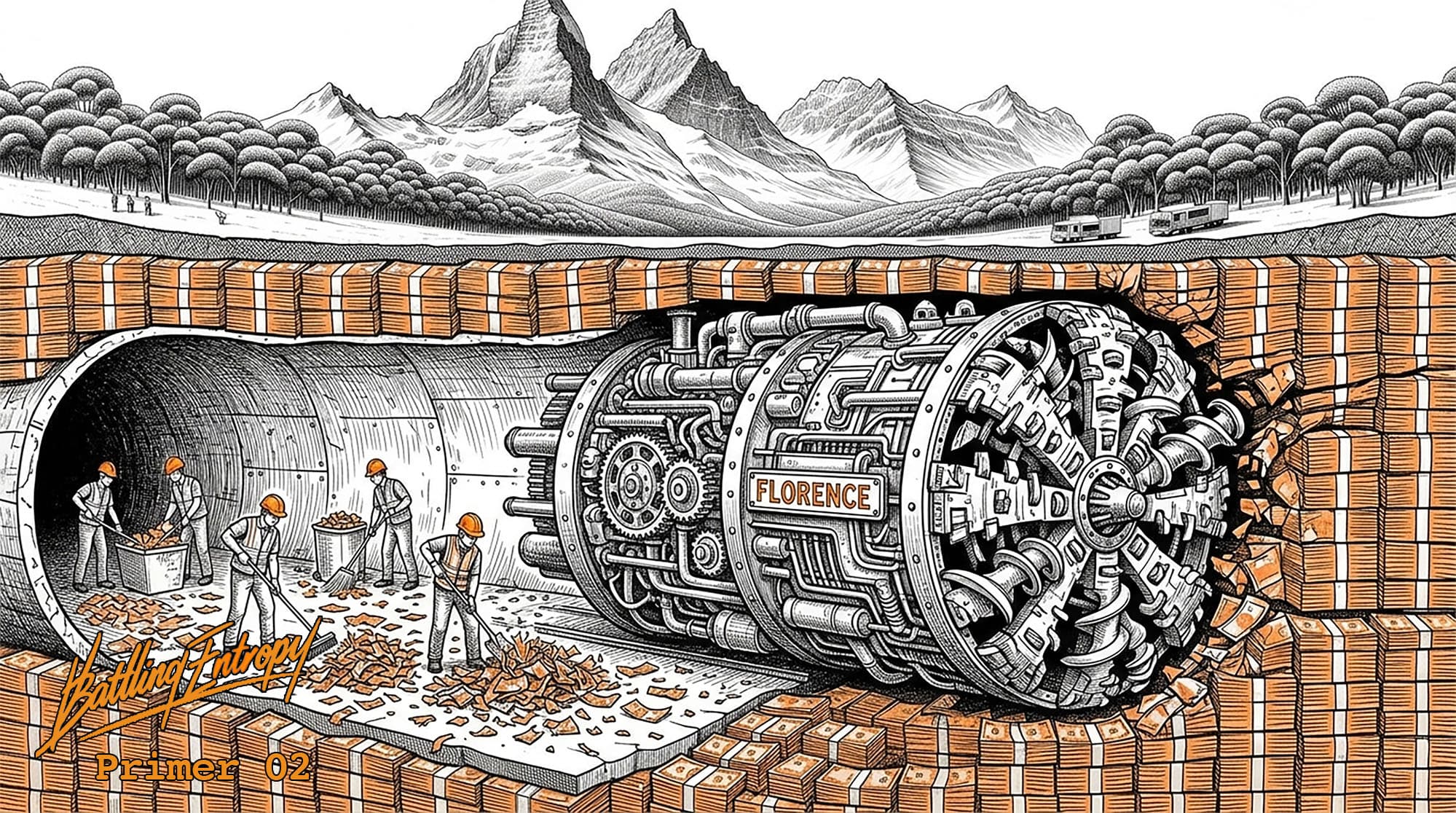
The second is the tunnel boring machine "Florence". Florence is one of four TBMs working on Snowy 2.0. She was originally specified for the deeper, harder rock conditions she would encounter at depth. In early 2022, near the start of her run, she hit unexpectedly soft, weathered ground at the entry portal. Florence was bogged for over a year while engineers stabilised the ground around her, drilled probe holes ahead of the cutter head, grouted weak zones, and converted the machine to closed-mode pressurised excavation. Then, in 2024, having emerged from the soft ground, she encountered fault zones in hard rock that were more abrasive and complex than expected. Direct construction overruns from Florence's troubles alone have been estimated at around $150 million. Indirect costs — schedule slippage compounding across four TBMs and contractors operating in parallel — are much larger.
The third is governance. Snowy 2.0 is a 100 percent Commonwealth-owned company with a board appointed by ministers. The project has run with relatively limited external oversight compared to similarly large public-sector projects in other jurisdictions. There has been no equivalent of the National Audit Office reviews that scrutinise UK megaprojects in detail, no Productivity Commission deep-dive of comparable depth, and the published evidence base behind successive cost resets has been thin. The Australian National Audit Office has reviewed the program and found areas of concern but has not had Snowy Hydro Limited's full books on which to render a complete judgement.
A "line-by-line funding reassessment" was scheduled by Snowy Hydro's CEO to conclude in the first half of 2026. The result of that reassessment, when it lands, will reveal whether the $12 billion construction figure is still defensible or whether a further reset is required.
The defenders' case
Critics tend to win the headlines. The defenders' case rests on three points and is harder to summarise but worth articulating.
Asset life and amortisation. If Snowy 2.0 operates for 100 years (the design basis), its construction cost amortises over roughly 35,000 days of operation. At a generous all-in cost of $20 billion, that is around $570,000 per operating day, or $260 per megawatt-hour for a typical 2,200 MWh discharge. Comparable to peaking gas at scale, and embedded into the system for a century. Lithium batteries last 12 to 15 years before requiring replacement.
Scale. The 350 GWh of storage in Snowy 2.0 would require approximately 90 individual 4-hour battery installations the size of the Waratah Super Battery to match in energy terms. The land footprint, the supply-chain demand on critical minerals, and the project-management overhead of building 90 separate utility batteries is non-trivial. Snowy 2.0 delivers the same energy storage in one site.
The duration the lithium fleet cannot reach. Lithium batteries dominate the daily cycling market. Pumped hydro is in a different operating class. Snowy 2.0 is sized for 175 hours of continuous discharge. That covers multi-day "wind drought" events when wind output collapses across the south-east for several days at a time. Lithium batteries cannot economically cover those events; gas peakers can, but only by burning fuel and emitting CO₂.
The defenders are correct that, if Snowy 2.0 commissions in 2028 and operates for a century, the project's economics over that lifetime are likely to be acceptable. They are also correct that no other technology fills the same role at the same scale.
The critics' case
The critics' case rests on three different points.
The cost trajectory has wiped out the economic case as built. At $5 billion, Snowy 2.0 was the cheapest large-scale storage option available. At $12 billion (construction only) or $42 billion (all-in), it is not. The Victoria Energy Policy Centre and other analysts have argued that an equivalent combination of utility-scale lithium storage plus existing Tasmanian pumped hydro (Battery of the Nation) could deliver similar system value at a lower total cost.
The geology and project-management risks are not yet fully priced in. Snowy 2.0 is roughly 70 percent complete on cost as of early 2026 but the remaining 30 percent includes the most technically demanding tunnel sections, the underground power station fit-out, and commissioning. The probability of further cost reset is high, not low.
The transmission story is genuinely additional. Without HumeLink, Snowy 2.0 cannot dispatch full output. HumeLink is a separate $4.9 billion project that also faces community opposition and consenting risk. Even assuming Snowy 2.0 commissions on time at $12 billion, the system-level cost of getting its output to load includes another $5 billion of transmission spend that does not appear on Snowy Hydro's headline number.
The critics are correct that the project would not be approved today on its current cost trajectory. They are also correct that the headline construction cost understates the system-wide cost.
What this all means for the NEM
The decision now facing the Commonwealth is not whether the original investment was wise. That decision was made in 2018, the money has been spent, and it is irrelevant to what happens next. The relevant question is whether the cost to complete justifies the value of the completed asset.
The cost to complete is, on current estimates, somewhere between $5 billion and $10 billion of additional capex (the remaining 30 percent of the project, plus the budget overrun expected from the 2026 reassessment). The value of the completed asset is a 2,200 MW / 350 GWh pumped storage plant with a 100-year design life, in a NEM that has no equivalent storage available at any price between now and 2030. On those numbers, finishing the project is the right call. The fact that the sunk $12 billion makes the all-in figures look terrible does not change that calculation.
The harder question is whether the comparable storage could have been built faster and cheaper through other means — a portfolio of 4-hour batteries, the Tasmanian "Battery of the Nation" pumped hydro, more interconnection. The honest answer is that it almost certainly could have been, but at the time of the 2018 Final Investment Decision the comparison was not as clear as it has since become. The retrospective verdict on Snowy 2.0 will be "expensive but necessary because of the choices made in 2017–18", which is a polite way of saying that the project was approved using the wrong cost forecasts and is now too valuable to abandon.
For now, Snowy 2.0 is the calendar-mover. The NEM's net-zero trajectory is built around its 2028 commissioning. Each year of further slippage pushes the structurally renewable grid further away. That is why the project still matters even as its cost story becomes increasingly difficult to defend.
What to watch next
Three milestones will determine whether the current trajectory holds:
- The line-by-line funding reassessment, expected to conclude in the first half of 2026. If it confirms a further cost reset above $12 billion, the political conversation moves from "expensive infrastructure project" to "open-ended liability".
- Tunnel breakthrough on the headrace tunnel, currently scheduled for late 2026 or early 2027. This is the technical milestone that locks in the 2028 commissioning date.
- HumeLink consenting and construction. Without HumeLink, Snowy 2.0 has no useful output. HumeLink's own delivery schedule is now the binding constraint.
Snowy 2.0 will be commissioned. The question is not whether but at what final cost, on what final date, and at what cost to public confidence in megaproject delivery. The answers are still being written.
Take care, Tony
Further reading
Further reading
- Snowy Hydro Limited. (n.d.). Snowy 2.0. https://www.snowyhydro.com.au/snowy-20/about/
- Australian Energy Market Operator. (2024). 2024 integrated system plan. https://aemo.com.au/energy-systems/major-publications/integrated-system-plan-isp
- Australian National Audit Office. (2024). Snowy 2.0 program review. https://www.anao.gov.au
- Mountain, B. and Sandiford, M. (2026). Snowy 2.0: Lifecycle cost analysis. Victoria Energy Policy Centre. https://vepc.org.au
- Renew Economy archive on Snowy 2.0. https://reneweconomy.com.au/tag/snowy-2-0/
- Wikipedia. Snowy 2.0 Pumped Storage Power Station. https://en.wikipedia.org/wiki/Snowy_2.0_Pumped_Storage_Power_Station