Rebuilding the rhythm — learning to keep time again
Issue 10: Part 2 of "When the rhythm section fades..." on the replacement of large spinning generators with power electronics
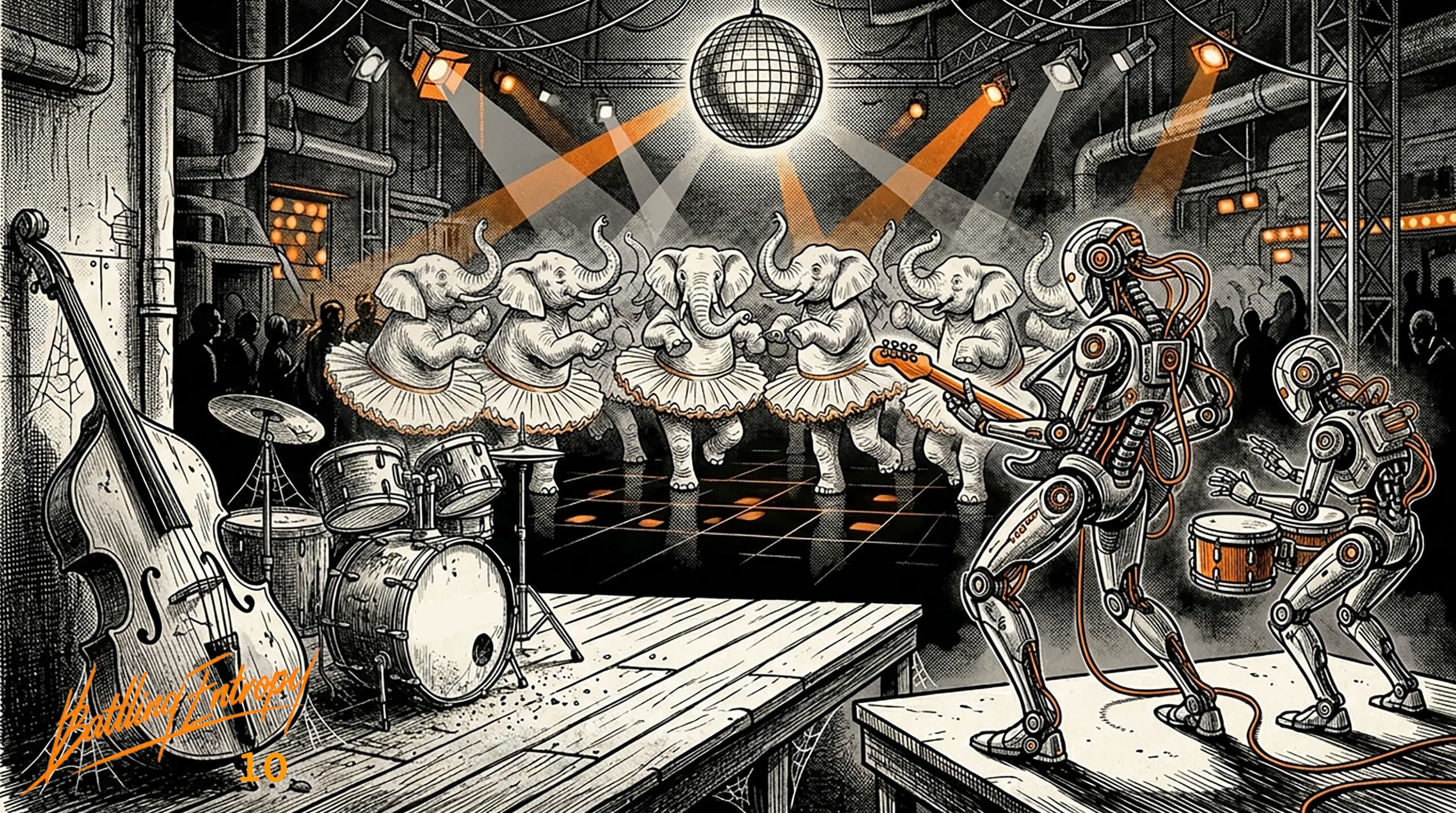
In the last post on this topic , I observed that the grid is losing its rhythm section. For decades, large synchronous generators — coal, gas, hydro — acted like the drummer and bassist of the system. They didn’t just produce energy. They held everything together. Frequency, voltage, stability — all of it emerged from the physical behaviour of spinning machines. That rhythm is fading. This piece is about what replaces it.
Australia’s electricity grid is undergoing a structural transition that is easy to describe in terms of technology but harder to fully grasp in terms of system behaviour. What is changing is not simply the mix of generation, but the way the system holds itself together. For most of its history, that cohesion was not something anyone needed to think about explicitly. Stability came bundled with generation. A coal-fired generator did not need to be asked to provide inertia or fault current or voltage support; those characteristics were inherent in the massive, spinning machine itself. They resisted sudden changes, absorbed disturbances and provided the conditions under which everything else could operate. None of this was explicitly priced because it did not need to be separated out. It was simply how the system worked.
In When the rhythm section fades, I observed that this arrangement depended on a fundamental mechanical tempo. The grid did not need to coordinate itself in a formal sense because the physics of large rotating machines imposed that coordination. The rhythm was not managed. It was embodied.
Since then, that rhythm has continued to recede, and the question has shifted. The issue is no longer whether inverter-based resources can keep the system stable, but how stability is reconstructed once it is no longer provided implicitly. What was previously a technical question is becoming an institutional one, because the system now has to decide, explicitly, what was once simply given.
As those machines retire, that implicit bundle is being dismantled. Wind and solar are replacing them, but they connect to the grid through inverters rather than turbines. An inverter is the electronic device that converts electricity into the precise voltage and frequency the grid requires, effectively acting as the interface between modern generation and the system. They do not spin, they do not carry "inertia" in the same way (the stored momentum in large rotating machines that naturally resists sudden changes in frequency), and they do not naturally provide the stabilising properties that the system has long relied on. The assumption that stability comes for free, as a byproduct of generation, is no longer reliable.
Most inverter-based resources today are designed to follow the grid meaning they adjust themselves to whatever conditions already exist rather than setting those conditions themselves. Grid-following inverters synchronise to whatever voltage and frequency already exist on the network. They are fast, efficient and precise, but they are also fundamentally dependent on the presence of a stable reference. They assume that someone else is keeping time, and as the proportion of synchronous generation declines, that assumption becomes progressively more fragile.
Grid-forming inverters represent a different mode of operation. Rather than adjusting to the system, they take on the role of setting the conditions that others respond to, much like a conductor establishing the tempo for an orchestra. They create a voltage waveform, set a frequency reference and coordinate with other devices to maintain stability. In effect, they emulate the behaviour that once came from rotating machines, but do so through control systems and power electronics. What was previously an emergent property of physics becomes something that is explicitly designed.
For a long time, this capability sat at the margins of the system, used in weak grids or isolated networks where there was little alternative. That is changing through necessity. Connection standards and system strength requirements are evolving. System strength is essentially the grid’s ability to maintain a stable voltage waveform under stress, particularly during faults or disturbances. New battery projects are increasingly expected to demonstrate grid-forming capability as part of connection and system strength frameworks, particularly in regions with high inverter penetration. The system is beginning to select for assets that can contribute to stability directly, rather than rely on others to provide it. Grid-forming is moving from demonstration into institutionalisation, with different regions adopting it through a mix of standards, procurement and planning assumptions.
This shift reflects a deeper transformation in how the grid is organised. The old system effectively bundled together a range of services that were inseparable in practice: energy, inertia, fault current, voltage support and system strength all arrived together with synchronous generation. As that generation exits, these services are being unbundled. Each becomes scarce under different conditions, in different locations and at different times. Each must be provided deliberately, and increasingly each must be valued.
Grid-forming technology is what allows inverter-based resources to participate directly in the provision of system stability. It extends their role beyond energy production into the provision of stability itself, turning a battery from a device that responds to price into one that helps define the operating envelope of the system. In doing so, it begins to reconstruct, in a very different form, the capabilities that were once embedded in large machines.
The consequence is that the grid is moving from a system that was stable by construction to one that must be stable by design. Stability is no longer ambient. It has to be engineered, coordinated and procured. This is already visible in the way system strength services are being contracted, in the operation of very fast frequency response markets, in the formalisation of synthetic inertia through system specifications, and in tightening connection requirements. At the same time, the overall architecture is still incomplete, with elements of the old and new systems coexisting in ways that are not always fully aligned. One way to understand this transition is to ask a simple question: what is actually keeping the system stable at any given moment?
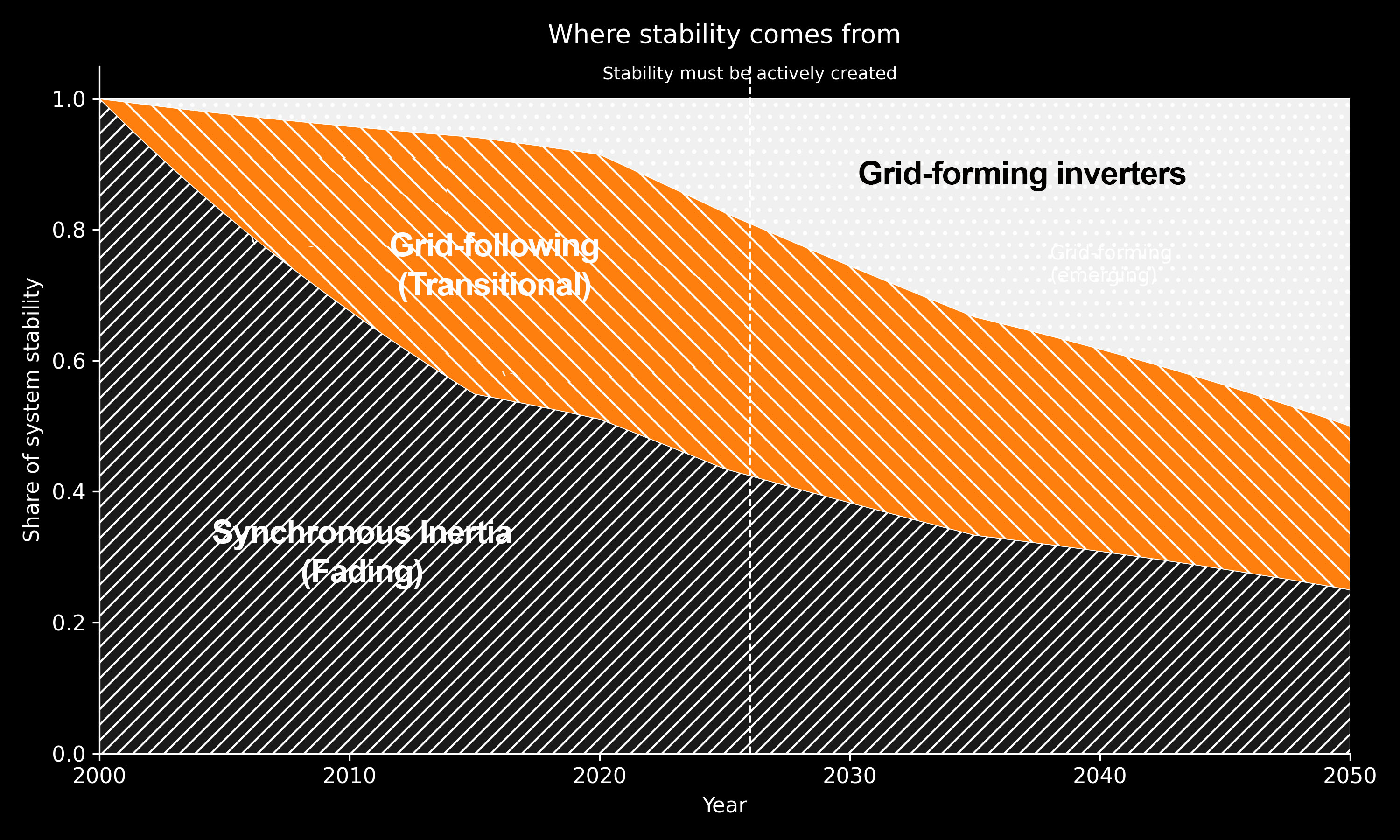
The chart illustrates, in simplified terms, how the sources of system stability are shifting over time. Synchronous inertia remains a significant contributor today and does not disappear abruptly, but its relative role declines as the generation mix changes. Grid-following inverter-based resources grow rapidly and form an important transitional layer, while grid-forming systems emerge more gradually and take on an increasing share of the stabilising function. The transition is not a simple substitution but a reconfiguration of how the system holds together.
The most difficult questions arising from this shift are not technical but economic. Once stability is no longer bundled into generation, it must be valued explicitly. That raises practical questions about how much system strength is worth, who is responsible for providing it and where it is needed. At present, much of this coordination sits outside the core energy price and is procured through a mix of regulated contracts, system strength tenders and transitional service mechanisms.
New mechanisms are emerging to bridge this gap. Transitional service frameworks are increasingly being used to trial capabilities that do not yet fit neatly into existing markets, allowing operators to test and validate new forms of system support in real time. This reflects a system in transition, where engineering capability is running ahead of formal market design.
The boundary of what counts, however, is still shifting. Grid-forming inverters are increasingly recognised for their ability to establish and maintain a stable voltage waveform, and for providing fast frequency response. But not all of the services once delivered by synchronous machines are yet fully recognised in the same way. In particular, protection-quality fault current (the surge of current that allows the system to detect and isolate faults quickly, as explained in Part 1) remains only partially integrated into formal frameworks.
The result is that the system is beginning to pay for some aspects of stability, but not all of them. The rhythm is being rebuilt, but the score is not yet complete.
There is also a coordination challenge that follows from this. Grid-forming resources do not operate in isolation. They interact with one another, with any remaining synchronous machines and with the broader network. Their control systems must be designed so that these interactions reinforce stability rather than undermine it. This is an active area of engineering and market design, and it will shape how quickly and effectively the transition unfolds.
This shift is now visible in procurement. Transmission network operators are building portfolios that include grid-forming batteries alongside synchronous condensers and other system strength assets. In some regions, grid-forming batteries are expected to provide a substantial share of system strength over the coming decade. What was once an engineering concept is now embedded in investment plans.
What is clear, however, is that the old rhythm section is not returning. The system is moving toward a form of coordination that is more distributed, more dynamic and more explicit than what came before. Grid-forming technology is the first widely visible layer of that change. It addresses the immediate problem of maintaining stability in a system without synchronous machines, but it also signals a broader shift toward a grid in which essential services are identified, measured and priced.
As that shift continues, the signals that guide behaviour will need to evolve. Investment, dispatch and demand will increasingly depend on information that is more granular, more local and more reflective of real conditions on the network. This is not a matter of elegance or theoretical preference. It is a practical requirement for a system that can no longer rely on the implicit coordination provided by large rotating machines.
The grid is no longer held together by inertia alone. It is increasingly coordinated through software, control systems and markets. Grid-forming inverters are not simply a new class of asset, and not yet a fully formed market category. They sit in an intermediate space where engineering capability is running ahead of market design, and where much of the next phase of reform will occur. Stability is no longer something the system simply has. It is something the system must continuously create.
New to this topic? See these Battling Entropy Primers to get you up to speed:
Get more like this
New analysis delivered to your inbox. No spam, unsubscribe anytime.
Take care, Tony
Disclosure: Battling Entropy is my independent commentary. The views expressed are my own and do not represent those of any organisation unless explicitly stated. This is not financial or investment advice.
I also have commercial interests in the energy technology field. I am working on a venture, Petajoule Capital, which is developing People-Powered Energy: one particular approach for the coordination of consumer-owned batteries, EVs and flexible demand. This article discusses issues relevant to that work.
Sources / Further Reading
Australian Energy Market Commission. (2025, October 9). Efficient provision of inertia. https://www.aemc.gov.au/rule-changes/efficient-provision-inertia
Australian Energy Market Commission. (2026, March 12). Security framework enhancements. https://www.aemc.gov.au/rule-changes/security-framework-enhancements
Australian Energy Market Operator. (2025). 2025 South Australian electricity report. https://aemo.com.au/-/media/files/electricity/nem/planning_and_forecasting/sa_advisory/2025/2025-south-australian-electricity-report.pdf
Australian Energy Market Operator. (2025). 2025 transition plan for system security. https://aemo.com.au/-/media/files/major-publications/tpss/2025-transition-plan-for-system-security.pdf
Australian Energy Market Operator. (2025). Engineering Roadmap FY2026 priority actions report. https://aemo.com.au/-/media/files/initiatives/engineering-framework/2025/engineering-roadmap-fy2026-priority-actions-report.pdf
Australian Energy Market Operator. (2025). Grid-forming technology access standards: Approach paper. https://aemo.com.au/-/media/files/stakeholder_consultation/consultations/nem-consultations/2025/grid-forming-technology/grid-forming-technology-access-standards-approach-paper.pdf
Australian Energy Market Operator. (2025). Grid-forming technology access standards technical requirements review. https://aemo.com.au/consultations/current-and-closed-consultations/grid-forming-technology-access-standards-technical-requirements-review
Australian Energy Market Operator. (2025). Engineering roadmap execution reports. https://aemo.com.au/initiatives/major-programs/engineering-roadmap/engineering-roadmap-execution-reports
Energy & Resources Knowledge Hub. (2026, March 13). New White Paper explores the technology mix needed to keep a renewable grid secure. https://www.energyinnovation.net.au/article/new-white-paper-explores-the-technology-mix-needed-to-keep-a-renewable-grid-secure
Transgrid. (2026). Meeting system strength requirements in NSW. https://www.transgrid.com.au/projects-innovation/meeting-system-strength-requirements-in-nsw
Transgrid. (2026, March 27). Transgrid shortlists grid batteries to support NSW energy transition. https://www.transgrid.com.au/media-publications/news-articles/transgrid-shortlists-grid-batteries-to-support-nsw-energy-transition/
University of Wollongong. (2026, March 13). UOW helps chart national roadmap to secure Australia’s renewable energy grid. https://www.uow.edu.au/media/2026/uow-helps-chart-national-roadmap-to-secure-australias-renewable-energy-grid.php
Discussion
Loading comments...