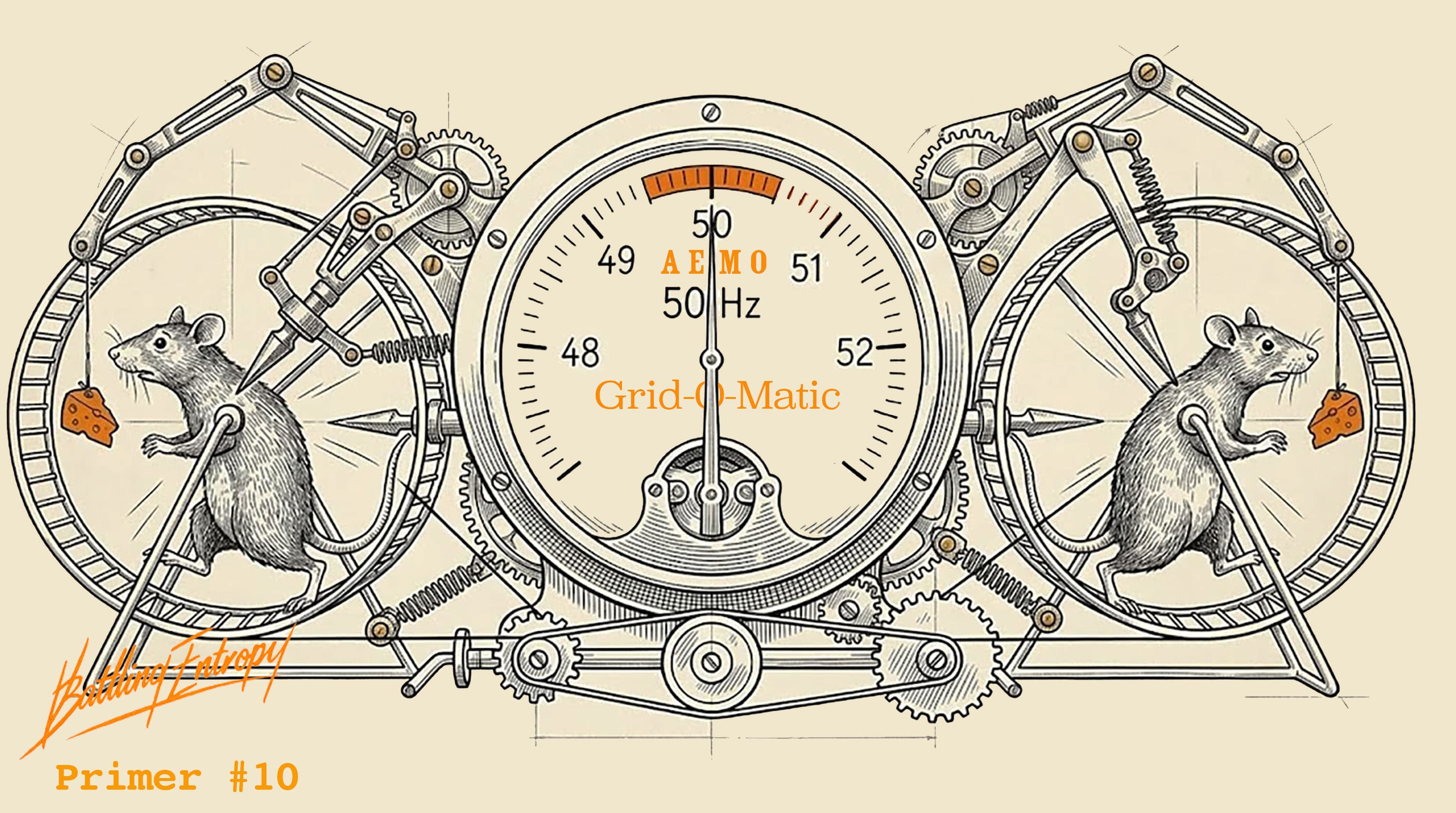
Battling Entropy Primer
Grid Frequency Control 101
Primer #10: Why the grid runs on a metronome (and who pays for it)
The frequency control service, known as FCAS, that keeps the grid operating in time. How the grid pays for the heartbeat it used to get for free — and why batteries are the best mechanism for keeping it in tune.
Plug in a kettle anywhere in eastern Australia and, somewhere a thousand kilometres away, a power station notices. The grid is not a network of independent suppliers and customers. It is a single, continent-spanning machine, with every turbine, every solar farm, every fridge motor turning in time with each other at exactly 50 cycles per second.
That 50 Hz is the grid's heartbeat. Push too much electricity into the system and the heartbeat speeds up. Pull too much out and it slows down. Let it drift more than a hair's breadth either way and the system's protective switches start tripping — generators disconnect, factories shed load, eventually whole regions go dark. Frequency control isn't a feature of the grid. It is the grid.
This is the part of the electricity business no-one outside it ever talks about. The energy market — the one quoted in dollars per megawatt-hour on the evening news — is about how much electricity is sold and for how much. The frequency control market is about whether the system stays standing at all. They run side by side, every five minutes, and almost nobody outside the industry has heard of the second one.
In Australia it has a name only an engineer could love: FCAS, Frequency Control Ancillary Services. Ten markets, run by AEMO, that pay generators and batteries to push the heartbeat back into time whenever it drifts.
Six of them are "contingency" services — six-second, sixty-second and five-minute response markets, in both directions (faster and slower) — that pay assets to spring into action when something major goes wrong: a coal unit trips, a transmission line falls over. Two more are "regulation" services that smooth the constant small wobble between supply and demand. And since 2023, two more again — the "Very Fast" products, clearing in a single second — were added explicitly because the grid was getting faster than the old markets could keep up with.
If you have wondered why every big battery in Australia gets built with cooling systems sized for sustained discharge it is never going to do — this is why. Batteries dominate these markets. Their superpower isn't capacity, it's speed. A coal unit takes minutes to ramp up; a battery responds in milliseconds. Hornsdale — South Australia's original Tesla big battery — earned roughly 70% of its early revenue from FCAS, not from buying cheap power and selling it dear. Every battery built since has been built with one eye on this stack.
There is a catch, though, and it's the reason this primer matters now rather than five years ago. FCAS pays for the response once the heartbeat has already moved. It does not pay for the thing that, until recently, kept the heartbeat steady in the first place.
That thing is inertia — the physical reluctance of thirty-odd coal units' worth of spinning steel to change speed. Push extra load onto a grid full of spinning machines and the machines slow infinitesimally, buying the system precious seconds before any market needs to act. Battling Entropy Issue 05 When the rhythm section fades… described what is happening to that free service. As coal retires, the rhythm section is leaving the band, and the grid’s tempo increasingly has to be imposed deliberately rather than emerging naturally from spinning iron. Issue 10 Rebuilding the rhythm… sketched the destination: grid-forming inverters, batteries and solar farms with software capable of imitating the stabilising behaviour of spinning machines, beginning to take over the conductor’s baton.
FCAS, in its current shape, doesn't quite know what to do with this. It is good at paying the drummer to hit harder when the tempo slips. It does not yet pay anyone to keep the tempo steady in the first place. Four pieces of the puzzle are visibly missing:
-
A market for inertia itself, not just response. AEMO procures it today through bespoke contracts — a synchronous condenser here, a grid-forming clause in a battery deed there. None of it clears like energy and FCAS do.
-
A standing product for grid-forming capability — paying assets to hold a frequency and voltage reference, rather than just to chase one.
-
Location. Energy is moving toward more locational pricing (Battling Entropy Issue 15); frequency services still clear nationally. As the grid becomes more spatially fragmented, where stability is delivered will matter more.
-
Sub-second response. Very Fast FCAS got the metronome to one second. The physics of an inverter-dominated grid will eventually want products that act even faster, potentially inside a single AC cycle.
None of this means FCAS has failed. It means FCAS was designed for a grid where stability was free and you only paid for the corrections. The grid we are now building is the opposite: stability is the product, and the energy almost a by-product of how that product gets delivered.
Issue 05 named the problem. Issue 10 named the destination. FCAS is the bridge — and the bridge is being widened in real time.
Take care, Tony
Further reading
Australian Energy Market Commission. (2021). Fast frequency response market ancillary service: Final rule determination. AEMC. https://www.aemc.gov.au
Australian Energy Market Commission. (2024). Operational security mechanism: Draft rule determination. AEMC.
Australian Energy Market Operator. (2015, updated). Guide to ancillary services in the National Electricity Market. AEMO. https://aemo.com.au
Australian Energy Market Operator. (2022). Engineering roadmap to 100% renewables. AEMO.
Australian Energy Market Operator. (2023). Power system frequency risk review. AEMO.
Australian Energy Market Operator. (2023). Very fast FCAS market ancillary services: Implementation report. AEMO.
Australian Energy Market Operator. (2024). Quarterly energy dynamics: Q4 2024 [Section on FCAS revenues and price trends]. AEMO.
Aurecon. (2018). Hornsdale Power Reserve year 1 technical and market impact case study. Report prepared for Neoen and the Government of South Australia.
Aurecon. (2020). Hornsdale Power Reserve year 2 technical and market impact case study. Report prepared for Neoen and the Government of South Australia.
ElectraNet. (2021). Main grid system strength project: Synchronous condenser commissioning at Davenport and Robertstown [Project report]. ElectraNet.
EnergyCo NSW. (2023). Waratah Super Battery project: System integrity protection scheme and grid-forming inverter requirements. NSW Government.
Reliability Panel AEMC. (2020). Frequency operating standard. Australian Energy Market Commission.
Riesz, J., & Milligan, M. (2015). Frequency regulation in the Australian National Electricity Market — Recommendations for reform. The Electricity Journal, 28(3), 86–99. https://doi.org/10.1016/j.tej.2015.03.001