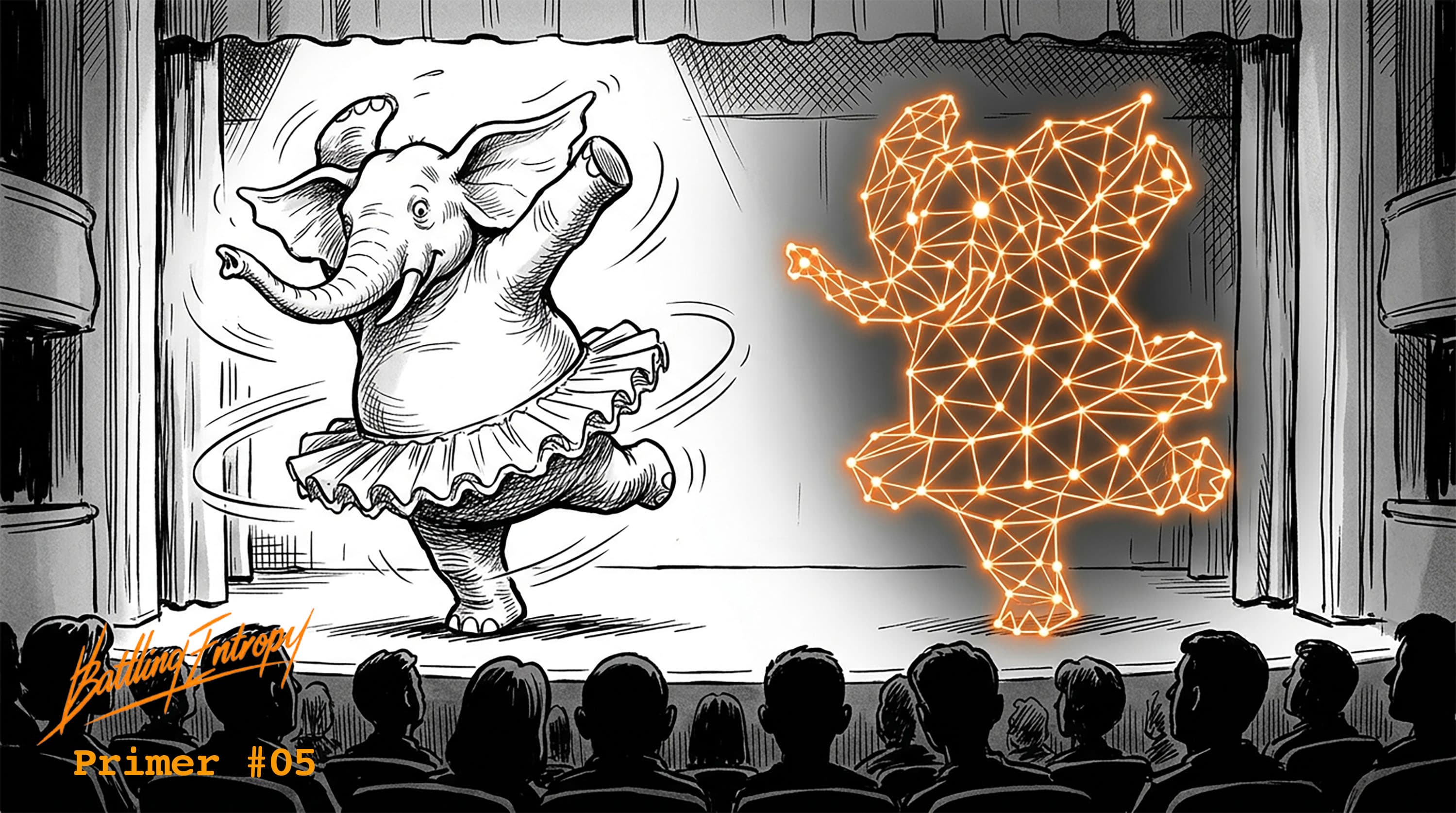
Battling Entropy Primer
Grid stability (and why power electronics will one day rule the grid)
Primer #05: Why a grid that loses its spinning machines must learn to keep in time on power electronics
Synchronous inertia — the kinetic energy stored in a coal turbine's spinning mass — was the grid's automatic shock absorber for well over a century. As coal retires and inverter-based generation rises, that absorber disappears. Grid-forming inverters and synthetic inertia are how we replace it.
A quick history lesson
Australia's grid runs at fifty cycles per second. So does Europe's. The Americas run at sixty. That number isn't a convention — it's a coordination problem. Every spinning machine connected to the grid, from a coal-fired turbine in the Latrobe Valley to your fridge compressor, must turn at exactly the same rate, locked together by the alternating current that links them. When demand and supply are balanced, frequency is stable. When they aren't, frequency drifts, and unless something pushes back fast, the whole synchronised orchestra falls apart.
For well over a hundred years that "something" has been the rotating mass of large thermal generators. A 500 MW coal unit weighs hundreds of tonnes and spins at 3,000 rpm. That mass stores kinetic energy — typically several gigajoules of it — and when grid frequency drops, the energy starts draining out within milliseconds, slowing the turbine and feeding power into the grid for the first second or two — long enough for the governor and primary frequency response to take over This stored kinetic energy is called synchronous inertia. It has been the grid's free, automatic shock absorber for as long as electricity has been a service, and almost nobody has had to think about it.
Why solar and batteries don't have any
A solar farm produces direct current. A wind turbine produces alternating current at a variable frequency depending on wind speed. Neither can connect to the 50 Hz grid directly. They go through inverters — power-electronic converters that synthesise a clean 50 Hz alternating waveform.
The catch is that the inverters that have dominated since the 2000s — known as grid-following inverters — don't choose the frequency. They look at the grid voltage, lock to it, and synthesise their own waveform to match. They are passengers. They have zero rotating mass and no kinetic energy reservoir to drain. A grid where most generation is grid-following is a grid with steadily disappearing inertia.
Australia has been running this experiment in real time. South Australia, which routinely runs above 70% instantaneous renewable share, has had to mandate a minimum number of synchronous
generators online at all times — burning gas not for the energy but for the inertia. New South Wales and Victoria face the same arithmetic as their coal fleet retires through the 2030s.
What changes with grid-forming inverters
A grid-forming inverter does what its name says: it doesn't follow the grid voltage, it sets it. Internally, it models a virtual synchronous machine — voltage, frequency, phase angle, even simulated rotor dynamics — and behaves like one. Unlike a grid-following inverter, a grid-forming inverter:
- can operate in an islanded grid, including a black-start;
- supplies fault current during disturbances, so protection systems can clear the right circuit;
- responds to a frequency drop in milliseconds, providing "synthetic inertia".
The physics is different from a spinning machine, but the function is similar. And in one important respect, it is better: where a coal turbine takes seconds for its governor to ramp up, a battery-backed grid-forming inverter can deliver its full response in under 200 milliseconds.
The Hornsdale moment
The point is not theoretical. In December 2017, three months after the Hornsdale Power Reserve (then 100 MW / 129 MWh) was commissioned in South Australia, a 560 MW unit at Loy Yang A tripped offline. The grid frequency dropped sharply. Hornsdale responded in 140 milliseconds — faster than any thermal generator in the country and well inside the four-second window that primary frequency response had previously been designed around. The official primary-response generator, Loy Yang B, was still ramping when Hornsdale had already finished.
Hornsdale's behaviour at that point wasn't yet "true" grid-forming — that came with the 2022 inverter upgrade — but it demonstrated to AEMO, and to the rest of the world, that batteries with the right inverter architecture could replace the inertia and primary-response role of synchronous plant. Every battery built in Australia since has been priced against that template.
Where the policy is going
AEMO's Engineering Roadmap has formalised the shift: new utility-scale connections must increasingly be grid-forming by default, with the bulk of new inverter capacity expected to be
grid-forming by the early 2030s. In parallel, network operators are installing synchronous condensers — large spinning machines without fuel inputs — as transitional inertia sources, particularly in South Australia and Tasmania.
Inertia is shifting from a free side-effect of fossil generation to an explicitly procured grid service. The unit of value is also changing. The grid increasingly places less value on MW (instantaneous power capacity) and more about MW·s — the kinetic energy a system can release in the first seconds of a disturbance. AEMO publishes regional minimum inertia thresholds in the thousands of MW·s, and the gap is concrete: a 100 MW solar farm adds 100 MW of capacity but 0 MW·s of inertia, while a 100 MW gas turbine adds 100 MW and several hundred MW·s on top. As the grid decarbonises those two numbers diverge sharply, and the market is still learning how to price the second one.
Where to read next
For what changes when the synchronous fleet retires, see When the rhythm section fades... and its follow-up Rebuilding the rhythm. For why Hornsdale rewrote Australian battery economics, see Australia's battery build-out has crossed the rubicon. For the academic-rigor version of the work that needs to be done to adapt our grid for the new world, the UNSW / UoW Securing power systems in the renewable revolution white paper (Konstantinou, Christopher, Fletcher and colleagues, cited below) is the best Australian reference and underpins the analysis in When the rhythm section fades…
Take care, Tony
Further reading
- AEMO, Engineering Roadmap to 100% Renewables — the grid-forming target trajectory and system-strength procurement framework.
- AEMO, Inertia Requirements Methodology / Power System Frequency Risk Review — the formal basis for regional minimum-inertia thresholds (in MW·s) and the operational rules that follow.
- AEMO, System Strength Impact Assessment Guidelines — how new generators are tested against system-strength shortfalls and what grid-forming connections must demonstrate.
- AEMO, Hornsdale Power Reserve — Year 1 Technical and Market Performance Report — documents the December 2017 Loy Yang A response and the Fast Frequency Response design implications.
- Alexander, Arraño-Vargas, Christopher, Fletcher, Jiang, Konstantinou, Lewis, Twidell, Securing power systems in the renewable revolution — UNSW Decarbonisation Innovation Hub, UNSW Energy
Institute, University of Wollongong, with the Real-Time Simulations Laboratory and APQRC. The Australian academic baseline reference for grid-forming, system strength, and inertia in a
high-renewables grid; cited in When the rhythm section fades… and the natural deeper read after this primer. - ARENA, Wallgrove Grid-Forming BESS Demonstration — early Australian grid-forming deployment with public technical reports.
- CSIRO, Renewable Energy Storage Roadmap — chapter on inertia, frequency control and the transition path.
- IEEE PES, Grid-Forming Inverter Technology and Standards (technical task force reports, ongoing) — the global engineering reference.