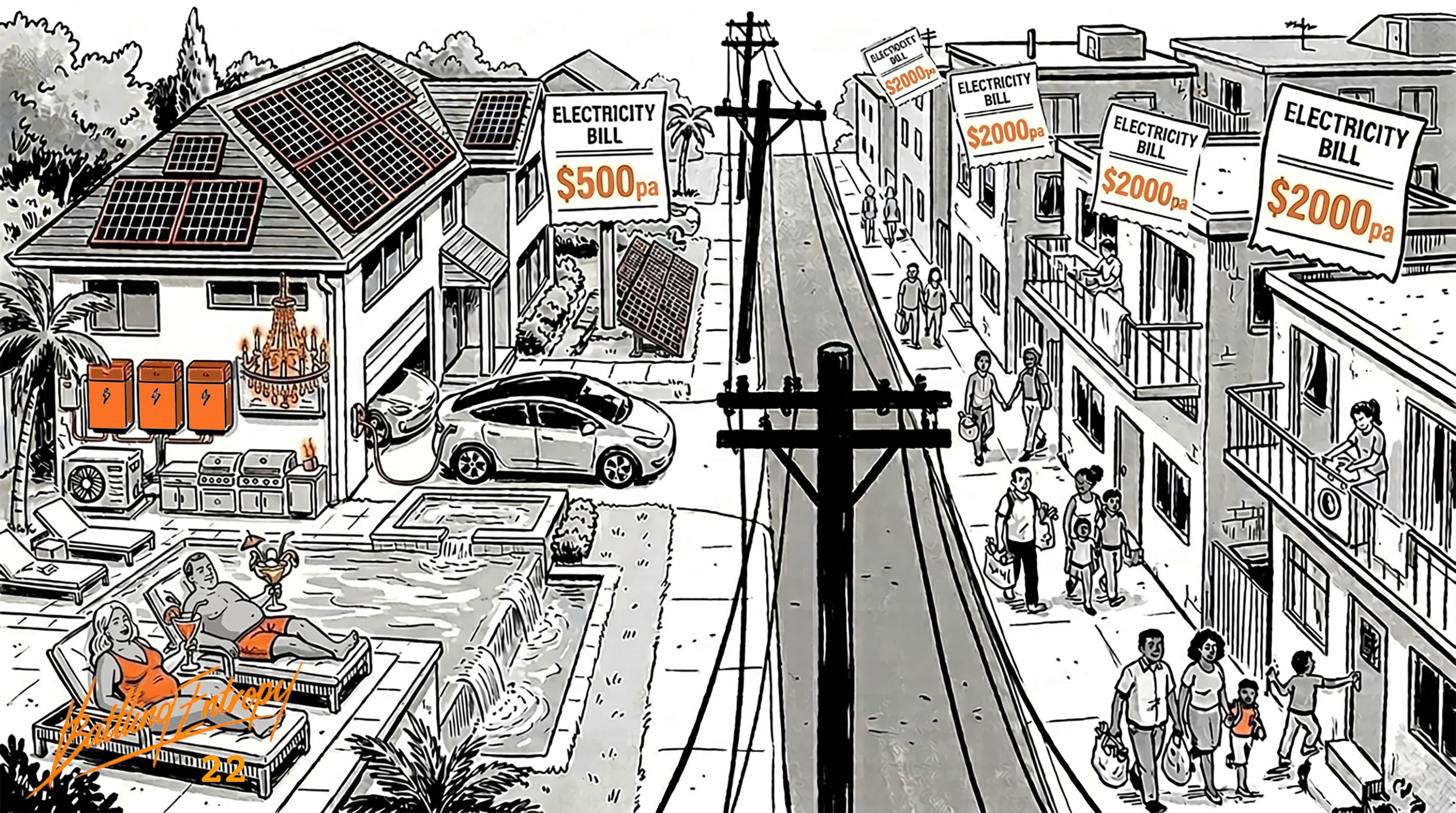
People Without Roofs
Issue #22: Why the next phase of energy democracy is storage, not solar
Australia's rooftop-solar revolution reached homeowners and stopped at the gutter — renters, apartments and low-income households were locked out. Free midday power is coming, but it's only democratic if you can store it for the evening. The next equity frontier isn't solar; it's storage: plug-in batteries, real community storage, and a universal storage credit.
The first democratisation stopped at the roofline
Australia's first energy democracy was built on our roofs.
It was a glorious accident of geography, policy and falling panel prices. Millions of households became small generators. The power station moved out of the valley, off the coalfield, away from the dam wall, and onto the suburban roof. That changed the grid from underneath.
The scale of it is hard to overstate. More than 4.2 million rooftop systems are now installed across the country — over 25 gigawatts of capacity, more than the entire remaining coal-fired fleet. No nation on earth generates more solar per person. We did it by leaning on an asset class Australia has in spades: the suburban roof, angled at the sun, otherwise doing nothing with its daylight.
But not everyone owns a roof.
Renters. Apartment dwellers. Public-housing tenants. Shaded homes, heritage homes, strata-bound buildings. Anyone without the spare capital to put several thousand dollars down and wait out the payback. The first democratisation reached the households that could mount a generator above their heads — and it stopped, neatly, at the edge of their gutters.
The contrast between the solar haves and have-nots is stark.
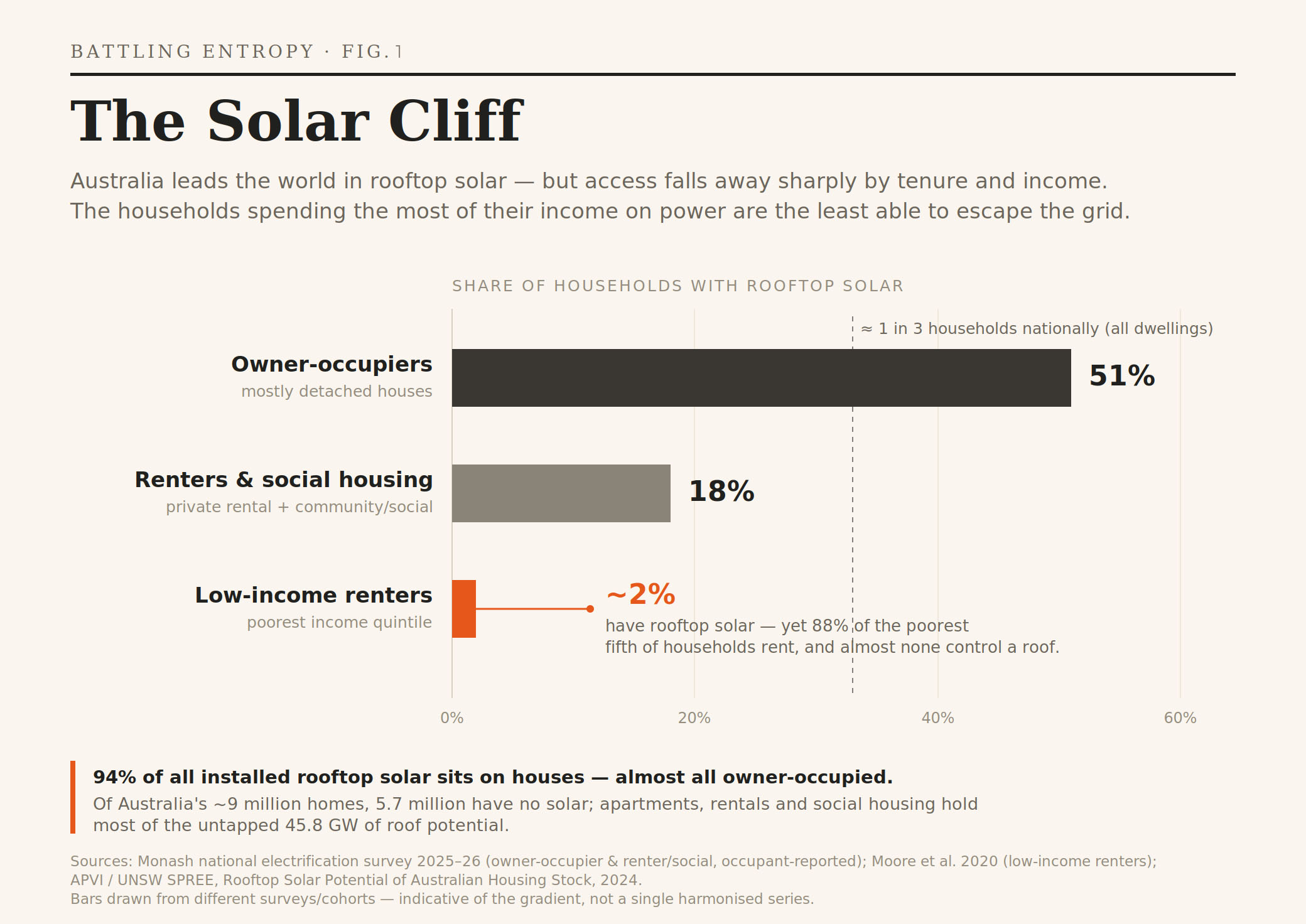
About half of owner-occupied houses now carry panels. Among renters and social-housing tenants, the figure falls to roughly one in five. Among the lowest-income renters — the households who spend the largest share of their income on power, and who can least absorb a bad winter bill — almost no one: somewhere around two percent. Ninety-four percent of all installed rooftop solar sits on houses, and almost all of it on houses someone owns. Of Australia's roughly nine million homes, 5.7 million have no solar at all.
This is not a critique of rooftop solar. Rooftop solar is the best thing to happen to the Australian grid in a generation. It is a critique of stopping there — of treating a revolution that reached the people with roofs and capital as though it had reached everyone.
Storage is the leveller
The first wave was about generation equity: access to panels. The next wave is about something subtler and, I think, more powerful. Call it time equity — the ability to capture electricity when it is cheap or free and abundant, and to use it when it is dear and scarce.
That distinction matters acutely right now, because Australian policy has finally, explicitly, admitted that midday electricity has become a surplus product.
From 1 July 2026, the federal Solar Sharer Offer gives households with a smart meter three hours of free power in the middle of the day, in the regions covered by the Default Market Offer. The Australian Energy Regulator has fixed the window at 11am–2pm for New South Wales and South-East Queensland, and 12pm–3pm for South Australia, with up to 24 kilowatt-hours free inside it. Crucially, you do not need to own solar to take it up. Renters qualify. Apartment dwellers qualify. Victoria has announced its own Midday Power Saver, also built around three hours of free daytime electricity, from 1 October. The government has flagged extending the offer nationally by 2027.
On paper, this is the most democratic energy policy in years. Free power, no roof required.
But read the fine print of daily life. Free daytime electricity is only fully democratic if people can carry it into the evening. Most people cannot be home at midday to run the dishwasher, charge the car, or pre-cool the house. The household that benefits most from three free hours at noon is the household that can already shift its load there — or, better still, the household with a battery quietly filling up while everyone is out, then paying for the evening peak at a price of zero instead of forty cents a kilowatt-hour.
Without storage, free midday power risks reproducing the very divide it was meant to close. The flood of cheap solar arrives at noon; the question is who has a vessel to catch it.
So the real question for the next few years is this: can we democratise storage in the way we never quite managed to democratise rooftop generation?
Yes, we can if we want to. I see three levers. Technology. Shared infrastructure. Policy.
The technological lever: plug-in storage
Start with the hardware, because here the news is good.
A 2 kW / 5 kWh plug-in battery is entirely plausible, technically. A standard Australian 10-amp circuit sits in roughly that power range, and five kilowatt-hours is enough to materially reshape a household's evening: lights, refrigeration, electronics, some cooking, a wash cycle, a chunk of air-conditioning. It would not run a fully electrified home through a heatwave. It does not need to. It needs to run the evening — the part of the day that costs the most and that midday solar, unstored, can never reach.
The problem is not the battery. The problem is the interface and the standards.
Australia's system is built around installed inverters, fixed wiring, network approval and compliance with standards like AS/NZS 4777.1 and 4777.2. This is essential safety machinery — anti-islanding, voltage control, grid protection — and none of it should be loosened carelessly. But it was designed for professionally installed, permanently wired equipment. It was not designed for apartment-friendly, appliance-like storage that an ordinary person could plug into a wall, charge at midday, and unplug when they move out.
Europe is showing the way through.
In December 2025, Germany published the world's first dedicated standard for plug-in solar — DIN VDE V 0126-95 — defining how a "balcony solar" device can be safely connected to a home circuit through an ordinary household plug. A companion standard for plug-in batteries is already being developed by a VDE working group. Germany has gone further than standards alone: renters and apartment owners now have a legal right to install plug-in solar, written into the country's rental and condominium law. More than a million such systems are already registered.
Britain has set the legal route for plug-in solar up to 800 watts — wiring rules amended in April 2026, a product standard due mid-year. And — this is the part worth dwelling on — the British government paired legalisation with a £25 million pilot to put plug-in kits into low-income homes. Not just permission to participate, but a pathway to it.
Australia has neither yet. We have four million households' worth of installed evidence that people will adopt this technology when it is made safe and simple. What we lack is the standards work. Experts I've spoken to put that at a three-to-five-year journey. That is precisely why it has to start now, not after the surplus is already sloshing through the grid every lunchtime.
The shared lever: Real community batteries
Australia already has community battery programs. The word "community", though, has taken quite a bit of credit there it hasn't earned.
The Commonwealth committed $200 million to deploy 400 community batteries; $171 million of that went to the renewable energy agency ARENA to deliver at least 342, and its first funding round conditionally backed up to 370. Useful infrastructure, all of it. But look at how the money is streamed: one channel funds distribution networks, the other funds non-network players — retailers, councils, developers. In practice, most "community batteries" are network batteries or retailer batteries. They sit in the community. They are not, in any meaningful sense, the community's.
A battery is not a community battery just because it is bolted to a footpath.
A true community battery would give a roofless household a real economic claim on storage. There is more than one way to do it:
-A household leases or buys a virtual slice of capacity — say 5 or 10 kilowatt-hours — and treats it as their own. -A household pays a simple storage fee — say ten cents a kilowatt-hour — to park free midday electricity and draw it back down in the evening.
The important distinction is not where the steel sits. It is whether the customer is getting storage access or merely subsidising an asset that someone else profits from.
Behind-the-meter storage may be the cheaper answer in some settings: apartment buildings, social housing, retirement villages, embedded networks, shopping precincts, schools, council sites, public-housing estates. Grid-side batteries may be better where the main value is local network support. The policy should not fetishise the location. It should require the economics to reach the people without roofs.
The policy lever: a universal storage credit
This is where free daytime power and household batteries should meet.
The federal Cheaper Home Batteries Program offers a valuable subsidy — around thirty percent off an installed battery. But it carries a revealing condition: the battery must be attached to a rooftop solar system. Storage support, in other words, is still bolted to the very asset class that renters and apartment dwellers can't access. The program inherits solar's roofline and stops at the same gutter.
We should move beyond this, and extend a universal storage credit — support that follows the storage, not the panel. It could subsidise the purchase of a plug-in battery the moment one is approved for sale here. It could equally subsidise renting shared storage in a genuine community battery. Either way, the roofless household gets the one thing the first democratisation never gave it: somewhere to keep the surplus.
If governments are going to mandate free daytime electricity — and from July, they are — they should also build the storage pathways that let people without roofs actually use it.
Conclusion
Australians deserve to reach energy storage far more equitably than we reached rooftop solar. The way ahead is not mysterious.
Start the plug-in storage standards work now, so the interface is ready when the surplus arrives. Design community batteries around customer storage rights, not just network support. Use free daytime power to charge assets that renters and apartment dwellers can actually touch. Let households keep control — but give them the machinery that lets them participate.
Australia pioneered rooftop solar. Then it began scaling home batteries. The next test is whether the energy transition can reach the people without roofs.
The sun is already producing the surplus. The missing question is who gets to carry it home.
New to this topic? See these Battling Entropy Primers and prior articles to get you up to speed:
The NEM 101 (The basics on how our Australian electricity market works)
The Cheaper Home Batteries Program (What's driving Australia's home battery acceleration to be the world's fastest)
Australia is winning the battery race. Now what? (As it says)
Free power at lunch and the democratisation of energy storage (What's driving the free power offers and what does it mean?)
The Machinery of Electricity (How does the institutional machinery of the grid work and how has it changed? Does it need to change again?)
When Time Ceases to Matter(https://battlingentropy.com/when-time-ceases-to-matter-mpytcrz8) (How 24-hour storage transforms the electricity grid)
Get more like this
New analysis delivered to your inbox. No spam, unsubscribe anytime.
Take care, Tony
Disclosure: Battling Entropy is my independent commentary. The views expressed are my own and do not represent those of any organisation unless explicitly stated. This is not financial or investment advice.
I also have commercial interests in the energy technology field. I am working on a venture, Petajoule Capital, which is developing People-Powered Energy: one particular approach for the coordination of consumer-owned batteries, EVs and flexible demand. This article discusses issues relevant to that work.
Sources / Further Reading
Australian Energy Regulator. (2026, May 26). AER releases final Default Market Offer 2026–27. https://www.aer.gov.au/news/articles/news-releases/aer-releases-final-default-market-offer-2026-27
Australian Photovoltaic Institute. (2024). Rooftop solar potential of Australian housing stock by tenure and dwelling type. https://apvi.org.au/wp-content/uploads/2024/04/Solar-potential-of-Australian-housing-stock-published-16-4-24.pdf
Australian Renewable Energy Agency. (2024). ARENA funds national community battery roll out. https://arena.gov.au/news/arena-funds-national-community-battery-roll-out/
Australia's home electrification boom has an equity problem. (2026, January 15). The New Daily. https://www.thenewdaily.com.au/opinion/2026/01/15/home-electrification-inequality
Department for Energy Security and Net Zero. (2026). Plug-in solar: Consultation document (accessible webpage). GOV.UK. https://www.gov.uk/government/consultations/plug-in-solar/plug-in-solar-consultation-document-accessible-webpage
Department of Climate Change, Energy, the Environment and Water. (n.d.-a). Cheaper Home Batteries Program. Retrieved June 24, 2026, from https://www.dcceew.gov.au/energy/programs/cheaper-home-batteries
Department of Climate Change, Energy, the Environment and Water. (n.d.-b). Community Batteries for Household Solar program. Retrieved June 24, 2026, from https://www.dcceew.gov.au/energy/renewable/community-batteries
Department of Climate Change, Energy, the Environment and Water. (n.d.-c). Default Market Offer. Retrieved June 24, 2026, from https://www.dcceew.gov.au/energy/programs/default-market-offer
Department of Climate Change, Energy, the Environment and Water. (n.d.-d). Eligibility information for the Cheaper Home Batteries Program. Retrieved June 24, 2026, from https://www.dcceew.gov.au/energy/programs/cheaper-home-batteries/eligibility-information
Department of Energy, Environment and Climate Action. (n.d.). Victorian Midday Power Saver. Retrieved June 24, 2026, from https://www.energy.vic.gov.au/households/save-energy-and-money/victorian-midday-power-saver
German Solar Association. (2025, December 17). DIN/VDE: World's first standard for plug-in solar devices. https://www.solarwirtschaft.de/en/2025/12/17/din-vde-worlds-first-standard-for-plug-in-solar-devices/
Minister for Climate Change and Energy. (2026). Reforms delivering a fairer deal and free daytime power for households [Media release]. https://minister.dcceew.gov.au/bowen/media-releases/reforms-delivering-fairer-deal-and-free-daytime-power-households
Discussion
Loading comments...