The Machinery of Electricity
Issue 19: The machinery of our electricity system is not just the physical infrastructure but the institutions that run it
Electricity institutions are not natural facts. They are machinery built for the grid of their time. Australia moved from local electricity systems to state utilities, then to the NEM. Now rooftop solar, batteries and EVs have moved the action behind the meter. The next challenge is not more market or more regulation, but new machinery for trusted coordination at the edge. Disclosure: I am working on a venture in this field. Details at the end.
I’ve just finished listening to a four-hour(!) podcast on the history of the American electricity grid: The Grid: The Largest Machine Ever Built. Great title. The grid really is the largest machine humans have built, but not only in the obvious sense of power stations, transmission lines and transformers. It is also a machine made of institutions.
That then sent me down a rabbit-hole into the history of the Australian grid: municipal electricity departments, county councils, state electricity commissions, regulated monopolies, privatisations, market operators, retailers and rule-makers.
This is not only because I am, regrettably, a grid geek. It is because the history of the grid shaped the institutions we built around it. And those institutions still shape what we think is possible today.
Each era of electricity built machinery for the problems of its time.
The question is whether yesterday’s machinery still fits today's grid, and then tomorrow's.
The Evolution of the US Grid
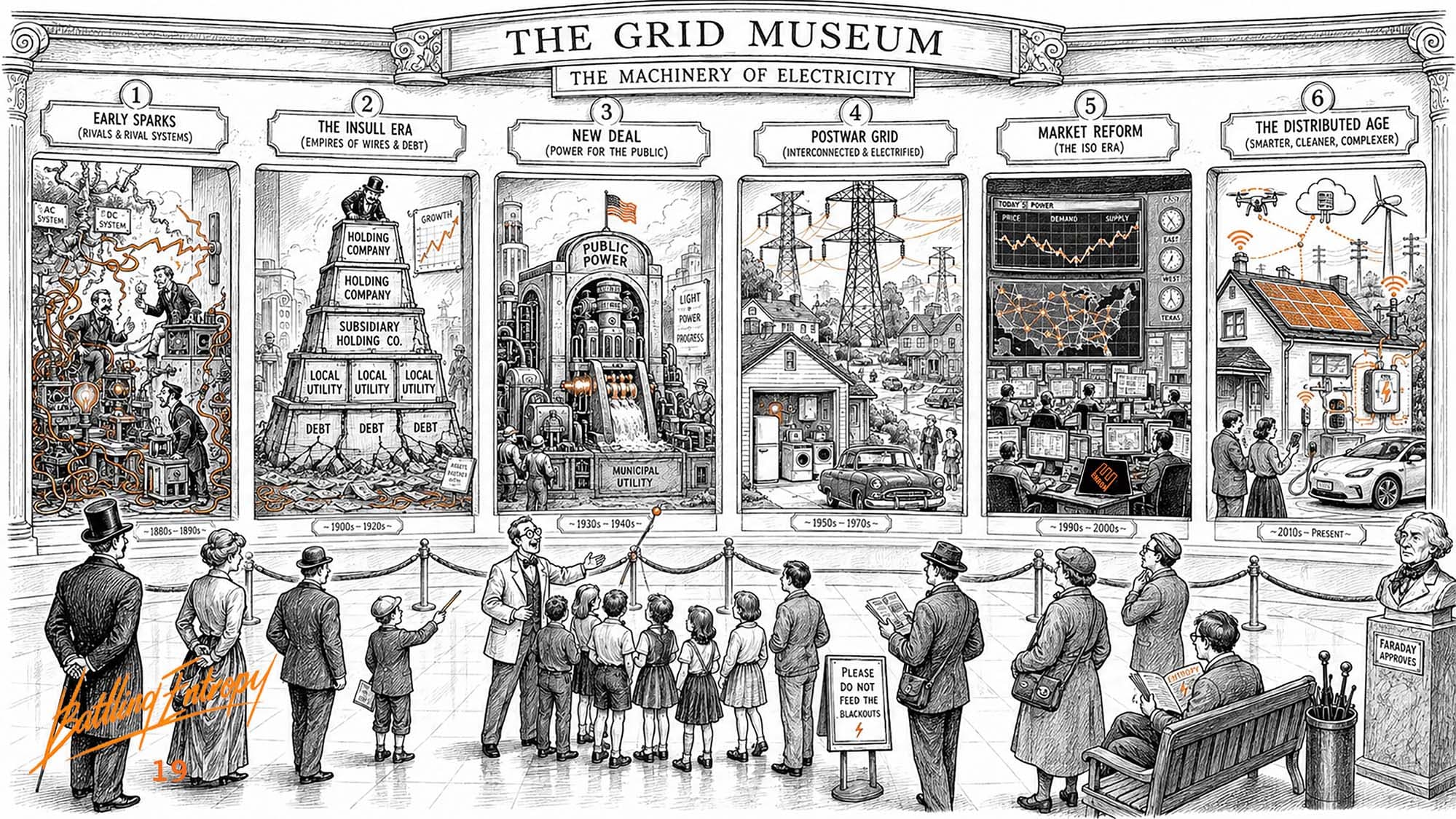
The American grid began as a technological scramble. In the late nineteenth and early twentieth centuries, electricity was local, experimental and competitive. Cities had isolated power stations, rival systems, private concessions and incompatible equipment. Electricity was obviously useful, but the institutional machinery around it was still being invented.
Then came Samuel Insull.
Insull had started as Thomas Edison’s private secretary before becoming one of the great builders of the American electricity industry. His key insight was that electricity had powerful economies of scale. Larger generating stations, broader customer bases and more diverse loads could drive down unit costs. A utility serving homes, factories, shops and streetcars could run its equipment more efficiently than a small isolated plant serving one narrow load.
That insight was real. It helped create the modern electric utility.
But Insull then built corporate machinery on top of the physical machinery. Local operating utilities were stacked into holding companies, which were stacked into larger holding companies, financed by debt, securities and intercompany control. The customers were real. The wires were real. The electricity was real. But above them sat elaborate financial pyramids that regulators struggled to see, let alone supervise.
After the 1929 crash, those edifices came down. The lesson President Roosevelt drew was not simply that some financiers had been reckless. It was that electricity had become too important to leave to unstable private empires.
The New Deal settlement broke up the utility holding-company pyramids, strengthened regulation and expanded public power. The Public Utility Holding Company Act of 1935 gave the Securities and Exchange Commission power to regulate and dismantle sprawling utility holding companies, generally pushing them back toward integrated systems that state regulators could understand. At the same time, public power, municipal utilities and rural electrification expanded the idea that electricity was an essential service, not just another business.
Two models from that era still shape America today: the regulated investor-owned utility and the publicly owned or municipal utility.
Then the Second World War changed the scale again. War production required vast amounts of power. Regional systems became more interconnected. More capacity was built. When the war ended, America briefly had more electricity than it needed. The suburban boom of the 1950s and 1960s solved that problem. Houses got refrigerators, washing machines, televisions and eventually everything else. Demand rose to meet the machine.
The next great shift came when the system began to fail in new ways. Oil shocks, nuclear cost blowouts, blackouts, environmental regulation and the limits of monopoly planning led to new attempts at competition. Independent generators appeared. Wholesale markets opened. System operators and regional transmission organisations were created to coordinate power flows across utilities.
Enron demonstrated that market machinery could be abused just as surely as monopoly machinery could become bloated. California’s electricity crisis was a reminder that electricity markets are not magic. They are machines too, and badly designed machines can explode.
So the American grid arrived at its current strange form: part monopoly, part market, part public service, part financial machine. The machinery has changed repeatedly because the physical system, the financial system and the politics kept changing.
If there is a lesson in all that it is that electricity institutions are not natural objects. They are machines built for the problems of their time.
The Australian Arc
Australia reached a similar conclusion by a different route.
We did not have a Samuel Insull figure. We did not have one giant national utility empire collapsing under the weight of its own securities. We did not have a single New Deal moment in which the federal government remade the electricity industry.
We had something more Australian: a state-by-state patchwork of councils, commissions, private concessions, railway systems, tramways, coalfields, hydro schemes and local politics.
In the early twentieth century, electricity in Australia was still local and uneven. Cities built their own power stations. Councils ran electricity departments. Private companies held concessions. Railways and tramways generated power for their own systems. Regional towns had isolated supply. Rural areas often had none.
There was not one grid. There were many small grids.
Victoria moved early toward the state-utility model. The State Electricity Commission of Victoria was created after the First World War and built its machinery around brown coal at Yallourn. This was electricity as state development: dig the coal, build the power station, run transmission to Melbourne, electrify industry and households, and make the state modern.
New South Wales took a more municipal and fragmented path for longer. Sydney had municipal generation, county councils, railway power and private legacy systems. The Sydney County Council became a huge electricity institution in its own right. Only later did the state consolidate generation into a statewide electricity commission.
South Australia had a stronger private-company phase before the Electricity Trust of South Australia took over after the second world war. Queensland and Western Australia were shaped by distance, local supply and the sheer difficulty of wiring large territories with thin populations.
The details varied. The direction did not.
Electricity was becoming too important, too capital-intensive and too network-dependent to remain an ordinary local business. It became machinery of state.
After the Second World War, Australia built the twentieth-century electricity machine in earnest. State electricity commissions and public authorities planned generation, built transmission, expanded distribution and supplied the suburbs. They were not merely companies. They were instruments of development. They electrified homes, powered factories, supported mining, extended supply to towns and helped turn postwar Australia into a modern consumer society.
This was the era of the big public electricity system.
It had its own logic. If the state owned the generators, the transmission system, the distribution networks and sometimes the retail relationship, coordination was conceptually easy. Not always efficient. Not always cheap. Not always disciplined. But easy to understand.
The state planned. The engineers built. The customers consumed.
For a long time, that worked well enough.
Then the machine began to show its own failure modes. Public electricity authorities could overbuild. Politicians could interfere. Costs could be hidden. State systems could become inward-looking. Investment decisions could be driven by forecasts that turned out to be wrong. The same monopoly machinery that made large-scale electrification possible could also produce complacency and waste.
By the 1980s and 1990s, the reform mood had changed. Australia, like much of the world, began to ask whether electricity really had to remain a vertically integrated state enterprise. Perhaps generation could compete. Perhaps retail could compete. Perhaps transmission and distribution were the natural monopolies, but the rest of the system could be separated, corporatised, regulated and exposed to market discipline.
So the old state machines were broken apart.
Generation, transmission, distribution and retail were separated. Public authorities were corporatised. Some assets were privatised, especially in Victoria and South Australia. New South Wales later followed with its own waves of restructuring and sales. Other states kept more public ownership but still adapted to the national market framework.
The National Electricity Market was born.
Instead of state commissions planning everything internally, generators would bid into a wholesale market. Prices would be set every five minutes. A market operator would dispatch the system. Retailers would buy electricity and sell to customers. Transmission and distribution networks would remain regulated monopolies. Rule-makers and regulators would sit around the machine, adjusting the mechanism as needed.
It was a profound institutional change.
The NEM did not abolish monopoly. It relocated it. Wires remained monopoly infrastructure. But generation and retail became more competitive. The system operator became separate from the asset owners. The rulebook became (almost) national. The market became the coordinating machine.
This was not a mistake. It solved real problems in the old state-utility model. It brought discipline to generation. It made interstate trade more meaningful. It created transparent wholesale prices. It separated some functions that had previously been bundled inside state electricity empires.
But, as always, it was machinery built for the problems of its time.
The NEM assumed that the active participants were mostly large generators and retailers. It assumed that the distribution system was mainly a delivery network. It assumed that customers were mostly passive loads at the end of the chain. It was designed around regional prices, wholesale dispatch and regulated wires. For the problems of the 1990s, that was a rational machine. But the world changed.
Now: Radical Technological Decentralisation
Then the roof became a power station.
This is where the Australian story stops merely echoing the American one. For most of the twentieth century, Australia followed the broad institutional path of other developed electricity systems: local fragments became state electricity machines; state machines were later broken apart into generation, transmission, distribution and retail; a market operator was put in the middle; regulated monopoly wires remained regulated monopoly wires; and competitive generation and retail were layered around them. The details were Australian, but the direction was familiar.
This time is different because Australia is not simply importing the next electricity model from the United States or Europe. In an important sense, we are already living inside a system we are pioneering. The reason is rooftops.
Australia did not add renewable energy only through large wind and solar farms connected to the transmission grid. We put solar on houses, schools, warehouses, sheds, shopping centres and factories. Millions of roofs became small generators. Electricity moved to the edge of the system before the institutions had even thought much about it.
A solar panel on a roof looks harmless enough. It is quiet. It has no smokestack, no turbine hall, no control room and no heroic cooling tower. It sits behind the meter, inside the customer’s premises, looking more like an appliance than a power station.
That classification mattered. Because rooftop solar was behind the meter, it was not treated like the generators around which the NEM had been designed. It did not bid into the market. It was not scheduled by the market operator. It was not dispatched every five minutes. A household could generate its own electricity, reduce its grid demand, and often export surplus energy into the local network without becoming a market participant in the ordinary sense.
At small scale, this was perfectly sensible. Nobody wanted every suburban solar system treated like a miniature power station with a trader, a bid stack and a compliance department. The whole point of rooftop solar was that households could install it, use it and get on with their lives.
But at system scale, the exemption became radical.
Millions of small private decisions created a generation fleet that was physically connected to the grid but institutionally outside the main machinery of dispatch and pricing. Rooftop solar could reshape demand seen by the market without being directly visible as scheduled supply. It could push down midday wholesale prices, reduce minimum operational demand, create reverse flows on distribution networks, trigger voltage problems on local feeders and force the system operator to manage a grid whose most important new generator was not a generator in the old institutional sense.
This is the strange genius of Australian rooftop solar. It did not wait for a new market design. It did not ask permission to become a central actor in the electricity system. It slipped in through the household roof, behind the meter, and changed the shape of the grid from underneath.
Once enough households did this, the institutional consequences became enormous. A home with rooftop solar is no longer just a customer. With a battery, it may be a storage operator. With an electric vehicle, it may become one of the largest loads on the street. With a smart meter, controllable appliances and an inverter, it may become flexible demand or respond to local electrical conditions faster than any coal unit ever could.
The old electricity categories begin to blur. Customer, generator, load, storage, network support, market participant, appliance and asset are no longer cleanly separate things. The same house can be several of them at once. That is not just a change in technology. It is a change in where the useful equipment sits, who owns it, who can see it and who has the right to make decisions about it. The future grid will look less like a power station and more like a swarm.
The NEM was a reform designed for a different world. It was built around large generators, regional wholesale prices, regulated wires and mostly passive customers. It solved real problems in the old state-utility model by separating functions, exposing generation to competition and creating a transparent dispatch and pricing machine. But rooftop solar, batteries and EVs do not fit neatly inside that architecture. They appear in the distribution network, not the transmission system. They sit behind retail meters, not at scheduled generator connection points. They affect local voltage, transformer loading and feeder constraints. They respond to household preferences, tariff incentives, inverter settings, export limits and occasional market signals. They are owned by millions of people, not a few utilities.
This is radical decentralisation, not as ideology but as fact. The interesting thing is that it did not arrive through a manifesto. It arrived through household economics. Solar got cheap. Households bought it. Batteries began following. EVs are next. The edge of the grid became active because millions of separate private decisions made it so.
That gives Australia a different problem from the United States. The US has enormous wholesale markets, vast transmission debates, regional grid operators, vertically integrated utilities and an emerging data-centre load shock. It also has distributed energy, but the American electricity system is still often described through the lens of utilities, wholesale markets and large-scale infrastructure. Australia’s distinctive stress is lower down the stack. We are discovering what happens when one of the world’s most rooftop-solar-heavy electricity systems tries to run through institutions designed for a centralised grid.
The symptoms are already visible: negative daytime prices, solar export limits, minimum-demand events, distribution voltage issues, household batteries nobody can reliably coordinate, and low voltage feeders that matter far more than the regional wholesale market can see. These are not separate curiosities. They are signs that the physical system has moved faster than the institutional machinery.
Put differently, the old electricity system had a tight relationship between capability and coordination. The institutions could see and manage most of the important machinery. Local systems had local managers. State grids had state electricity commissions. The NEM created a market operator and rulebook for large generators, interconnectors, retailers and regulated networks.
The problem begins when useful electrical capability moves behind the meter. Rooftop solar, household batteries, EVs and flexible load add real capacity to the system, but not in a form the old coordination machinery was designed to see, let alone dispatch, verify or settle.
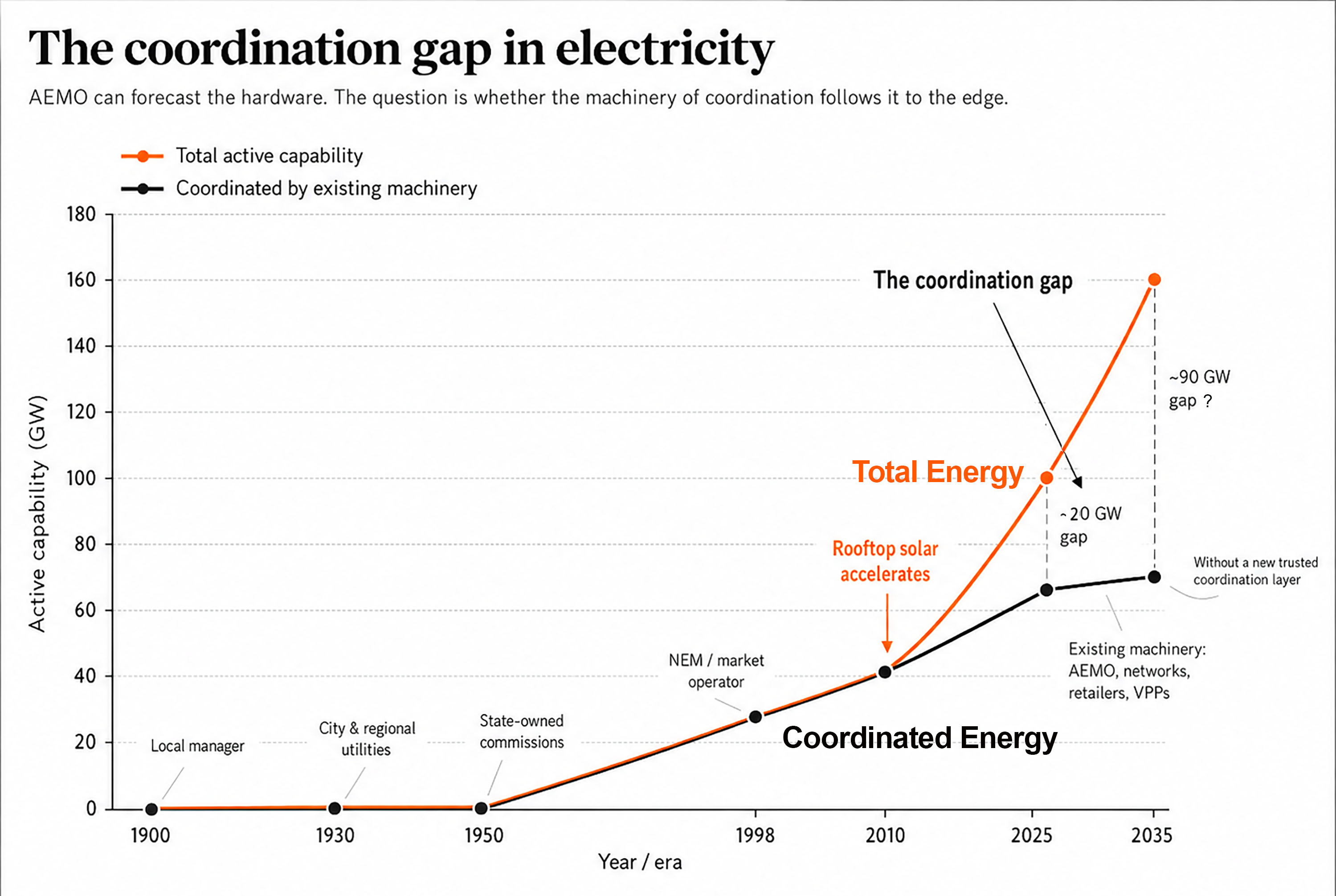
The chart highlights the huge increase in the amount of energy generated but not coordinated by the existing institutional machinery of the grid. Without a trusted system for consent, visibility, dispatch rights, verification and settlement, a growing share of useful electrical capability remains only partially available to the institutions trying to run the grid.
This does not mean home batteries do nothing today. Many are already well coordinated by their owners, serving the household first and often reducing evening demand when the grid is under stress. But that is not the same as being visible, dependable and rewardable as a local system resource. There is much more they could do, and be paid for doing, without compromising their primary role in the home.
That is the coordination gap. The hardware is arriving, at an accelerating rate. The machinery has not caught up.
That is why Australia is not merely following the American grid story. The US taught the world that electricity needed institutional machinery: regulated utilities, public power, wholesale markets, system operators and reliability rules. Australia now has a different lesson to learn, and perhaps to export: what happens when the customer becomes part of the machine?
The answer is not to go back. The rooftop will not unbecome a power station. The battery will not unbecome storage. The EV will not unbecome a large flexible load. Consumers will not politely hand back the machines they have bought to make their homes cheaper, cleaner and more resilient. The low voltage network will not go back to being boring. The machinery has to change again.
New Machinery for the New World
This is where an economist called David Friedman becomes useful.
Friedman is the son of Milton Friedman, and his work is quite a bit more radical than his father's broad free-market advocacy. In The Machinery of Freedom, he argues not merely for smaller government, but for a society in which many functions normally treated as public monopolies could be provided through markets, contracts and competing institutions. It is a bracing book, sometimes exhilarating, sometimes alarming. For present purposes, its value is not its politics. It is its method.
Friedman's method is to look at institutions as machinery. A court is a machine for resolving disputes. A police force is a machine for producing security. A market is a machine for coordinating dispersed information and incentives. A regulated utility is a machine for financing and operating monopoly infrastructure while constraining monopoly power. Once you start thinking this way, institutions stop looking like natural features of the landscape. They are not mountains. They are arrangements built by people, under particular technological and political conditions, to solve particular coordination problems.
One reason Friedman is worth reading now is that some of his stranger examples look different with today’s technology. When founded on the technology of the 1970s, his discussion of private alternatives to public systems could sound ingenious but utterly impractical: too many vouchers, too much verification, too much trust required between strangers, too much friction in matching participants. His ride-sharing idea, for example, imagined mechanisms that would let private drivers and passengers find one another, transact and build reputations outside the conventional taxi and public transport systems. This entailed designated meeting points, magnetically coded identification cards and machines to read them. That just wasn't going to happen at scale, certainly never globally.
Then the smartphone arrived.
GPS, digital maps, payments, identity, ratings, matching algorithms and real-time dispatch turned what once sounded like a fiddly libertarian thought experiment into Uber and similar ride-sharing apps. Whether one likes them is not the point. The point is that technology changed the institutional frontier. It did not make transport simple, fair or problem-free. It did make a different coordination machine possible.
The old taxi system of licenses and regulations was not repealed. It was outflanked by a new way of matching cars, passengers, payments, locations and trust. One thing Friedman got absolutely right was who would object to his new system. He writes “Changes in such regulations would be opposed by bus drivers, cab drivers, and cab companies.” That happened. But the new way of implementing urban travel had so many advantages that it prevailed.
Electricity is now approaching a similar moment. For decades, the idea of coordinating millions of small customer devices would have been absurd. The meters were too dumb, the devices too invisible, the data too slow, the transaction costs too high and the customer interface too weak. The only practical machinery was centralised: large generators, monopoly wires, regulated utilities, market operators and retailers. But smart meters, inverters, batteries, EV chargers, cloud software, APIs and real-time settlement tools change what can be coordinated. They do not abolish the need for rules. They change what kinds of rules are possible.
The history of electricity makes this point unusually clear because the institutions have already changed several times. Local systems, state electricity commissions, regulated monopolies and the NEM were not eternal forms. Each was a practical response to the physical, financial and political problem of its time. The early machinery brought electricity into cities and towns. The state machines built large-scale infrastructure and extended reliable supply. The regulated monopoly financed networks that made no sense to duplicate. The NEM separated contestable generation and retail from monopoly wires, and coordinated large generators through dispatch and regional wholesale prices. Each machine solved real problems. Each also produced new failure modes when the system underneath it changed.
That is the point of the history. The problem is not that we built the wrong machinery. The problem is assuming that the machinery we inherited is the machinery we must keep using now that the grid itself has changed. As the Battling Entropy Manifesto says, technology is the accelerator, human imagination is the brake.
The NEM still does many things well: dispatching large resources, pricing wholesale energy, supporting financial contracting and giving networks a regulated revenue model. But it was designed around scheduled generators, passive customers, regional prices, regulated wires and competitive retailers. It was not designed around millions of private generators sitting on roofs, batteries sitting in garages, electric vehicles becoming large household loads, or low voltage feeders becoming active constraints.
The new machinery therefore cannot simply be “more market” or “more regulation”. That is the lazy argument. Electricity is too physical for market slogans and too distributed for command-and-control nostalgia. The hard question is functional: what coordination problem are we now trying to solve, and what institutional device is best suited to it? The problem is no longer only how to build enough generation, or how to stop monopoly wires from overcharging customers. It is how to coordinate millions of customer-owned devices that are individually small, privately controlled, locally important and collectively system-shaping.
That requires a different kind of institutional imagination. A rooftop solar system, household battery or EV charger is not merely an appliance, but it is not simply a grid asset either. It is private equipment with public consequences. The network may need it to reduce a local constraint. The retailer may want it to manage exposure to wholesale prices. The system operator may care about its aggregate effect on demand and security. The customer may simply want lower bills, backup power, resilience, convenience or control. If the new machinery treats the household as raw material for someone else’s optimisation problem, it will fail the trust test.
Where the current mechanisms fall shortest is in relieving local network constraints. As discussed in Battling Entropy 18, a household battery charging from rooftop solar and discharging into evening load already creates value. Better tariffs and more dynamic prices can create more. But to defer a transformer upgrade, a network operator usually needs something more dependable than a general expectation of customer response. It needs visibility, consent, availability, verification and settlement around capacity at a particular location and time.
The better answer is coordination without command. That means building interfaces that let the system use distributed capability without pretending it owns it. A network should be able to express local need without owning the battery. A retailer should be able to create better products without trapping flexibility inside a closed portfolio. A household should be able to protect its own use first while still earning from genuinely useful surplus capacity. A market operator should be able to maintain system security without needing every rooftop device to become a miniature scheduled generator. A regulator should be able to see enough to protect consumers and system reliability without forcing the edge of the grid back into twentieth-century categories.
These are not merely software features. They are the key functions enabling coordination. Availability, visibility, consent, local value, verification, operating rights, customer protection, data access and settlement may sound less dramatic than privatisation or market reform, but they are becoming central. They define who has rights, who has obligations, who sees information, who can request action, who gets paid and who bears risk.
The next layer of electricity market infrastructure should not be a giant commission, a new market operator or a nationalised utility. Far better a set of trusted, interoperable interfaces that makes millions of private devices intelligible to the public system around them — without turning those private devices into public assets.
This doesn't mean dissolving the existing system. The point is not to abolish AEMO, the AER, the AEMC, DNSPs, retailers or the NEM. The new grid will still need operators, regulators, networks, markets and rules. In fact, it will need them more than ever. But it will also need something the old system barely required: trusted coordination at the edge, between households and networks, between devices and markets, between local physics and regional prices, between private equipment and public reliability.
The grid has always been a machine for battling entropy. The machine has changed before. It has to change again.
New to this topic? See these Battling Entropy Primers and prior articles to get you up to speed:
Do Not Disturb (Explores why today's aggregation mechanisms for home batteries aren't specific enough for DNSPs to rely on them instead of network augmentation)
Get more like this
New analysis delivered to your inbox. No spam, unsubscribe anytime.
Take care, Tony
Disclosure: Battling Entropy is my independent commentary. The views expressed are my own and do not represent those of any organisation unless explicitly stated. This is not financial or investment advice.
I also have commercial interests in the energy technology field. I am working on a venture, Petajoule Capital, which is developing People-Powered Energy: one particular approach for the coordination of consumer-owned batteries, EVs and flexible demand. This article discusses issues relevant to that work.
Sources / Further Reading
Australian Energy Market Commission. (n.d.). National electricity rules. Retrieved May 29, 2026, from https://www.aemc.gov.au/regulation/energy-rules/national-electricity-rules
Australian Energy Market Commission. (n.d.). The role of the AEMC. Retrieved May 29, 2026, from https://www.aemc.gov.au/about-us
Australian Energy Market Operator. (2024). 2024 integrated system plan. https://aemo.com.au/energy-systems/major-publications/integrated-system-plan-isp/2024-integrated-system-plan-isp
Australian Energy Market Operator. (n.d.). About the National Electricity Market. Retrieved May 29, 2026, from https://aemo.com.au/energy-systems/electricity/national-electricity-market-nem/about-the-national-electricity-market-nem
Australian Energy Market Operator. (n.d.). Emerging generation and energy storage. Retrieved May 29, 2026, from https://aemo.com.au/energy-systems/electricity/national-electricity-market-nem/nem-forecasting-and-planning/forecasting-and-planning-data/generation-information
Australian Energy Regulator. (2025). State of the energy market 2025. Commonwealth of Australia. https://www.aer.gov.au/publications/state-of-the-energy-market-reports/state-of-the-energy-market-2025
Australian Energy Regulator. (2025). State of the energy market 2025: Chapter 2: National Electricity Market. Commonwealth of Australia. https://www.aer.gov.au/system/files/2025-08/State%20of%20the%20energy%20market%202025%20-%20Chapter%202%20-%20National%20Electricity%20Market.pdf
Australian Energy Regulator. (2025). State of the energy market 2025: Chapter 3: Electricity networks. Commonwealth of Australia. https://www.aer.gov.au/system/files/2025-08/State%20of%20the%20energy%20market%202025%20-%20Chapter%203%20-%20Electricity%20networks.pdf
Australian Energy Regulator. (2025). State of the energy market 2025: Chapter 6: Retail energy markets and energy consumers. Commonwealth of Australia. https://www.aer.gov.au/system/files/2025-08/State%20of%20the%20energy%20market%202025%20-%20Chapter%206%20-%20Retail%20energy%20markets%20and%20energy%20consumers.pdf
Australian Energy Regulator. (n.d.). Our role. Retrieved May 29, 2026, from https://www.aer.gov.au/about/our-role
Australian Government. (1996). National Electricity (South Australia) Act 1996. https://www.legislation.sa.gov.au/lz?path=%2FC%2FA%2FNATIONAL%20ELECTRICITY%20(SOUTH%20AUSTRALIA)%20ACT%201996
Australian Government Productivity Commission. (2013). Electricity network regulatory frameworks (Report No. 62). https://www.pc.gov.au/inquiries/completed/electricity/report
Commonwealth of Australia. (1993). National competition policy: Report by the Independent Committee of Inquiry (Hilmer Report). https://ncp.ncc.gov.au/docs/National%20Competition%20Policy%20Review%20report,%20The%20Hilmer%20Report,%20August%201993.pdf
Energy Security Board. (2021). Post-2025 market design: Final advice to Energy Ministers. Australian Government. https://www.energy.gov.au/sites/default/files/2021-07/Post-2025%20Market%20Design%20Final%20advice%20to%20Energy%20Ministers%20Part%20A.pdf
Federal Energy Regulatory Commission. (1996). Promoting wholesale competition through open access non-discriminatory transmission services by public utilities; recovery of stranded costs by public utilities and transmitting utilities (Order No. 888). https://www.ferc.gov/sites/default/files/2020-05/order888.asp
Federal Energy Regulatory Commission. (1999). Regional Transmission Organizations (Order No. 2000). https://www.ferc.gov/sites/default/files/2020-04/RM99-2-00K.pdf
Federal Energy Regulatory Commission. (2006). Promoting transmission investment through pricing reform (Order No. 679). https://www.ferc.gov/sites/default/files/2020-05/E-1_35.pdf
Friedman, D. D. (1989). The machinery of freedom: Guide to a radical capitalism (2nd ed.). Open Court.
Friedman, D. D. (2014). The machinery of freedom: Guide to a radical capitalism (3rd ed.). David D. Friedman. http://www.daviddfriedman.com/The_Machinery_of_Freedom_.pdf
Hirsh, R. F. (1999). Power loss: The origins of deregulation and restructuring in the American electric utility system. MIT Press.
Hughes, T. P. (1983). Networks of power: Electrification in Western society, 1880–1930. Johns Hopkins University Press.
International Energy Agency. (2023). Electricity grids and secure energy transitions. https://www.iea.org/reports/electricity-grids-and-secure-energy-transitions
Munro, C. (2018). National Electricity Market: A case study in successful microeconomic reform. Australian Energy Market Commission. https://www.aemc.gov.au/sites/default/files/2018-08/AEMC%20NEM%20case%20study%20for%20PC%20FINAL.PDF
National Museum of American History. (n.d.). Lighting a revolution: Electrifying America. Smithsonian Institution. Retrieved May 29, 2026, from https://americanhistory.si.edu/lighting/
NERC. (2004). Technical analysis of the August 14, 2003, blackout: What happened, why, and what did we learn? North American Electric Reliability Corporation. https://www.nerc.com/pa/rrm/ea/August%2014%202003%20Blackout%20Investigation%20DL/NERC_Final_Blackout_Report_07_13_04.pdf
NSW Treasury. (2017). Electricity network assets: Lease transactions. https://www.treasury.nsw.gov.au/projects-initiatives/electricity-network-assets-lease-transactions
OpenNEM. (n.d.). National Electricity Market data. Retrieved May 29, 2026, from https://opennem.org.au
Public Utility Holding Company Act of 1935, 15 U.S.C. § 79 et seq. (repealed 2005). https://www.loc.gov/law/help/statutes-at-large/74th-congress/session-1/c74s1ch687.pdf
Public Utility Regulatory Policies Act of 1978, Pub. L. No. 95-617, 92 Stat. 3117. https://www.govinfo.gov/content/pkg/STATUTE-92/pdf/STATUTE-92-Pg3117.pdf
Securities and Exchange Commission. (1936). Report on the study and investigation of the work, activities, personnel and functions of protective and reorganization committees: Part 72: The public utility holding company. U.S. Government Printing Office. https://www.sechistorical.org/collection/papers/1930/1936_1201_SEC_Report_Part72.pdf
Stepchange. (2026, April 26). The grid: The largest machine ever built [Podcast episode]. In The Stepchange Show. Presented by Crusoe. https://www.stepchange.show/
Tennessee Valley Authority. (n.d.). Our history. Retrieved May 29, 2026, from https://www.tva.com/about-tva/our-history
U.S. Department of Energy. (n.d.). The history of electricity. Retrieved May 29, 2026, from https://www.energy.gov/articles/history-electricity
U.S. Energy Information Administration. (n.d.). Electricity explained. Retrieved May 29, 2026, from https://www.eia.gov/energyexplained/electricity/
U.S. Federal Trade Commission. (1935). Utility corporations: Final report of the Federal Trade Commission to the Senate of the United States pursuant to Senate Resolution No. 83, 70th Congress, 1st session. U.S. Government Printing Office. https://www.ftc.gov/reports/utility-corporations-final-report-federal-trade-commission-senate-united-states-pursuant
Victorian Auditor-General’s Office. (2000). Privatisation of the State Electricity Commission of Victoria. https://www.audit.vic.gov.au/report/privatisation-state-electricity-commission-victoria
Victorian Government. (n.d.). The State Electricity Commission. Retrieved May 29, 2026, from https://www.secvictoria.com.au/
Yergin, D., & Stanislaw, J. (1998). The commanding heights: The battle for the world economy. Simon & Schuster.
Discussion
Loading comments...