
Synchronised Chaos
Issue 17: The incredibly rapid decentralisation of Australia's electricity system
For more than a century electricity grids were synchronised by giant spinning machines acting in near-perfect unison. Now millions of rooftop solar systems, batteries and EVs are replacing mechanical inertia with software orchestration. Some see chaos. Battling Entropy sees the birth of a faster, smarter, synchronised grid.
Australia's electricity grid used to resemble a ballet performed by elephants. The ballet is turning into a roller derby.
Across vast distances, giant spinning machines weighing hundreds of tonnes rotated in near-perfect synchrony at 50 cycles per second. Coal turbines in Victoria, hydro generators in the Snowy Mountains and gas plants in Queensland all moved together as if mechanically connected, despite being separated by thousands of kilometres of wire. It remains one of the great engineering achievements of the early-mid twentieth century. The alternating current grid was not merely a collection of power stations. It was a continent-scale machine.
The physics behind it is surprisingly beautiful. Every synchronous generator connected to the grid locks itself to the common electrical frequency. If one machine begins to drift slightly ahead or behind, electromagnetic forces pull it back into step, rather like dancers unconsciously matching rhythm through the floorboards beneath them. The entire system behaves like an enormous rotating orchestra, storing stability in spinning mass. Frequency control was not something the grid "did". In many respects, frequency was the grid.
For more than a century that architecture barely changed. Electricity systems became larger, more interconnected and more efficient, but the basic model remained recognisable: a relatively small number of gigantic machines generating power for millions of passive customers. The grid was centralised because the economics of generation favoured scale, and the physics of coordination favoured inertia. Large spinning machines are naturally stable. An elephant does not change direction quickly.
Now the elephants are being joined by mice.
Rooftop solar panels, home batteries, electric vehicles, smart hot-water systems and flexible appliances are proliferating across the grid by the millions. Individually they are tiny. Collectively they are beginning to rival the influence of traditional generation. Australia leads the world in household solar penetration, with rooftop systems now installed on roughly one in three freestanding homes. In some suburbs, rooftop solar capacity already exceeds local daytime demand. Household batteries are being installed at accelerating speed, helped along by recent federal subsidies. Electric vehicles are quietly adding another vast layer of distributed storage and flexible demand.
To the traditional electricity industry, this can look like chaos. The old system was designed around predictability and central control. The new system is increasingly decentralised, software-mediated and fast-moving. Instead of a few hundred large assets responding to dispatch instructions every five minutes, millions of devices are beginning to react continuously to price signals, software commands, weather conditions and household behaviour. The grid is evolving from a machine into something closer to an ecosystem.
But ecosystems can also synchronise.
Modern communications networks, cloud computing and increasingly sophisticated control software are making it possible to coordinate enormous fleets of distributed devices in real time. Virtual power plants already orchestrate tens of thousands of household batteries. Smart inverters can respond to frequency deviations in fractions of a second. Distribution networks are experimenting with dynamic export limits that change continuously according to local grid conditions.
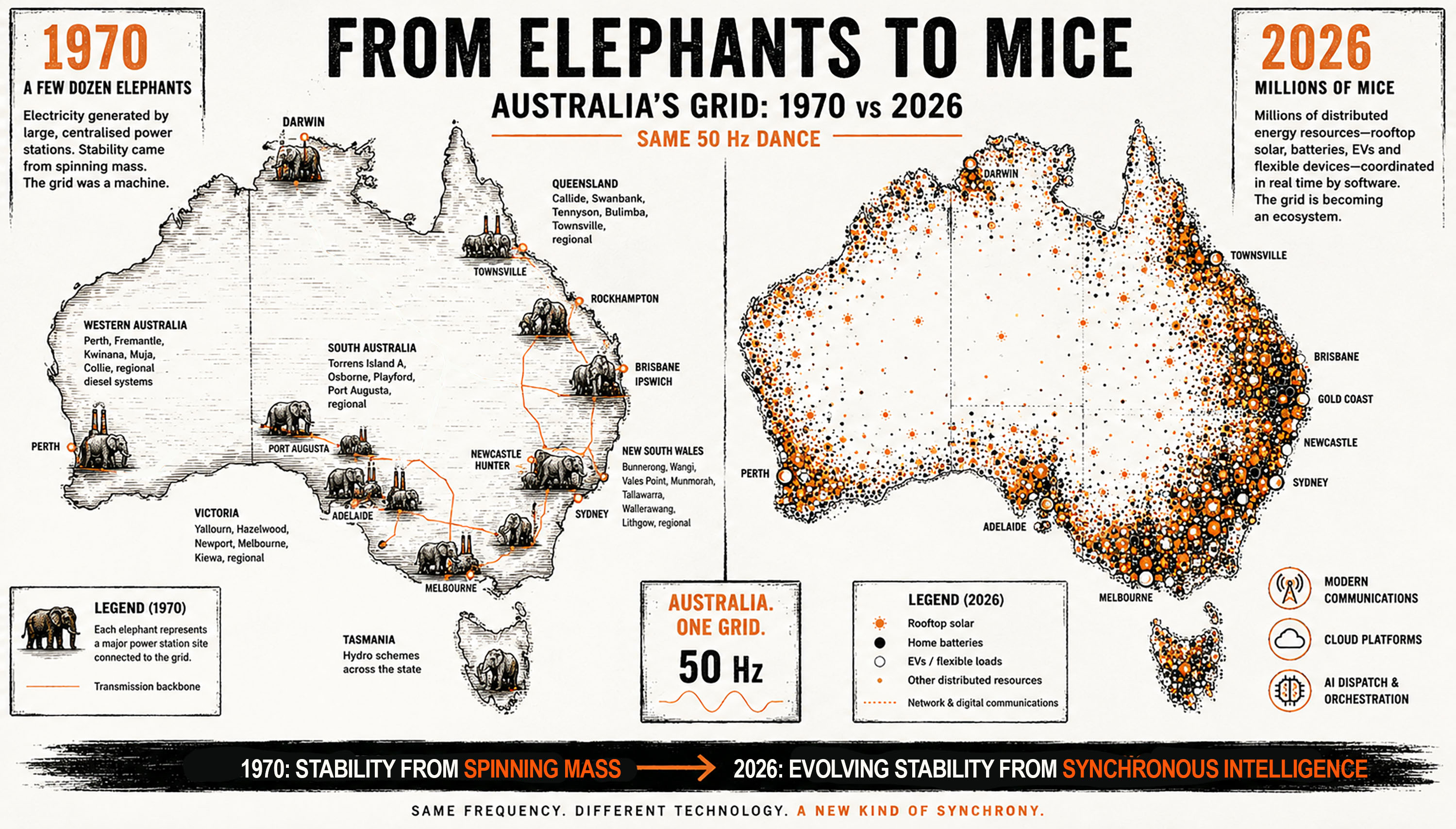
The remarkable thing is not that this coordination is imperfect. The remarkable thing is that it works at all. A modern inverter can react hundreds of times faster than a coal turbine governor. A household battery can stabilise local voltage faster than traditional network equipment. Millions of distributed devices connected through software may eventually prove more adaptive, resilient and efficient than the giant spinning machines that dominated the previous century. The future grid will not derive stability from sheer mechanical inertia, but from communication, coordination and speed. In effect, the grid is shifting from analogue stability to digital stability.
This is why debates about distributed energy often feel so culturally divided. Some people see fragmentation, instability and loss of control. Others see intelligence emerging at the edge of the network. One side sees the grid dissolving into disorder. The other sees the early stages of a software-defined energy system capable of coordinating complexity at a scale previously impossible.
Synchronised chaos.
That phrase sounds contradictory only because we are still picturing the electricity system through twentieth-century eyes. What looks like chaos from the centre may actually be coordination emerging at the edge. The old grid achieved order through mass and momentum. The emerging grid needs to achieve it through orchestration.
None of this is easy. Synchronous machines did more than set the frequency — they also provided the fault current and system strength that protective equipment relies on, and inverters are only just learning to do those jobs convincingly. An orchestrated grid depends on communications, software and cyber security in ways the old grid never did, which creates new failure modes alongside the old ones. There are also uncomfortable questions about who pays and who benefits: rooftop solar and home batteries have so far flowed disproportionately to homeowners, while renters and apartment dwellers risk being left subsidising a system increasingly designed around assets they cannot install. These are real problems, not rhetorical ones.
But the direction of travel still seems clear. I would not underestimate the mice.
The elephants built one of the greatest engineering systems humanity has ever created. But history suggests that large, slow and centralised systems eventually struggle against technologies that are smaller, faster and more numerous. Especially when those smaller systems can communicate with one another. The most obvious example is computing, where mainframes evolved into PCs and then into the tiny, networked machines in your pockets.
The future grid will look less like a power station and more like a swarm.
New to this topic? See these Battling Entropy Primers to get you up to speed:
Grid stability (and why power electronics will one day rule the grid)
Get more like this
New analysis delivered to your inbox. No spam, unsubscribe anytime.
Take care, Tony
Disclosure: Battling Entropy is my independent commentary. The views expressed are my own and do not represent those of any organisation unless explicitly stated. This is not financial or investment advice.
I also have commercial interests in the energy technology field. I am working on a venture, Petajoule Capital, which is developing People-Powered Energy: one particular approach for the coordination of consumer-owned batteries, EVs and flexible demand. This article discusses issues relevant to that work.
Sources / Further Reading
Australian Energy Market Commission. (2018). Coordination of generation and transmission investment: Final report (EPR0052). Australian Energy Market Commission. https://www.aemc.gov.au/sites/default/files/2018-12/Final%20report_0.pdf
Australian Energy Market Commission. (2019). Coordination of generation and transmission investment – Access reform: Directions paper (EPR0073). Australian Energy Market Commission. https://www.aemc.gov.au/sites/default/files/2019-06/Directions%20paper.pdf
Australian Energy Market Operator. (2018). Integrated System Plan. AEMO. https://aemo.com.au/energy-systems/major-publications/integrated-system-plan-isp
Australian Energy Market Operator. (2018). Electricity Statement of Opportunities. AEMO. https://aemo.com.au/energy-systems/electricity/national-electricity-market-nem/planning-and-forecasting/electricity-statement-of-opportunities-esoo
Commonwealth Scientific and Industrial Research Organisation (CSIRO). (2024). GenCost 2023–24: Final report. CSIRO. https://www.csiro.au/en/research/technology-space/energy/gencost
Energy Security Board. (2018). Integrated System Plan: Action plan. Energy Security Board. http://www.coagenergycouncil.gov.au/publications/integrated-system-plan-action-plan
Finkel, A., Moses, K., Munro, C., O’Kane, M., & Sandiford, T. (2017). Independent review into the future security of the National Electricity Market: Blueprint for the future. Commonwealth of Australia. https://www.energy.gov.au/publications/independent-review-future-security-national-electricity-market-blueprint-future
McKinsey & Company. (2022). The net-zero transition: What it would cost, what it could bring. McKinsey Global Institute. https://www.mckinsey.com/mgi/our-research/the-net-zero-transition-what-it-would-cost-what-it-could-bring
International Energy Agency. (2023). Electricity grids and secure energy transitions. IEA. https://www.iea.org/reports/electricity-grids-and-secure-energy-transitions
Australian Competition and Consumer Commission. (2025). Inquiry into the National Electricity Market – 2025 report. ACCC. https://www.accc.gov.au/about-us/publications/inquiry-into-the-national-electricity-market-report-2025
Discussion
Loading comments...