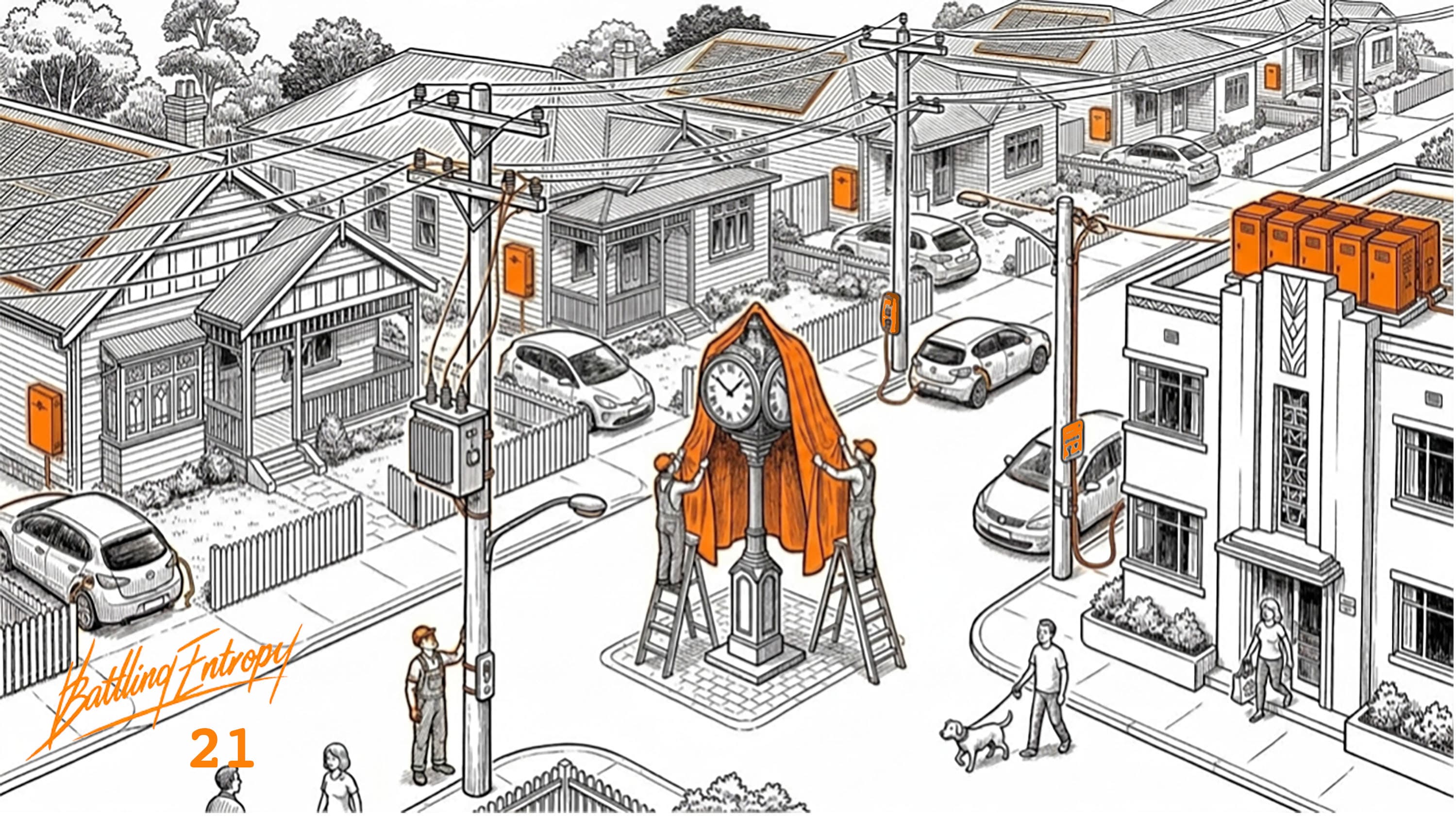
When time ceases to matter
Issue #21: Breaking the real-time constraint that has governed the electricity grid since its invention, and why claiming the prize turns out to be a coordination problem.
Storage at every demand point dissolves electricity's age-old real-time constraint, and marginal energy becomes cheap. But cheap energy is not enough to make cheap bills: the wires that deliver it are now the dominant cost, and spent unwisely they squeeze us for decades. The prize becomes working the existing wires far harder. Yet a single blunt signal like "free power" at noon synchronises demand rather than spreading it, rebuilding the peak from the import side. Time stops being the limit; coordination needs to take its place, feeder by feeder. Disclosure: I am working on a venture in this field. Details at the end.
The times that bind
For its entire history, electricity has lived under one unforgiving rule: it must be produced at the very instant it is used. Power stations chase demand second by second; the grid is a vast machine for holding supply and consumption in perfect, continuous balance.
Storage changes that rule at its root.
When storage holds a day’s load at every demand point, the real-time constraint that has governed electricity since its invention simply dissolves. The mature electrified grid will not merely have more rooftop solar, more batteries and more EVs; it will have storage spread through the system: in homes, apartments, vehicles, community batteries, substations and commercial sites. The network no longer has to deliver every kilowatt-hour at the moment it is consumed. Energy can be moved when the system has room, and used later. Time, in effect, stops being the thing that limits the grid.
This Battling Entropy issue takes the longer view: a grid where marginal energy is cheap, where the poles and wires are the dominant cost, and where the great economic prize is using the infrastructure we already have far harder by breaking the tyranny of real-time demand.
In Australia in mid-2026, tens of thousands of home batteries are being deployed each month, adding over a gigawatt-hour of storage every thirty days through a willing coalition of household and government capital. Roughly eight million households are connected to the NEM. If each draws around 15 kWh on an average day from the grid (using AER benchmark figures), then 120 GWh of storage distributed at the point of use would hold a full day’s household energy at the meter. At the current run-rate, that volume would take under ten years to reach — and typical technology adoption curves suggest it will arrive faster. I expect we'll see meaningful 24-hour-scale storage at many households and demand points within around five years.
Is that future closer than you thought?
The Anaconda
The last issue of Battling Entropy followed a slower clock. It showed how poles, wires and transformers are built as forty-year assets and recovered through regulated charges that barely move when energy gets cheap. Spend unwisely on that infrastructure and the cost does not wash out with the next sunny afternoon; it sits on every bill for decades. Cheap midday energy can collapse the wholesale price and still leave a rising floor underneath it. That is the anaconda of electrification — not dramatic enough to notice at first, but powerful enough to squeeze the promise out of the whole transition.
At first glance, the world we have just described looks like the perfect escape. Put a day's storage at every demand point and the timing problem seems to disappear. Why upgrade a transformer for the sake of a few hours a year, when you could move the same energy through the wires overnight, or in the slack middle of the day, when they sit half-empty? Defer the steel, defer the bill, loosen the coils. Storage, on this telling, is the antidote to the anaconda: it lets us serve tomorrow's demand on yesterday's network.
Not so fast. The instinct is sound — there really is room in those wires, and using it really would defer a great deal of spending. But "the wires are half-empty, so just fill them" hides an arithmetic that does not behave the way we think it should. Before we bank the saving, we have to ask exactly how much room is really there. And that is where the trouble starts.
The seductive number
How much harder could we work our infrastructure if we had these levels of storage? Here the temptation is to reach for a figure. Our networks are built for their worst moments — a handful of fierce evenings a year, when everyone is home, the air-conditioners are roaring and the sun has gone. For the rest of the time the wires sit well below their limit, often less than half-used. Look at all that spare room and it is tempting to say the same poles and wires could carry twice, even three times, what they do today.
That number is a mirage. A distribution network is not a single fat pipe with a duty cycle; it is a branching tree of local limits, and they do not add up to one tidy multiplier. And the limit that binds is itself a local matter. On a long suburban feeder it is often voltage — the sag or swell that depends on where the storage sits along the line, not merely how much of it there is. Nearer the substation it is the thermal rating of the transformer and conductors — how much current they can carry before they cook. Which one bites, and when, changes street by street. Flows now run both ways: solar pushing outward at midday, demand pulling inward at night, batteries quietly filling one another down the street. And the hard moments are correlated — the still, hot evening that strains a wire is also the evening with no solar and the heaviest load. So the honest answer to "how much more?" is this: a whole lot more, but how much is a local question, settled feeder by feeder, not a single number you can paint on a banner.
To see why that tidy multiplier is a mirage, look at how power actually flows on a single local feeder.
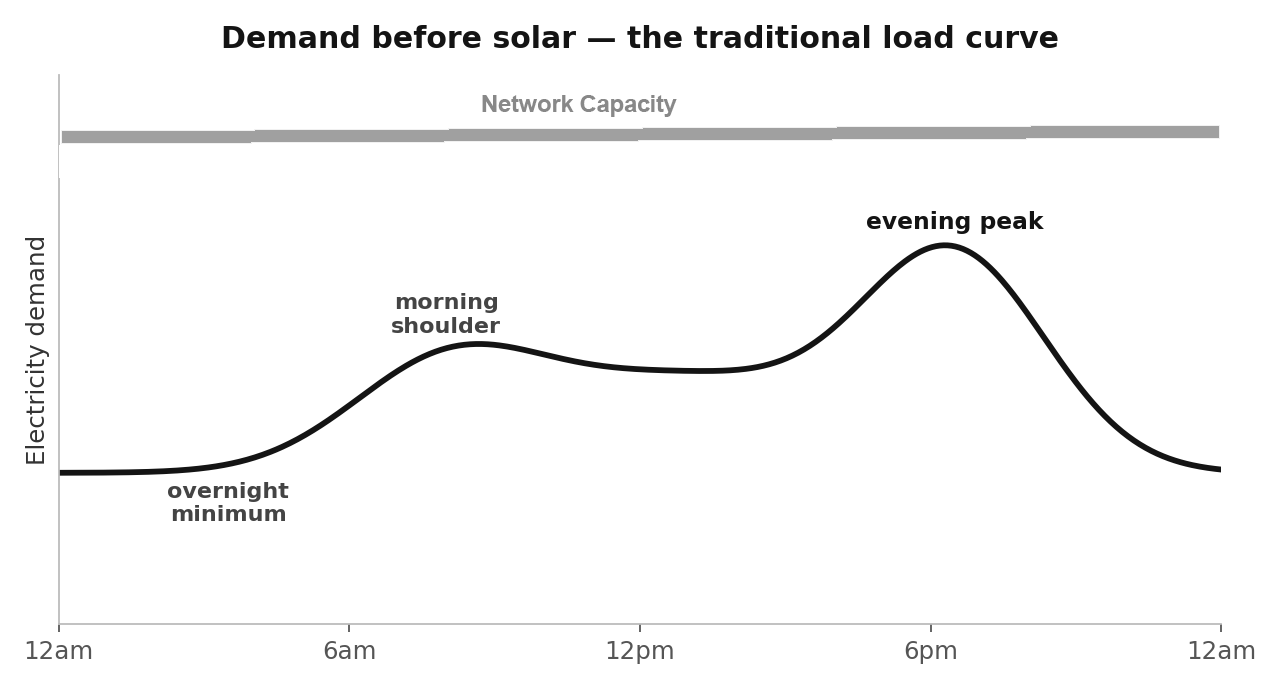
The first chart shows typical energy flows 20 years ago. Then, one-way power flowed to meet demand: low overnight, a small peak in the morning, and then moderate all day until the true evening peak. The grey line shows the network capacity for reference. Does that mean the area between the grey and black lines was available for extra electricity? Yes, theoretically, but because power had to be used in the same instant it was sent, that evening peak was always the constraint.
Then, the world changed with the advent of rooftop solar.
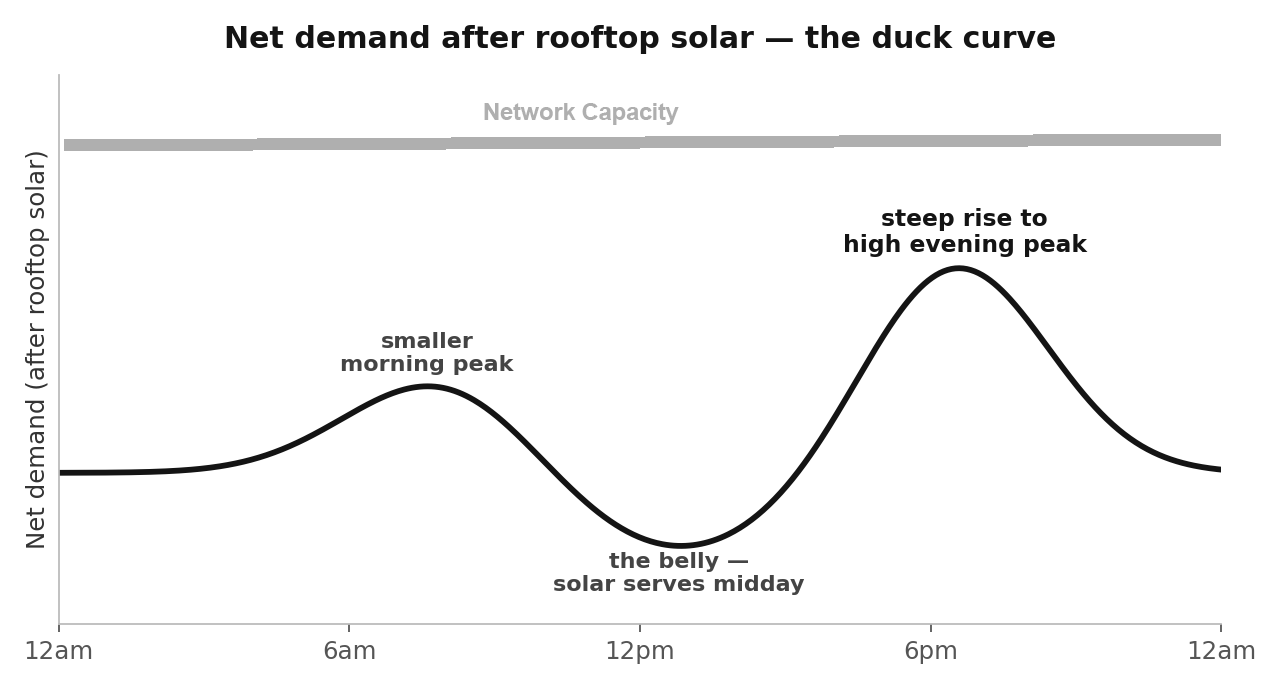
The introduction of rooftop solar reduced power demand during the day because many houses were generating their own. We still see a morning peak but then demand can fall close to nothing in the middle of the day, before rising sharply in the evening. The now-infamous "duck curve". So, does that mean we now have even more unused network capacity? Certainly, but without storage how could we use it?
The world changed again when rooftop solar generation exceeded household needs and the excess power was exported to the grid.
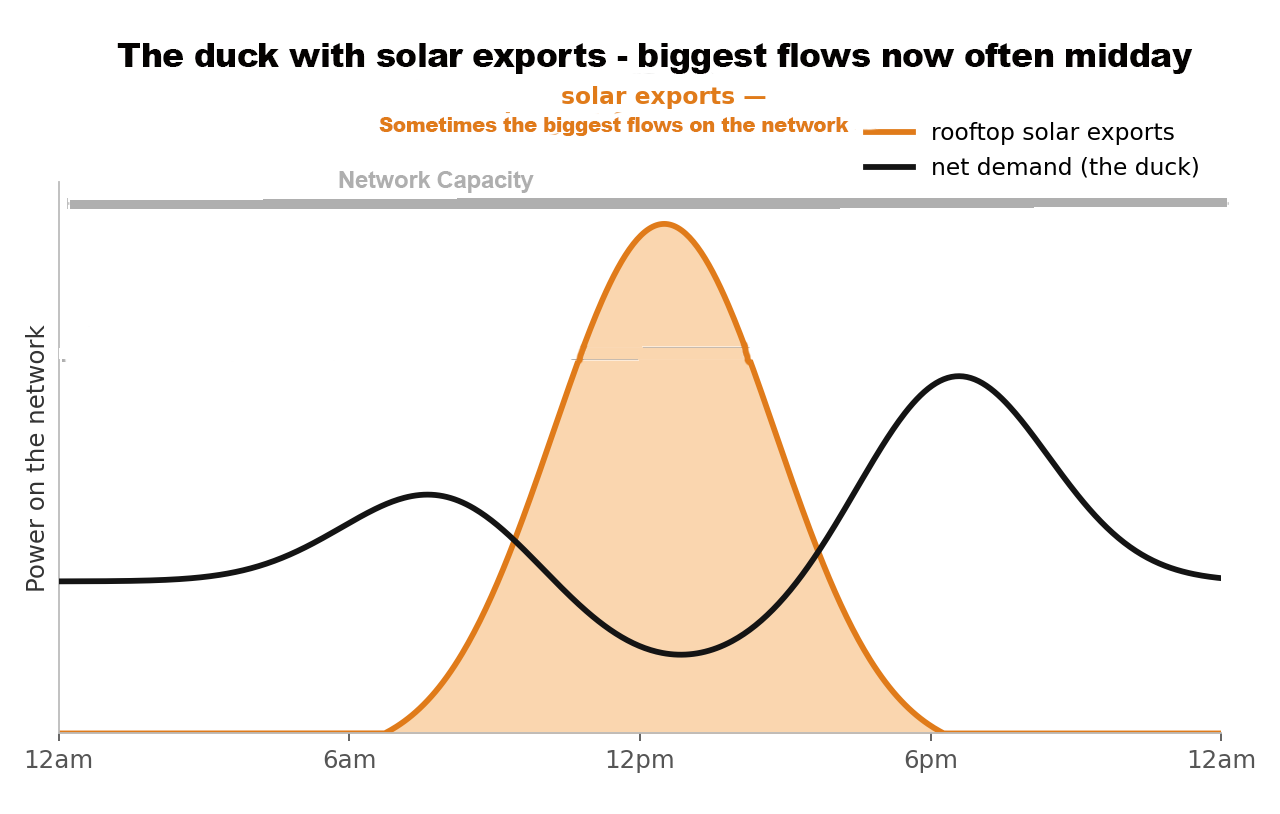
When solar capacity outgrew household demand on that local feeder, power started to flow the other way (shown in orange), back along the network and through the transformer so it could be used in other parts of the grid that needed it (or stored in pumped hydro or later, battery storage). On many networks, on a sunny day, those reverse flows grew to be greater than evening flows and became the limiting factor.
And now we are changing the system yet again to introduce far more storage along that electrical network. Here, unfortunately, our simple chart can't tell the whole story. It was measuring electricity flows at a point on that network (nominally, at the transformer) but, in our new system, energy flows in all directions. Perhaps from one neighbour's rooftop to another's battery, or to a third's load. In reality, electricity always did that, but we ignored the physics to create a simpler financial story for our accounting and billing. That simplification no longer serves us well.
We want to have all those batteries along the network charging and discharging in a way which frees up additional network capacity so that, at the transformer, we see something like the chart below. Is that even possible?
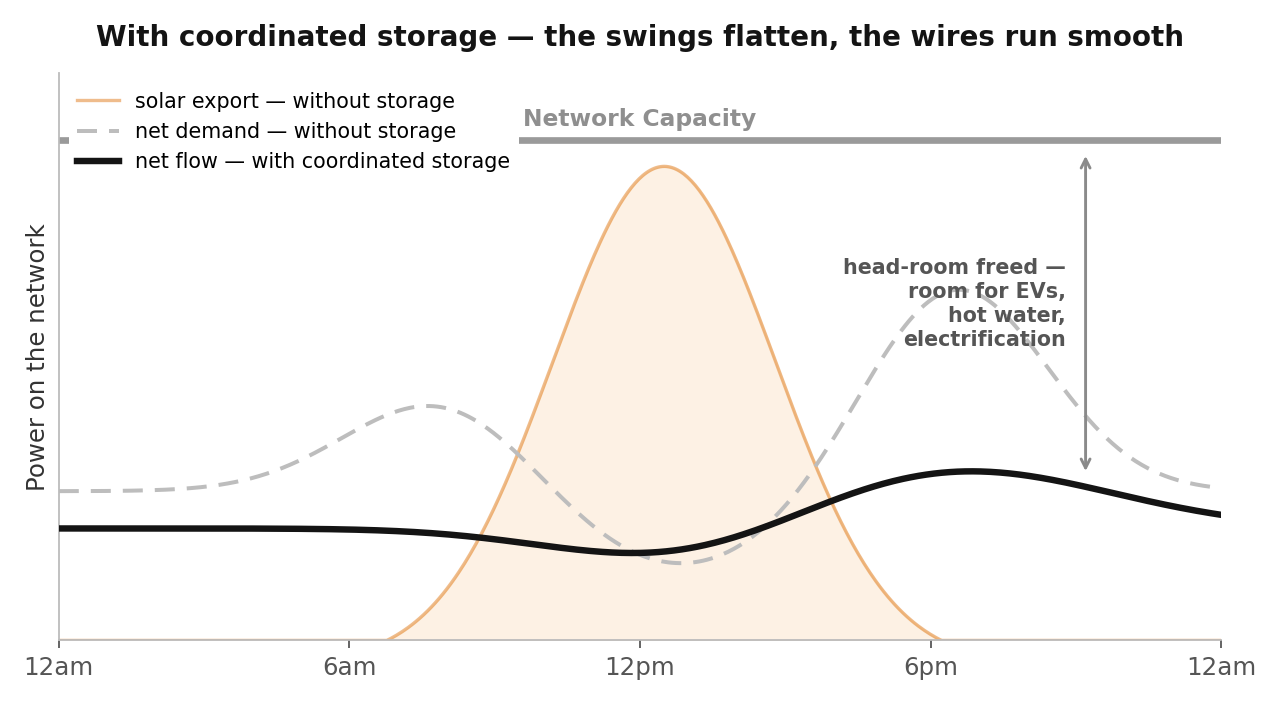
Yes — in principle. Coordinated, the swings can flatten and the gap to the limit becomes real, reusable headroom. But, here is the catch — and it is the whole game. That spare capacity is potentially huge, but it does not unlock itself.
The starting-gun problem
Most modern Australian home battery systems can be configured to charge from the grid as well as from rooftop solar — to take advantage of cheap tariffs or to top up on cloudy days. One obvious way for "the system" to share excess midday energy is to make prices ultra-cheap, or free, through a window each day. Everyone can fill their batteries then. This simply rebuilds the very problem it was meant to solve in an even more acute way. A single price signal applied to a whole state does not spread demand — it synchronises it. Tell millions of households that noon is free and they will all set their batteries to charge at the same hour. The flexibility that storage created is thrown away in the rush.
This is not just theory. The EV world has already found this bug. Time-of-use tariffs do shift flexible load away from expensive periods, but they can also create new peaks when everyone responds to the same cheap window. A recent EV charging field experiment found that time-of-use pricing moved charging into off-peak hours, but also produced larger “shadow peaks” of simultaneous charging; managed charging solved much of that coordination problem.
Governments have already started legislating around the same problem. The UK’s smart EV charger regulations require default off-peak charging capability and randomised delay functions, precisely because a common start time can turn flexible demand into a surge. Randomisation helps soften the cliff. But it is not enough to shift demand away from a fixed hour; the system also has to know whether a particular street — not the whole system — has room.
We are about to watch this problem surface here in Australia. From the second half of 2026, midday "free power" windows are being rolled out state by state — typically three free hours — explicitly to coax washing machines, hot-water systems, and EVs into soaking up the surplus solar. The intent is noble and we do have a glut of energy at that time of day. But a window that opens at the same time for everyone, blind to which local street can take the load and which cannot, turns a fleet of helpful appliances and batteries into a synchronised surge. The flood arrives all at once on whichever local feeders have enough devices responding together — and the wires that were meant to be relieved are strained instead, now from the import side.
This is the basic failure mode of blunt flexibility. A system-wide price signal can solve a system-wide energy problem while creating a local network problem. Wholesale energy may be cheap at noon, but a local transformer may still have limited headroom. Conversely, a local feeder may desperately want batteries to charge while the wholesale price is only mildly attractive. The network problem is inherently local. ARENA’s work on V2G network tariffs makes the same point in another form: local network peaks and wholesale price signals can point in opposite directions, so a price that is good for the market can be wrong for a particular substation or feeder. The price signal, if it is to be useful, must become local too.
So the real-time constraint does dissolve, but it is replaced by something more complex. The question is no longer when energy must be delivered. It is how to coordinate that delivery while preserving the value to the battery owners who make the new grid possible. Storage turns a real-time balancing problem into a scheduling problem — and a scheduling problem, by its nature, needs something to do the scheduling: something that knows not just the price, but the particular feeder, the particular street, the particular moment when there is room.
What coordination actually does
So what would that something be? Not, despite the instincts of some, one great computer in a control room dispatching every battery on the continent. The numbers are too vast and the knowledge too local for any central mind or system. It has to be the opposite: millions of batteries each making their own decision, but each one guided by a signal far richer than a single state-wide price. A signal that carries what "noon is free" cannot — the value of energy here, on this feeder, at this moment: high when the local wires are straining, near nothing when the street is drowning in sun.
Make the signal local and the synchronised surge dissolves on its own. If the right hour differs from one street to the next, the crowd stops moving as one. None of this comes for free. A signal that knows the value of energy on this feeder at this moment requires seeing this feeder at this moment — its loading, its voltages, its headroom — and that sight is precisely what the low-voltage network has always lacked. The distribution system was built to push power one way and not to watch itself; for most of its length it is still effectively dark. Manufacturing the local signal — measuring, estimating and forecasting the state of each street — is not a detail beneath the coordination problem. It is most of the work. The EV trials point in the same direction. Tariffs can move behaviour, but dependable local flexibility requires some combination of forecasting, consent, device visibility, scheduling and verification. That is not central command. It is the plumbing that stops millions of rational devices from all answering the same signal in the same second.
And the battery sometimes has to think further ahead than tonight. When it holds more than a day's load, the question is no longer "is power cheap right now?" but "when is it cheapest across the days to come, and when will my own household need it?" The reflex becomes a plan. That is the deeper meaning of time ceasing to matter: the decision stretches out across days, and something has to weigh them against each other.
The deepest piece of this puzzle can be borrowed, of all places, from hydro dams. A litre of water held behind a dam wall has a value that has almost nothing to do with today; its worth is set by the next drought — by what it will be worth when the rivers run low. Stored electricity is the same — only the scale differs. A single home battery is a relatively small vessel: it holds hours, not seasons, and is emptied and refilled most days. Even the 24-hour-plus batteries we are now contemplating hold a day, not a week — so a home battery's horizon is the days just ahead, enough to know not to dump its charge for two cents on the afternoon before a cloudy week, but no further. Coordinating millions of them does not change this. Power and energy add up; duration does not. A million day-long batteries managed as one make a vast reservoir, but still a day-long one — superb for flattening the daily swing, powerless to bridge a windless week. The reservoir whose value really is set by the next drought is deep storage: the literal version of the metaphor, pumped hydro like Snowy 2.0, holding close to a week of generation behind the wall. The home fleet cannot store across a season, but coordinated it can answer to one — a signal that carries the value of holding on, set by the scarcity the deep storage is hedging, telling each small vessel when to fill and when to wait, so the fleet leans into the grey stretch rather than emptying in unison just before it. Time ceasing to matter by the hour, in a single home, becomes a reservoir managed across days — and, through the signal, a fleet that moves as if it could see the season coming.
And none of this can be a broadcast. A single number shouted at millions of identical machines is precisely what produces the surge. Real coordination is closer to a conversation than a command: the system watches how the fleet actually responds and adjusts — nudging, prizing difference over uniformity — so the response arrives as a smooth tide rather than one coherent wave. The grid that works will look less like a single large instruction and more like a million small negotiations, each settled where the energy actually flows.
The shape of the mature grid
None of this is to say the network cannot cope. It can. Some blunt instruments already exist, although they are lopsided. The power to reach in and curtail what customers export is already live and mandated — the emergency backstops now written into connection rules across South Australia, Victoria and New South Wales. The power to curtail what customers draw barely exists: the only thing like it I can find is a single network's voluntary scheme — a small daily rebate for letting them throttle your EV charger on the rare occasions the local wires are full. We have built an elaborate apparatus to ration what households push out, and left almost nothing to govern what a synchronised storage fleet will pull in. Extending that reach to switch off home battery charging would let the grid cope. But there is a long distance between coping and thriving, between control imposed on customers and participation offered to them, and that distance is where almost all the value lies.
This, then, is the shape of the mature grid. The dominant cost is the wires; the great prize is using them harder; and the thing standing between us and that prize is not more storage — it is coordination. Build all the batteries you like: left to a single blunt signal, they will charge in unison and waste most of the room they could have filled. Coordinate them well, feeder by feeder, and the same poles and wires already in the ground can carry far more than they do today — deferring the day we must reinforce them, and drawing more from everything we do build.
That is the prize worth chasing. Time is ceasing to matter. What matters now is coordination — the difference between a fleet of batteries that floods the wires in unison and one that fills them like a rising tide. Entropy always offers the disordered version for free. The ordered one we have to build.
New to this topic? See these Battling Entropy Primers and prior articles to get you up to speed:
The NEM 101(The basics on how our Australian electricity market works)
The Cheaper Home Batteries Program(What's driving Australia's home battery acceleration to be the world's fastest)
Australia is winning the battery race. Now what?
Free power at lunch and the democratisation of energy storage
Get more like this
New analysis delivered to your inbox. No spam, unsubscribe anytime.
Take care, Tony
Disclosure: Battling Entropy is my independent commentary. The views expressed are my own and do not represent those of any organisation unless explicitly stated. This is not financial or investment advice.
I also have commercial interests in the energy technology field. I am working on a venture, Petajoule Capital, which is developing People-Powered Energy: one particular approach for the coordination of consumer-owned batteries, EVs and flexible demand. This article discusses issues relevant to that work.
Sources / Further Reading
Australian Renewable Energy Agency. (2023). AGL electric vehicle orchestration trial: Final report.
Australian Renewable Energy Agency. (2024). Network tariffs for V2G.
Bailey, M., Brown, D. P., Myers, E., Shaffer, B., & Wolak, F. A. (2025). Electric vehicles and the energy transition: Unintended consequences of a common retail rate design. American Economic Review: Insights, 7(4), 550–566.
Department of Climate Change and Energy. (n.d.). NSW Emergency Backstop Mechanism. NSW Government. Retrieved June 12, 2026, from https://www.energy.nsw.gov.au/households/ways-get-started-households/home-solar-systems/nsw-emergency-backstop-mechanism
Department of Climate Change, Energy, the Environment and Water. (2025, May 20). Solar emergency backstop. NSW Government. https://www.energy.nsw.gov.au/nsw-plans-and-progress/regulation-and-policy/public-consultations/solar-emergency-backstop
Department of Climate Change, Energy, the Environment and Water. (2025, November 4). Have your say on a Solar Sharer Offer (SSO). Australian Government. https://consult.dcceew.gov.au/solar-sharer-offer
Department of Climate Change, Energy, the Environment and Water. (2026). Default Market Offer. Australian Government. https://www.dcceew.gov.au/energy/programs/default-market-offer
Department of Energy, Environment and Climate Action. (n.d.). Victorian Midday Power Saver. Victorian Government. Retrieved June 12, 2026, from https://www.energy.vic.gov.au/households/save-energy-and-money/victorian-midday-power-saver
Minister for Climate Change and Energy. (2026, March 19). Reforms delivering a fairer deal and free daytime power for households [Media release]. Australian Government. https://minister.dcceew.gov.au/bowen/media-releases/reforms-delivering-fairer-deal-and-free-daytime-power-households
Premier of Victoria. (2026, March 25). Three hours of free power every day [Media release]. Victorian Government. https://www.premier.vic.gov.au/three-hours-free-power-every-day
UK Government. (2021). Regulations: Electric vehicle smart charge points.
Discussion
Loading comments...